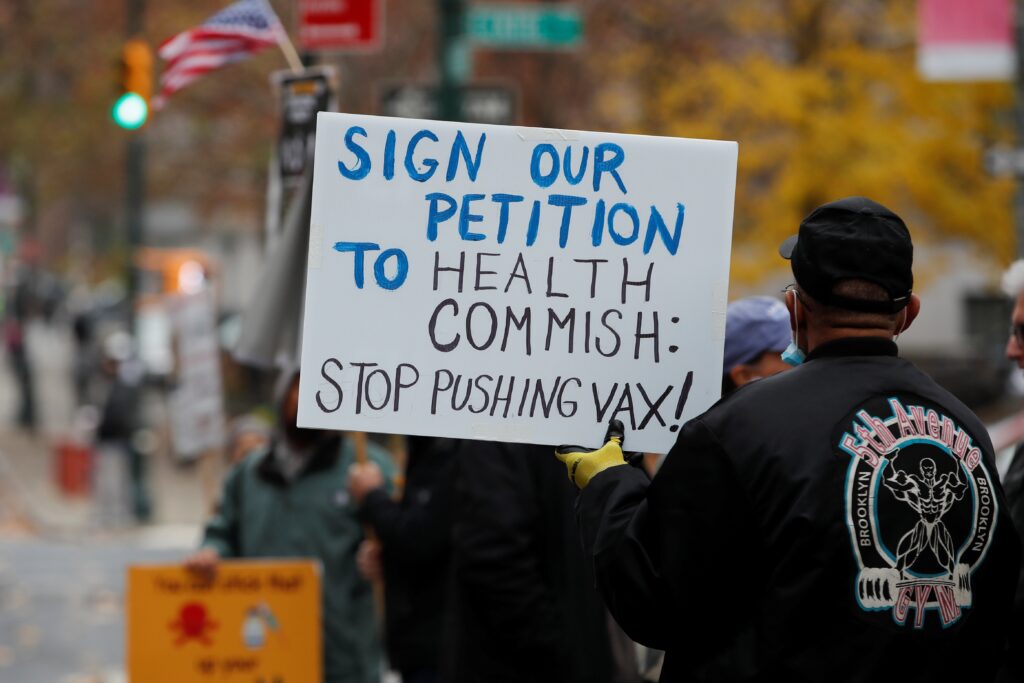
This week, the Trump administration filed an amicus curiae brief asking the US Supreme Court to deny the petition for a writ of certiorari – which effectively asks SCOTUS to review a lower court’s decision – in the case of four New York healthcare workers who were denied religious exemptions for the COVID vaccine and subsequently fired. Critics are calling the brief a betrayal to religious liberty.
As correctly explained in the DOJ’s brief, “On August 18, 2021, the Commissioner of the New York State Department of Health issued a short-term, emergency order obligating certain healthcare entities to require specified employees to be vaccinated against COVID-19…That order permitted medical and religious exemptions.”
However, eight days later, “New York’s Public Health and Health Planning Council superseded that order by issuing a regulation known as Section 2.61…Like the short-term order, Section 2.61 required covered healthcare entities to mandate COVID-19 vaccination for covered ‘[p]ersonnel’ who ‘engage[d] in activities such that if they were infected with COVID-19, they could potentially expose other covered personnel, patients or residents to the disease.” Unlike the original short-term order, “Section 2.61 permitted only a medical exemption and did not include a religious exemption.”
Three of the four health workers had already obtained a religious exemption under the original short-term order. After Section 2.61 was promulgated, those religious exemptions were revoked. The fourth petitioner sought a religious exemption after Section 2.61 was promulgated but was denied.
The DOJ’s brief then seems to contradict itself in arguing against the petitioners, echoing the same language used by a federal judge in New York who previously ruled against the workers.
In the brief, the DOJ acknowledges that “Petitioners alleged that they were willing to comply with ‘[m]asking and testing protocols’ while continuing in their roles as ‘a reasonable alternative to vaccination’ and ‘an accommodation of sincerely held religious beliefs’… but that employer respondents denied those requests based on Section 2.61.” The petitioners argued this violated Title VII.
But then, the DOJ turns around and claims that the petitioners sought complete exemptions from the vaccine mandate. “Petitioners did not allege that they sought and were denied other accommodations aside from a complete exemption,” the brief reads. This appears to be blatantly false.
Indeed, in an early court ruling against the petitioners, Judge Ann M. Donnelly for the United States District Court (Eastern District Of New York) also acknowledged that “The plaintiffs say that the ‘accommodation’ they would have accepted was to ‘wear facial coverings, submit to reasonable testing and reporting requirements, monitor symptoms, and otherwise comply with [the] reasonable conditions’ with which they had previously complied.”
Judge Donnelly then claimed “that is not an ‘accommodation.’ It is a blanket exception from Section 2.61.” This is the same argument that Trump’s DOJ is now running with in asking the Supreme Court not to review the petitioners’ case.
The argument from the DOJ is that the petitioners’ claim that their denial and subsequent firing was a violation of Title VII is invalid because they allegedly sought this “blanket exemption” and not reasonable accommodations. But their own writing, as does Judge Donnelly’s, suggests that the petitioners did seek accommodations, but the judge and the current DOJ are opining that it was effectively an exemption.
Aaron Siri, author of Vaccines, Amen and a lawyer who has dedicated his career to exposing vaccine corruption, criticized the DOJ on X: “Instead of defending these wrongfully terminated workers, the DOJ nonsensically and shamefully plays word games to characterize their requests as seeking an “exemption” (which New York law prohibited) instead of an “accommodation” (an option federal law requires). It then relies on this sematic [sic] nonsense to argue that the Supreme Court should not review the Second Circuit’s holding that a policy providing for medical but not religious exemptions is legal.”
Siri continued: “Having dealt with scores of religious employees in New York that lost their jobs under this policy, the Trump administration’s position is a sharp betrayal. The DOJ should have simply argued the obvious – that Section 2.61 foreclosed any religious exemption and hence should not stand under federal law. Period. That would have taken one or two pages. Instead, it spends over 20 pages creating a word salad of nonsense to justify New York’s and the DOJ’s unjustifiable position.”
Carrie Prejean Boller, who received the Catholic Champion Award from Catholics for Catholics after she was fired from Trump’s Religious Liberty Commission, wrote, “I was appointed to defend religious liberty in America. That’s why this betrayal is so disgusting to watch.”
Save and Share This Catholic Patriotic Minute!