On Wednesday, the Society of Saint Pius X (SSPX) is set to consecrate new bishops at the SSPX Seminary in Écône, Switzerland. This controversial move has been anticipated, pondered, and discussed by many Catholics throughout the world.
The SSPX was founded in 1970 primarily as a means to preserve the Traditional Latin Mass. In 1988, SSPX founder Archbishop Marcel Lefebvre consecrated four bishops against Pope John Paul II’s personal appeal and an official warning from the Vatican. The debate about whether the SSPX is either schismatic or preserving essential elements of traditionalism has been hot, and some key Catholic figures have offered thoughts and proposals in the recent weeks.
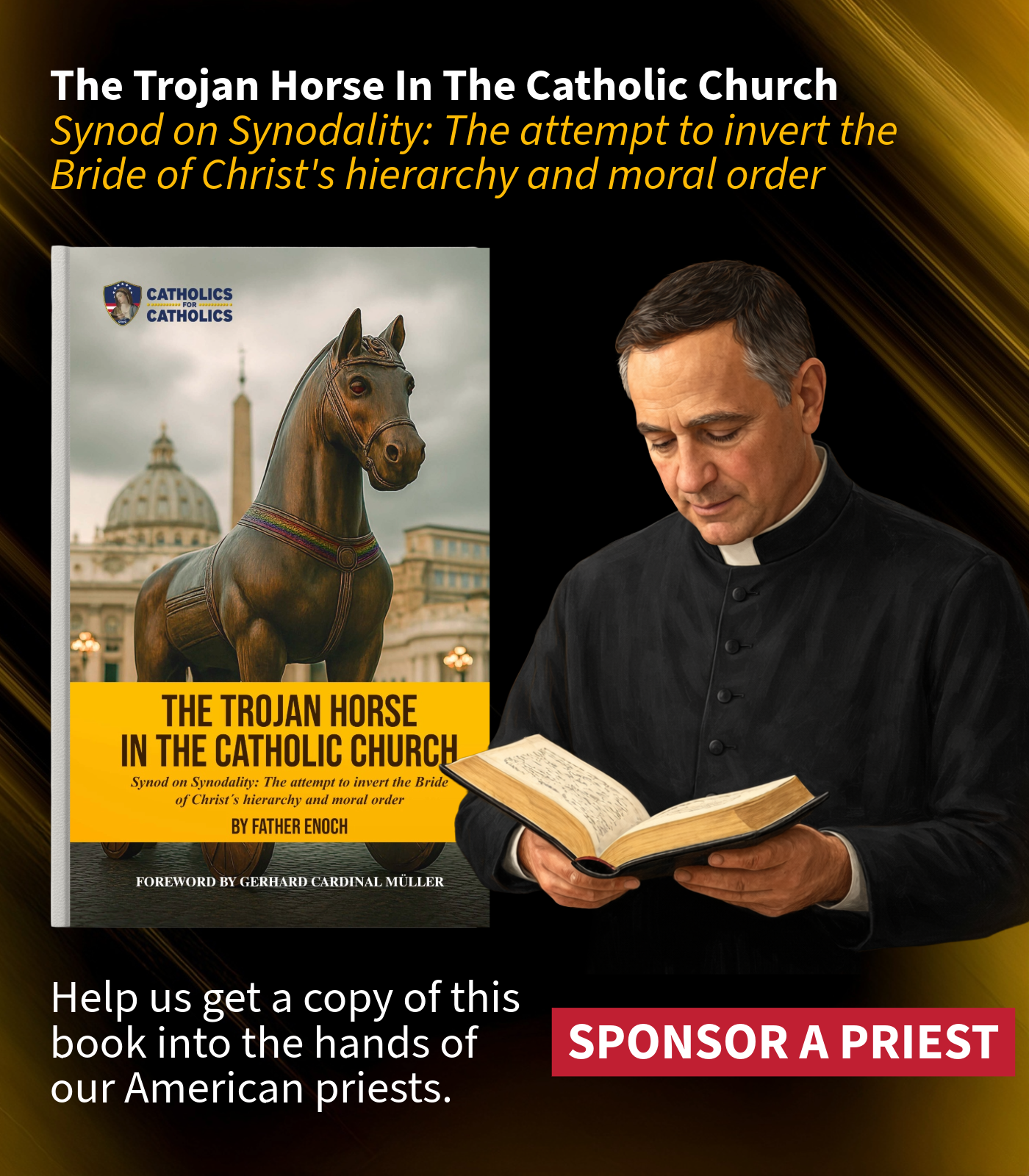
Cardinal Müller, who wrote the foreword to the Catholics for Catholics book The Trojan Horse in the Catholic Church: Synod on Synodality, used his time at the June 26-27 extraordinary consistory at the Vatican to urge Pope Leo XIV to offer a clear response to the SSPX following its open letter addressed to the Holy Father and the College of Cardinals, according to Vatican reporter Diane Montagna.
In addition to calling for a more open exchange of views at the consistories, Cardinal Müller warned that the “boundary into schism” is crossed “when the ministry of the Bishop of Rome, as the visible principle and during foundation of the Church’s unity in revealed truth, is violated.”
He stated, “In the face of the schismatic act of episcopal consecration carried out without the prior grant of communion with the Pope, there must be no ambiguity,” but he also proposed a solution to receiving SSPX clergy back into the fold.
Bishop Strickland, another friend of Catholics for Catholics, also addressed the matter in Pillars of Faith last week. He wrote, “As discussions continue regarding the Society of St. Pius X, I believe we must ask a question that reaches deeper than canonical arguments or historical disputes. What has moved these priests and faithful throughout the past fifty years?”
“To understand the Society, we must remember its beginnings,” he continued. “Archbishop Marcel Lefebvre did not embark upon this path because it was easy, nor because it brought him honor or peace. Whatever one thinks of every decision he made, few would deny that he bore immense personal suffering. He believed that precious treasures entrusted by Christ to His Church – the Holy Sacrifice of the Mass, the reverent celebration of the sacred mysteries, the formation of holy priests, and the perennial teachings of the Catholic Faith – were in danger of being diminished. His response was born from a profound desire to preserve and hand on what generations of Catholics had received with gratitude…”
He continued, “Whether every decision made along the way was prudent is a question that reasonable Catholics may discuss. But it is difficult to deny the love that has inspired countless sacrifices, vocations, families, and faithful souls who have desired only to remain close to Our Lord and faithful to the deposit of faith.”
Bishop Strickland noted the moral confusion stemming from ambiguous leadership from Catholic clergy throughout the world. “This is also a moment for honest reflection. Across the world, many public challenges to Catholic doctrine and morality have caused great confusion among the faithful,” he stated. “Catholics naturally ask why those who openly reject settled teachings of the Church often appear to face little correction, while those whose deepest desire is to preserve the Church’s sacred inheritance are viewed with the gravest penalties. Such questions should not be dismissed, but answered with justice, wisdom, and charity.” In closing, Bishop Strickland asked everyone to pray for the SSPX, the Holy Father, and all of our bishops.
Prior to the SSPX’s open letter to Pope Leo XIV and the College of Cardinals, Bishop Athanasius Schneider published an extensive document titled THE CORE QUESTION REGARDING THE PRIESTLY SOCIETY OF SAINT PIUS X. Bishop Schneider commented that the debates surrounding the SSPX are often emotion-driven and repetitive, without examining the central issue raised by the SSPX. “At its core, the conflict revolves around the question of truth,” he wrote.
Bishop Schneider wrote that the first error in the history of this controversy was “treating a pastoral council—in this case, the Second Vatican Council—as though it were entirely dogmatic, and presuming that all its statements are to be regarded as definitively proposed and binding upon all Catholics,” he wrote. “Those who do so overlook that Paul VI himself stated: ‘There are those who ask what authority, what theological qualification the Council intended to give to its teachings, knowing that it avoided issuing solemn dogmatic definitions engaging the infallibility of the ecclesiastical Magisterium…This applies also to the Council’s two “dogmatic” constitutions, Dei Verbum and Lumen gentium, since the adjective “dogmatic” possesses a broader meaning and is not limited to dogmas understood as teachings endowed with infallibility.”
Schneider commented that oftentimes a full acceptance of all Vatican II teachings is often presented as a condition for full communion with the Holy See, “particularly those concerning religious liberty, ecumenism, interreligious dialogue, and collegiality—whose formulations are ambiguous and difficult to reconcile with doctrines taught consistently by the Magisterium from the era of the Church Fathers through the period immediately preceding the Council.”
Bishop Schneider wrote that the SSPX is undergoing a serious “dilemma of conscience” and places responsibility on Pope Leo XIV to clarify and amend teachings related to Vatican II that have fueled so much confusion within the Church. He also encourages the Holy Father to “build a bridge” to the SSPX and offer a “truly generous pastoral gesture” to avoid excommunication if the SSPX performs the consecrations against explicit prohibition from the Holy Father.
Cardinal Víctor Manuel Fernández, prefect of the Dicastery for the Doctrine of the Faith, recently warned that the consecrations would “constitute ‘a schismatic act,” and Pope Leo XIV himself cautioned the SSPX not to move forward with the consecrations.
“We have invited them, and I am still considering making another appeal, to say: ‘Do not do this. Let us try to live communion in the Church.’ But it is their choice. They must understand what it means for them and for the Church,” he told reporters on June 16.
“Certainly, division among Christians is always a painful matter,” the pope also stated. “But they refuse to accept certain fundamental elements of the Church, beginning with various points of the Second Vatican Council. And if they make those choices, I am sorry. But we must move forward.”
After the SSPX’s 28-page Profession of Faith was published last week, Dr. Taylor Marshall, known as a supporter of the SSPX in general who even defended the actions of Archbishop Lefebvre in his book Infiltration, gave some clarifying remarks both about his stance on the July 1 consecrations. Marshall attends Latin Mass through the FSSP (Priestly Fraternity of St. Peter), but noted that many of his closest friends go to SSPX chapels and he has been a “big advocate.” That said, he has “hesitations” about the July 1 consecrations.
First, he thought the society’s announcement that the consecrations would be taking place just nine months into Pope Leo XIV’s pontificate seemed “premature,” as it generally takes a full year for a new pope to establish surrounding personnel. Dr. Marshall also, however, thinks it was an error on Pope Leo XIV’s part to assign this issue to Cardinal Fernández, who himself has a controversial legacy. Ultimately, while the SSPX has valid concerns, Marshall thinks it puts many good Catholics in a difficult position who are sympathetic to the society but do not want to go as far as supporting them against the pope.
Eric Sammons, editor-in-chief of Crisis magazine, recently echoed similar sentiments. On X, he wrote, “For years I’ve opposed hyperpapalism, emphasizing the need for a proper Catholic understanding of obedience as it relates to the pope. For years I’ve opposed the errors coming out of the Vatican and the hierarchy. For years I’ve defended the traditional understanding of the Catholic Faith. For years I’ve appreciated the work of the SSPX, and how it has brought countless souls closer to Christ. Yet when it comes down to it, I can’t see how disobeying required papal approval to consecrate bishops is consistent with a proper understanding of obedience or a traditional understanding of the Catholic Faith.”
Save and Share This Catholic Patriotic Minute!