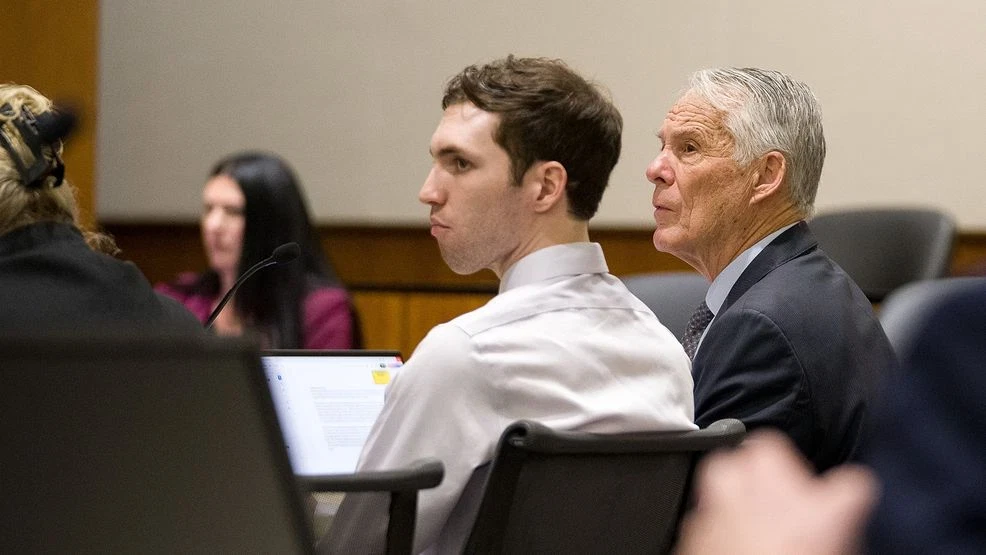
Monday, July 6, the preliminary hearing for Tyler Robinson, accused of killing Charlie Kirk, began in Provo, Utah. This preliminary hearing, set to conclude on Friday, July 10, will determine if the case proceeds to trial.
Baron Coleman, a Catholic who spent over two decades as an attorney and now hosts the Real Baron Podcast, provided a recap of the first day of the hearing.
Arrivals to the hearing
Erika Kirk, widow of Charlie, arrived and was escorted through a side door into the courthouse.
Charlie’s parents arrived in a car together, but interestingly, it appeared that TPUSA’s Senior Director for Advancement, Stacy Sheridan, was waiting for them in the parking lot. It looks as if Sheridan attempted to escort them into the building as she reaches out for Mr. Kirk’s arm, but the two do not appear to exchange any words.
Other notable attendees include Donald Trump, Jr., Brandon Tatum, and Jack Posobiec.
Assessing the judge and layers on the first day
Coleman indicated that he thought Judge Tony Graf was balanced overall on day one and even commended him. When footage of Charlie Kirk being hit was played for the courtroom, the judge visibly flinched. If this was truly the first time (or one of the few times) that the judge had actually seen this footage, that would be a sign he was respecting the judicial process, according to Coleman. Juries are instructed not to go out and look for additional information pertaining to cases so as to not taint the evidence that is actually presented, so if Judge Graf similarly abstained from doing this, that would be a positive sign.
Coleman said Graf might have given a little latitude to the prosecution, but did rule against them in some cases.
Given his personal legal experience, Coleman provided insight as to what actually occurs in a preliminary hearing as opposed to an actual trial. He mentioned that some commentators and critics of the legal proceedings had argued yesterday that certain evidence presented was “hearsay” and should not be allowed. Coleman explained that at an actual future trial, those pieces of evidence would not be allowed in, but Utah allows the use of “reliable hearsay” at the preliminary stage according to Utah Rule of Evidence 1102 embedded in the state’s constitution.
Questions regarding investigation’s thoroughness
Coleman pointed out that neither the defense nor the prosecution has reached out to former TPUSA employee Aubrey Laitsch who was personally responsible for approving each of the press passes for the September 10 event at Utah Valley University (UVU) at which Charlie Kirk was killed. Laitsch would have possessed the complete list of these media personnel who may have clear footage from that day at UVU, as much of the video footage that the public has seen thus far is grainy and does not appear to clearly identify Tyler Robinson.
No state or local authorities have reached out to Laitsch, and neither has the FBI, said Coleman. “The FBI has considerable resources when it comes to looking at individual crimes. They could have taken this in. They could have run it through AI programs. They could have at least cataloged it and preserved it somewhere as some sort of central repository of truth,” he argued.
First Witness: Officer Bagley
The first witness on the stand was Christopher Bagley, a former UVU police officer. Coleman described his testimony as “a little shocking” and bad for the prosecution.
According to his own testimony, Bagley arrived on the rooftop of the Losee Center at UVU, where Tyler Robinson allegedly shot Kirk from, at 12:44pm local time, 21 minutes after Kirk was hit. Bagley was positioned on top of the Hall of Flags, which sits behind the courtyard where Kirk was speaking.
He said as soon as Kirk was hit, he went down the stairs to the courtyard, found a gun holster but did not catalog it, and then headed towards the Losee Center.
“It’s noteworthy that he’s the only one who would have had eyes on the Losee Center – the only one who could have possibly had eyes on the Losee Center – and video footage suggested he did,” Coleman said. “Video footage from the moment of the bang suggests that’s where he was looking, yet he didn’t see anything, but he knew where to go.”
Bagley states that when he leapt over the guardrail of the rooftop of the Losee Center, he spotted a red and black screwdriver. This screwdriver allegedly has DNA of Tyler Robinson on it, according to FBI director Kash Patel. Bagley said he also observed markings of someone having been in the prone position on the gravel rooftop. When the defense asked him about his body cam footage from the day, Bagley claimed that the battery went dead “right at that moment” when he got to the rooftop. Coleman expressed serious concerns about the timing of this lost footage.
Bagley arrived at the event around 11am, so a charged body cam should have been able to last an entire shift, somewhere between ten and fourteen hours, according to Coleman. Interestingly, according to the police radio scanner, no mention of the screwdriver having been found is made while Bagley is on the rooftop.
Further, upon defense questioning, Bagley testified that he ascended the Losee Center rooftop with another individual who he did not know. This individual was dressed in civilian clothes and possessed a badge and a handgun, but Bagley did not inquire or find out this individual’s identity. “Who? Are you telling me there was law enforcement there that we don’t have documented?” Coleman asked.
In Bagley’s initial police report after reviewing surveillance footage of the Losee Center rooftop, he did not mention having seen a gun at any point, or even an object that could resemble a gun. Bagley testified that he has only reviewed the surveillance footage twice, and the last instance was several months ago. It was only during his testimony on July 6 that Bagley said that looking back, it looks like there is a rifle or a long object in the hand of the person on the rooftop, “but almost like it was covered” by something, perhaps a towel or a blanket.
Coleman said his description from Bagley falls short of even circumstantial evidence. Further, the probable cause affidavit from September 12 states, “Suspect appeared to be carrying an item, whose identity is not clear from the surveillance.” That affidavit was signed by Officer Brian Davis, who writes that “the following information was obtained by your affiant from police officers, multiple video recordings posted on social media websites, Utah Valley University campus surveillance cameras and those who witnessed the incident.”
It was four days later, on September 16, that the language shifted in the charging document to state, “Immediately after the shot was fired, a camera captures the suspect running across the roof carrying an item whose shape is consistent with a rifle.” Coleman noted this discrepancy.
“Four days later, September 16th, we have ourselves new language…I think somebody realized you can’t convict somebody for carrying a large object. So, they’ve changed it,” he said.
In reviewing the surveillance footage, Bagley also stated that he could not identify the face of the person on the rooftop. In testimony, he also stated he could not identify the height of the individual or the markings on their clothing. All he could determine was that the individual was not “heavy-set.”
Second Witness
The second witness was David Hull, an investigator with the State Bureau of Investigation, and Coleman found his testimony to be “noteworthy.” His testimony was largely centered around obtaining additional footage from Terryl Farnsworth, a contractor for TPUSA who was seen removing the camera behind Kirk’s head immediately after he was taken down. Farnsworth had previously told investigative journalist Candace Owens that he removed the camera for fear of someone stealing the SD card.
According to Hull, Farnsworth provided copies of the footage via a flash drive and downloadable electronic versions, and that the electronic versions were given on September 10th. Coleman noted that this is interesting, given that he allegedly told Owens that he could not figure out how to send the file and that he did not want to send it online for fear of being hacked by Google.
Coleman also noted a discrepancy that Farnsworth’s company, Visual Impulse, possessed footage from three different angles, but that four files were provided to authorities. He also noted that on Farnsworth’s 1102, which is a sworn statement provided to police, he only mentioned providing the four videos through a Google Drive link, which is an electronic, downloadable file. He did not mention an SD card or flash drive.
“So, I think I would ask where are the SD cards and can we look at them?” Coleman stated, referring to the defense. “Is there a way to analyze them to see have they been altered? Are they the original footage?”
Save and Share This Catholic Patriotic Minute!