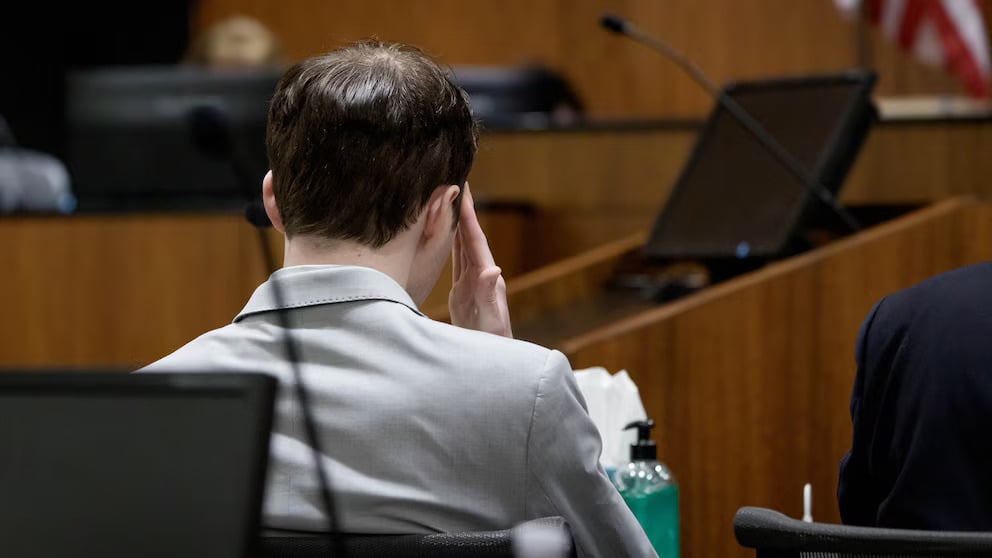
The hearing began with continued arguments regarding whether certain exhibits would be broadcast to the gallery and therefore the media. Eventually Agent Brian Davis, the co-case manager of the investigation into the murder of Charlie Kirk, returned to the stand.
At one point during the hearing, there was additional debate about whether certain exhibits should be broadcast to the gallery. The victim representative, Erika Kirk’s attorney, stood up to make arguments to the judge.
Baron Coleman, a Catholic, former attorney, and podcast host, noted that this attorney for Mrs. Kirk, Jeffrey Neiman, has an interesting connection: Neiman previously legally represented former U.S. Attorney Alex Acosta for closed testimony in front of the House Oversight Committee, which was tasked with investigating Jeffrey Epstein’s 2008 “sweetheart” deal which Acosta personally negotiated. Epstein was facing federal sex trafficking charges.
The videotaped interview of Lance Twiggs, roommate and supposed lover of Tyler Robinson, which was recorded in April 2026 was broadcast in part to the gallery.
HIGHLIGHTS
Twiggs testified to not having received an individual message from Robinson all day, but the texts show otherwise
In the recorded interview, Twiggs states that Robinson did not message him at all on September 10, and only first heard from him around 11:00 PM when Robinson had supposedly scheduled a text to Twiggs to tell him to look underneath his keyboard. When the state broadcast the photographs of the text messages on Twiggs’ phone, however, a text from Robinson at 4:33 PM was seen. Robinson allegedly wrote, “I love you! mwah mwah” to which Twiggs replied, ” I love you moresies mwah mwah mwah,” but that discrepancy was not addressed in the hearing.
Further, Agent Davis indicated that the Cellebrite extraction performed on Twiggs phone revealed the first text message being at 11 PM, so it seems that either the extraction did not capture any texts prior to that, or that Davis did not recall seeing that or did not see any previous texts.
🚨 NOW: PHOTOS of Lance Twiggs' text messages with Tyler Robinson, straight from Twiggs' phone, are being shown in court
— Nick Sortor (@nicksortor) July 9, 2026
TWIGGS: "You weren't the one who did it, right?"
TYLER: "I am, I'm sorry."
LANCE: "Why?"
TYLER: "I had enough of his hatred. Some hate can't be negotiated… pic.twitter.com/235WlOaknh
Test “inconclusive” as to whether bullet fragments came from the rifle in question
Bullet jacket fragment and some other fragments that were recovered from Charlie Kirk’s body in the autopsy. Sergeant Fauimuina, who testified on previous days, read from a report that “one 30 caliber class deformed damage bullet jacket fragment and four lead fragments” were recovered and that the bullet jacket fragment “could not be identified or excluded as having been fired” from the rifle that was recovered from the woods – the results were inconclusive. The lead fragments recovered were not suitable for microscopic comparison.
Faumuina also read from a report that concluded that swabs taken from the dremel tool were more likely to have originated from Robinson and two unknown individuals as opposed to three unknown individuals. The report reached the same conclusion for DNA taken from a .30-06 cartridge case that came from the townhome of Robinson and Twiggs.
Fragment diameters do not match the diameter of a .30-06
The defense introduced ATF (Alcohol, Tobacco, & Firearms) gun examiner Samantha Karner to the stand and she stated that she was asked to “test fire the firearm and compare the test fires to the cartridge case and the bullet jacket fragment” and also “do a toolmark characterization on the cartridge case and the cartridges.” She also performed a “general rifling characteristic search on the bullet jacket.”
Some of the fragments were too small to analyze, but crucially, she testified that she was able to measure the diameter of the larger fragment, and she concluded it was between 0.286 to 0.301 inches. As Coleman pointed out, this would make it smaller than the diameter of the ammunition supposedly used by Robinson.
The testimony also revealed that there were potentially seven bullet fragments that were supposedly recovered by the medical examiner but that Karner only received four.
Twiggs did not identify Robinson in the FBI suspect photos with certainty
When shown photos of the FBI’s press release which contained suspect photos published soon after the crime, Twiggs stated that he could not identify the suspect as Robinson with 100% certainty. He also testified that he had never heard Robinson talk about Charlie Kirk before or LGBT or gender identity issues. More detail on Twiggs’ testimony is below.
🚨JUST NOW: Lance Twiggs, while reviewing surveillance footage still images, says he recognizes Tyler Robinson. Full relevant quote:
— Andrew Kolvet (@AndrewKolvet) July 9, 2026
"I wouldn't say with a 100% certainty just because of the camera quality, but that looks like him in terms of the shoes he's wearing, the… pic.twitter.com/LPxpt9C6Ni
Twiggs’ testimony
The video call interview is between Lance Twiggs and Deputy Utah County Attorney Ryan McBride. It appears that one of the state attorneys, Lauren Hunt, is in the room with Twiggs but it is unknown if anyone else was present.
The testimony confirmed that Twiggs was given both a federal and state agreement of immunity for what they were to discuss in that interview.
Twiggs testified to meeting Robinson in person for the first time in 2023 when they became roommates, but they knew of each other before then through friend groups. They started dating two to three months after moving into the townhome which they were still living in as of September 10, 2025.
Interestingly, Twiggs did not seem sure about what Robinson was doing for school and work at that time. “I think he was both working…I think he was working for an electric– like an electrician company then and he was also in a trade school for being, I don’t know a higher, like, ranking electrician. I’m not sure how the trade system works for that. But I think he was both.”
Twiggs said Robinson left “early” on the morning of September 10:
“I don’t know an exact time. I just know he left early. Uh, I heard him leaving and he just said he had a like long drive to work that day, so he was leaving early,” Twiggs said. Pressed for more specifics about what time that was from McBride, Twiggs said, “Uh, I don’t know. I would have thought it was 5:00 a.m. because that’s when like an early work day was for him, but it was probably more like 4.”
Twiggs said he then slept in until around 12-1pm and did not have work that day. His work involved bathtub and shower repairs in new construction.
Twiggs said Robinson asked about engraving bullets about a month prior to September 10. In the text messages, however, Twiggs asks Robinson, “how long have you been planning this?” to which Robinson replies, “a bit over a week I believe.”
Twiggs testified that he saw Robinson when he woke up on the morning of the 11th and that Robinson was “doing stuff around the house” and that after Robinson left, Twiggs went to his parents’ house. Twiggs said he asked Robinson if what he said the night before was true, and that Robinson said it was, and was crying, and said he wished he hadn’t done it.
Upon McBride’s suggestion, Twiggs affirmed that he left the townhouse with the understanding that Robinson was either going to his parents’ house or to turn himself in, and that he himself (Twiggs) then went to his parents’ house.
In the recorded interview, McBride presented the FBI press release that had been published on September 11 which featured six photos of the suspect they were looking for. Twiggs said he thought he had seen these photos on the 11th that were circulating.
McBride then showed the photos to Twiggs and asked, “do you recognize the person in these images?” Twiggs replied, “I wouldn’t say with 100% certainty just because of camera quality, but that looks like him in terms of the shoes he’s wearing, the sunglasses. I don’t think I’d specifically seen him wearing that hat, but he was usually wearing a hat. Um, and then jeans. So, it definitely, especially the bottom, the last two definitely do look like him.”
Twiggs said that Robinson talked about politics more than he did himself, mostly about things he had heard on the radio either driving to and from work or when driving with the work crew. He testified “I personally had never heard him talk about Charlie Kirk before specifically,” Twiggs stated, and when asked if Robinson ever talked about LGBT or gender identity issues, Twiggs said, “No, not really.”
Twiggs said that Robinson had first asked where the dremel tool was in the townhouse about a month prior to September 10 to inscribe messages into bullets for an upcoming hunt with his family.
Agent Davis testified that he was not present at the September 12 interview with Twiggs, which has not been broadcast in court this week. Davis said that an FBI agent took a photo of Lance’s phone which had the text message conversation with Robinson.
Davis stated that a Cellebrite extraction was performed on the phone to retrieve data, but that data has not been presented in court. Davis said he reviewed the extraction. The state attorneys asked him what time the first text message between Robinson and Twiggs was on the 10th according to the extraction, and Davis stated it was 11pm. Again, the state perhaps unintentionally showed a text exchange between the two at 4:30 PM, so it is unclear if Davis was unaware of this earlier exchange, or if the data extraction only began with the 11pm conversation.
The photographed text conversation was then broadcast to the gallery; many of the messages are the ones that were published by the state in the charging document from September 16, 2025. It includes an indication that Robinson meant to delete the 11pm scheduled text telling Twiggs to look under his keyboard. Podcaster Baron Coleman raised several concerns with this text exchange, detailed below.
Agent Davis also testified that Robinson sent a Discord message in a group thread at 7:57 PM on September 11, but these Discord messages have not been published. Davis had testified on day three of the hearing that he had received a phone call about 8:30 PM that an individual was turning themselves in to the police with regard to the murder of Charlie Kirk.
There was an interesting exchange between Deputy Utah County Attorney Lauren Hunt and Agent Davis on the stand, during which Hunt appeared to expect Davis to say something different than what he testified:
Hunt: “We mentioned a Cellebrite extraction of Mr. Twiggs’ phone. Do you know what time that last text was sent?”
Davis: “Yeah, I recall it was just before 8:00 p.m. on September 11th. It was I think 7:42 p.m. is my recollection.”
Hunt: “I’m sorry, September 11th?”
Davis: “Yes.”
Hunt: “Um, would September 12th make more – make sense –or you’re saying September 11th?”
Davis: “So, September 11th was when he turned himself in. September 11th.”
Hunt: “Okay, thank you.”
Questions about when the handwritten note was burned
Twiggs testified that at 11pm, when the scheduled text from Robinson was sent instructing him to look under his desk keyboard, he found a handwritten note from Robinson. The note was not supposed to be broadcast to the gallery according to the judge’s orders, but the state did so for long enough that screenshots of the note have circulated online.
According to prior information from the publicized investigation, the note was burned, but it was not specified who burned this note. Twiggs, however, stated that he read the note, took a picture of it, and then put it back down and never saw it again. Baron Coleman, a Catholic who currently hosts a podcast but was an attorney, raised questions about when the note was burned because a file name indicates that the photo of the note could have been taken on September 15, after Robinson was in custody. It is possible that date just reflected when the photo was uploaded into the system, but the file name appears to start with “JPEG_20250915.”
Sergeant Faumuina testimony
SBI’s Sergeant Faumuina returned to the stand and spoke about arriving on campus after the incident on September 10th. Faumuina stated that palm prints on the exterior windows of the Losee Center where the individual in dark clothing is seen lowering himself from were examined for evidence, but that Robinson was excluded as a source of these prints. She later stated that after reviewing the security footage closer, they did not think he touched the window where these prints were taken.
Faumuina also stated that the FBI was assigned to process the courtyard area crime scene.
Faumuina was tasked with processing the wooded area which they believed the suspect dropped into when exiting campus and was told a gun had been found. She asked them to hold the scene. The FBI removed a rifle from the bushes which was wrapped in a dark colored towel and was placed on a cardboard box so they could take pictures. She stated they also found rounds of ammunition with engravings on them, including a series of bullets that when put together read, “IF U READ THIS U R GAY LMAO” and “O CIAO BELLA.”
At the home of Robinson, Faumuina stated authorities collected Remington .30-06 ammunition and cartridge cases as well as guns, and a burned note. This is supposed to be the note found under the desk which allegedly contained a confession from Robinson. Twiggs testified he did nothing with the note other than take a picture and then did not see it again; this testimony would indicate that either Robinson or another individual burned the note. As stated previously, the JPEG file of the photo of the note taken, purportedly by Twiggs, indicated a processing date of September 15, 2025. It is unclear if this was when the photo was taken or when it was uploaded into an evidence processing system.
Faumuina also indicated that they also recovered a dremel, bits, and two pairs of shoes: both gray Converse shoes, one with gray laces, and one with white laces. These shoes were in different sizes; the Converse with the white laces were size 10.5, but she could not recall the size of the second pair with gray laces.
The ammunition was the same type of round found in the gun that was recovered. One of the rounds at home was engraved with the phrase “TEST SHOT.” Also recovered from the home were three posters of shooting targets with perforations in them. Of the three targets, only one had a perforation in the bullseye.
‼️🇺🇸: MEDIA SABOTAGE?! 👀
— Diligent Denizen 🇺🇸 (@DiligentDenizen) July 10, 2026
Yesterday during Tyler Robinson's preliminary hearing the media showed alleged "confession note" when they weren't supposed to.
FOUR TIMES they have broken the media rules of the court.
Are they intentionally trying to get the cameras removed? 🤔 pic.twitter.com/ZyNS9Fh7Al
Timeline issue
Outside of this preliminary hearing, employees at a restaurant in Panguitch, Utah spoke out about Robinson allegedly coming in and eating a meal at the bar by himself on the evening of September 10. These witnesses previously stated that Robinson came in around 8:45 PM. At the time, they did not know who he was, but after his photo was released to the public in the following days, they realized they thought he had been in their restaurant. They claimed to have checked the credit card receipts and confirmed that it was him.
Recently the restaurant owner told a reporter that Robinson was at their restaurant at 9:30 PM, but he did not say that the credit card receipts were able to confirm it was indeed him.
The issue raised by Coleman is that Panguitch is approximately three hours away from Orem, Utah. In the text exchange between Twiggs and Robinson after 11PM, Robinson indicates he is “stuck in Orem” and that an officer with a K9 had been around the wooded area where the gun was supposedly left behind, in addition to a vehicle that was “lingering.” Though the witnesses from the restaurant have not been referenced or introduced in this preliminary hearing, Coleman pointed out that it would be impossible for Robinson to be eating the meal in Panguitch while also monitoring the crime scene in Orem, and that the entire text exchange with Twiggs would have at soonest been while Robinson was driving back to Orem.