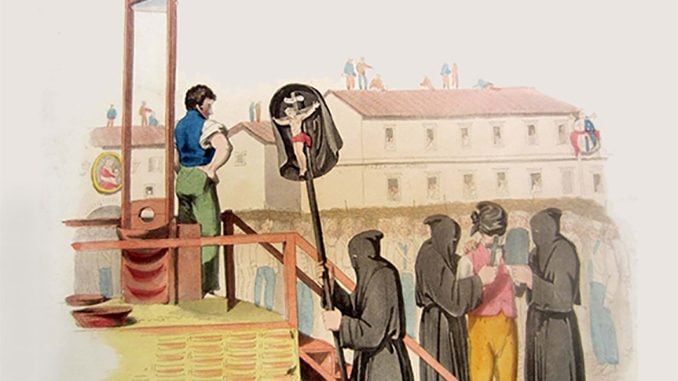
A recent survey found that 65% of adult American Catholics support the death penalty for individuals convicted of murder, which is about the same level of support as the general adult population in the country (66%).
Historically, the Catholic Church had been fairly consistent in allowing for the legitimacy of capital punishment under certain circumstances. In Chapter 21 of City of God, titled “Of the Cases in Which We May Put Men to Death Without Incurring the Guilt of Murder,” St. Augustine wrote that “there are some exceptions made by the divine authority to its own law, that men may not be put to death. These exceptions are of two kinds, being justified either by a general law, or by a special commission granted for a time to some individual.”
At the end of the section. St. Augustine confirms this notion and writes that there is an exception that is “justified..by a just law that applies generally,” even though elsewhere, he still advocated for clemency in certain situations, without rejecting the validity of the law.
St. Thomas Aquinas, living in the 1200s, wrote that “If a man be dangerous and infectious to the community, on account of some sin, it is praiseworthy and advantageous that he be killed in order to safeguard the common good” in his Summa Theologica.
The Catechism of the Council of Trent published in 1566 stated that the prohibition of killing “Thou shalt not kill” “does not apply to the civil magistrate, to whom is intrusted power of life and death, by the legal and judicious exercise of which he punishes the guilty and protects the innocent. The use of the civil sword, when wielded by the hand of justice, far from involving the crime of murder, is an act of paramount obedience to this commandment which prohibits murder.”
In the 1900s, Pope Pius XII stated: “In the case of the death penalty the State does not dispose of the individual’s right to life. Rather public authority limits itself to depriving the offender of the good of life in expiation for his guilt, after he, through his crime, deprived himself of his own right to life.”
Pope John Paul II believed that the state in our times possesses more means for preventing crime, and can “[render] one who has committed an offense incapable of doing harm – without definitely taking away from him the possibility of redeeming himself” and that “the cases in which the execution of the offender is an absolute necessity ‘are very rare, if not practically nonexistent,” still acknowledged that “the traditional teaching of the Church does not exclude recourse to the death penalty, if this is the only possible way of effectively defending human lives against the unjust aggressor.”
Pope Francis, however, departed from this, and declared the death penalty as “inadmissible.” It should be noted, however, that this teaching is not considered to have occurred under the conditions that make it infallible.
Save and Share This Catholic Patriotic Minute!