By Javier Villamor
Catholics for Catholics Contributor
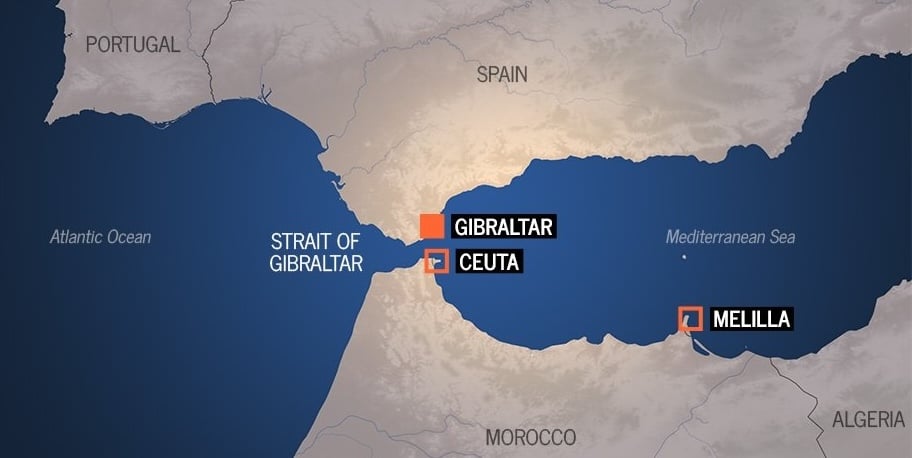
SF: The arrival of tens of thousands of people in Ceuta on July 30 and 31 was not a migration accident, but a calculated move. It is best understood by looking at a map of the world’s maritime routes: Spain guards the last major gateway to the Mediterranean that Washington and Tel Aviv do not yet control.
Last weekend, tens of thousands of people invaded Ceuta by land and sea in less than twenty-four hours. This is neither new nor sporadic: Morocco already pulled the same lever in May 2021, because its border does not open by itself—it opens when convenient and closes once it has delivered the intended message.
Rabat presents the issue as an attempt to “recover” Ceuta and Melilla, but the term conceals a trap: one cannot recover what one never possessed. Melilla has been Spanish since 1497 and Ceuta since 1580, both predating the modern Moroccan state itself.
The narrative of the “occupied cities” is therefore not history but obvious manipulation. It serves to transform a territorial claim into a grievance, and that grievance into a roadmap. The roadmap has clearly defined stages. First came Western Sahara, with the Green March of 1975; then Spain’s surrender of sovereignty in 2021; now Ceuta and Melilla. Anyone who reads these as isolated episodes has understood neither the method nor the strategy sustaining it.
.@martinvars igual te interesa por tema USA y Marruecos https://t.co/93LpSu3o9H
— Javier Villamor (@JavierVillamor) August 1, 2026
Who is behind it: Washington and Tel Aviv
It is therefore worth examining who supports that strategy, because Morocco is not acting alone. However much it may have grown, it cannot confront an EU and NATO member state without the backing—or at least the tolerance—of a major power. That backing has two capitals.
In December 2020, Trump recognised Moroccan sovereignty over Western Sahara in exchange for Rabat normalising relations with Israel under the Abraham Accords. Israel took longer to reciprocate, but eventually did so in July 2023, recognising the same sovereignty over a territory that, for all practical purposes and according to the United Nations, still has Spain as its administering Power.
The distinction matters, because it is what separates analysis from conspiracy theory: no one is claiming that Israel organised the invasion. The argument is subtler—and harder to refute.
A diplomatic and media environment favourable to Rabat has been constructed, and Morocco has operated within it. First, think tanks and analysts legitimise the claim; then American officials take it up; finally, Rabat acts on the ground. The sequence says more than any signed document because it is the same modus operandi as always. For those who have spent years studying how globalism has operated through the left, recognising the same mechanism on the supposed right completes a picture that often resembles a puzzle more than a painting.
Pedro Sánchez surrender
That picture has a Spanish chapter, and it bears a signature. In March 2022, in a letter made public by the Moroccan royal cabinet—not by La Moncloa, a detail that already says everything—Sánchez described Morocco’s autonomy plan as “the most serious, realistic and credible basis” for Western Sahara. Half a century of neutrality was swept away at a stroke, without parliamentary debate, with every political group opposed—including his coalition partners—and with Algeria withdrawing its ambassador from Madrid.
No one has convincingly explained that reversal. The alleged Pegasus surveillance of phones belonging to members of the Spanish government—using Israeli software and attributed to Moroccan services—still hangs over the affair. The same pattern was repeated last weekend: concede first and explain later—or do not explain at all—while the government boasts of having “resolved” a crisis despite thousands of Moroccans still wandering through the city.
It was not always this way. On the islet of Perejil in 2002, the Spanish Legion removed a group of Moroccan gendarmes within minutes and without firing a shot—although only after José María Aznar’s government had asked Washington for permission to defend its own territory against the invader.
If Madrid gives way, Europe looks elsewhere, and that is the level that should hurt most. Spain has supported package after package of sanctions against Russia and has unwaveringly upheld the common European position on Ukraine. Yet when its turn comes to request support against direct pressure on its own territory, the silence becomes deafening.
There has been no extraordinary European Council meeting and no declaration recalling that Ceuta and Melilla form part of the Union’s external border. Several member states prefer not to strain their relations with Rabat, while the Commission has turned caution into doctrine. The message to Madrid therefore resembles a stab in the back more than an expression of support: European solidarity has variable geometry. The implication is even worse, because harming Spain means harming Europe. Anyone who accepts that the sovereignty of an external border may be questioned is accepting that it can be negotiated anywhere else on the map.
Do not forget that Greenland is already on the table. What comes next?
The last gateway to the Strait
The core of the matter, however, is not diplomatic but geographical. One need only look at a map of the world’s major maritime chokepoints. Hormuz escaped Western control after the confrontation with Iran; Bab el-Mandeb fell at the mercy of the Houthis, Tehran’s allies; while Malacca and the Suez and Panama canals lie within the American sphere of influence. In almost all of them, Washington and its allies retain either control or the ability to exercise a veto. Israel, for its part, is weaving a chain of partnerships across the Red Sea, and the recognition of Somaliland as a bridgehead on the other side of the Gulf of Aden follows the same logic of securing strategic passages.
Only one major lock remains uncontrolled: Gibraltar. The decisive position there is not British—the Rock is tiny—but rather the crucial stretch of water between Tarifa and the African coast. Whoever controls Ceuta controls part of the southern shore.
It is no coincidence, then, that on March 16 Michael Rubin—of the American Enterprise Institute and the Middle East Forum, and a former Pentagon official—called in writing for a new Green March against the two cities and argued that NATO would not lift a finger to protect Spain.
He does not speak on behalf of a state, but he represents the trial balloon that often precedes policy decisions. The pretext—that Spain did not support the operation against Iran—is merely an excuse. The objective is to take control of the last maritime passage that remains outside the Atlantic-Israeli orbit.
Washington’s willingness to place an ally under pressure—as it has already done with Greenland and Denmark—opens a major conflict for those who believed they were standing in the same trench. Uncertainty will only grow as Washington and Tel Aviv increasingly act exclusively in pursuit of their own interests.
The preferred ally and the $20 million
Why Morocco rather than another country? Because it is now Washington and Tel Aviv’s preferred partner in North Africa, and its accession to the Abraham Accords demonstrates the extent to which its foreign policy has become interwoven with the interests of third parties.
A country that trades recognition of Israel for support over Western Sahara has accepted that its major strategic moves will be discussed beyond its own borders. This leads to a conclusion Rabat does not like to hear: it cannot launch an operation of this magnitude against a NATO border without its sponsors knowing about it or permitting it.
It is no coincidence that on October 31, 2025, the UN Security Council, acting on an American initiative, established the autonomy plan as the basis for negotiations, after which Mohammed VI turned the decision into a national holiday. Morocco’s victories are almost always won in other people’s offices.
That backing has ceased to be tacit and has now been committed to paper. The House Appropriations Committee incorporated into its budget report—attached to a $47.3 billion bill passed on July 15 by 217 votes to 209, with every Republican voting in favour except Thomas Massie—an unprecedented sentence: Ceuta and Melilla, “administered by Spain,” are “located in Moroccan territory.”
The text supports the Secretary of State “facilitating” dialogue over their “future status,” invokes the 1786 treaty of friendship and earmarks no less than $20 million in security assistance for Morocco. It is the first time Congress has put Mohammed VI’s claims in writing. The initiative was promoted by Mario Díaz-Balart, an ally of Marco Rubio, who had already described the cities in April as being “within Moroccan geography.” The document does not have the force of law, certainly, but such texts often become drafts for those that eventually do.
"HOW ISRAEL CAN HELP MOROCCO RECLAIM ITS NORTH"
— Javier Villamor (@JavierVillamor) July 31, 2026
Para los despistados. https://t.co/yXDo6otl6Z
A ten-year commitment
And in case any doubt remains about the scale of the commitment, those twenty million dollars are little more than a tip. The real weight lies in the 2027 National Defense Authorization Act—the NDAA currently moving through the Senate. Its Section 1268, approved in committee on June 15, instructs the Pentagon to submit to Congress, within 180 days of enactment, a ten-year roadmap covering 2026 to 2036, with an explicit objective: to turn Morocco into “the most capable military partner” the United States has on the African continent.
This is neither a gesture nor an isolated budget item buried beneath thousands of pages. It is a strategy protected by law and designed to survive changes of president, congressional majorities and budgetary cycles. In a different field, it resembles the fusion Washington and Tel Aviv established in intelligence and defence.
Nor is that all. Morocco, which raised its military expenditure to $15.3 billion in 2026, is already incorporating Israeli systems—including the Barak MX air-defence shield and Elta radars—as well as a maintenance centre for drones manufactured by Turkey’s Baykar on Moroccan soil. The platform is being armed piece by piece, and it is looking north. In other words, towards Spain.
Here we collide head-on with the hypocrisy that Atlanticism is determined to keep out of the mainstream media. While Western public opinion is warned almost daily about the Islamist threat, Washington is building its principal African alliance around Morocco that was governed until 2021 by an Islamist party, the PJD.
During the same period, it lifted sanctions on Syria and received Ahmed al-Sharaa at the White House in November 2025—a president who had led HTS, the former Al-Qaeda affiliate that the US State Department itself had classified as a terrorist organisation and for whose capture it had once offered a reward.
Read together, the message is stark: Islamism is a threat when convenient and a partner when profitable. One begins to suspect that the red line was never ideology, but usefulness.
The escalation has only just begun
The century changes; the script does not change very much. Spain remains the “black beast” of the Anglo-Saxon narrative—or at least that is what a Black Legend that has always served others remarkably well continues to claim. None of this should therefore be read as the end of a crisis, but as the opening of a sequence divided into several acts.
The Moroccan method is a staircase, and every consolidated step becomes the floor for the next one. From the Perejil incident in 2002, Rabat extracted a permanent dispute over the islet; from the 2021 assault, Spain’s policy reversal over Western Sahara; from the UN resolution of October 2025, international cover; and from the July assault, the words “Moroccan territory” printed for the first time in a document issued by the United States Congress.
The fact that the escalation appears endless is not merely an impression. It is what the system of incentives dictates. Morocco applies pressure and pays no price; Washington rewards it with recognition, twenty million dollars and a ten-year roadmap; Brussels looks the other way; Madrid gives way and calls it management.
There is not a single signal in this cycle encouraging anyone to stop. On the contrary, each round demonstrates that persistence pays. The next move is therefore predictable in form, although not in timing: another wave, another document, another map shifted slightly further north.
The border will continue to move until someone decides that it must remain somewhere. So far, the person who should make that decision has not done so.
Javier Villamor is a Spanish journalist based in Brussels covering NATO, the EU, and global affairs for The European Conservative. You can follow him on X @JavierVillamor
Sources and Links
Save and Share This Catholic Patriotic Minute!