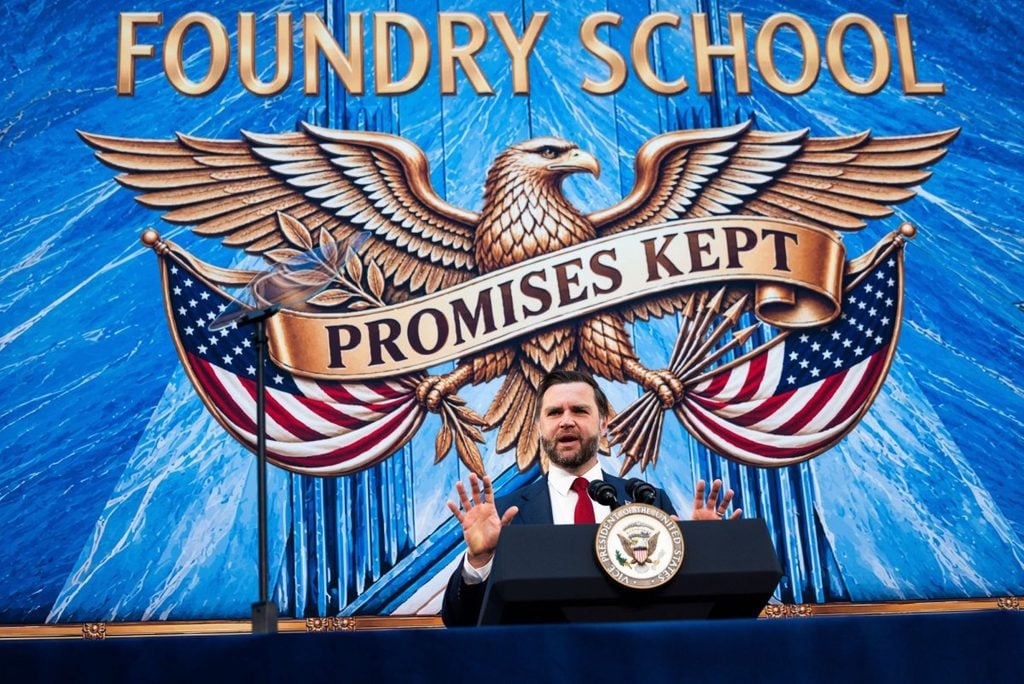
The new school was introduced by Vice President JD Vance and Secretary of State Marco Rubio.
By Catholics for Catholics
Looking to boost the country’s manufacturing industry, the Trump administration started the Foundry School on Thursday, a new plan aimed at training laborers in production and design skills.
At the launch ceremony for the program in Washington, D.C., Vice President JD Vance and Secretary of State Marco Rubio spoke during the event. The program is the result of a partnership between the administration and several universities, including Ohio State, Penn State and Stanford.
In its fact sheet, The Trump administration said that the manufacturing industry will require 3.8 million skilled workers by 2033 to construct semiconductors, defense and energy items and more.
The Foundry program is part of the Trump administration’s Pax Silica initiative, a strategy under the State Department that seeks to take the United States’ AI and supply chain capabilities to another level.
HAPPENING NOW: Trump Administration launches Foundry School to build the workforce behind America’s manufacturing comeback, at the Donald J. Trump Institute of Peace.https://t.co/d7I9S3HSZc
— Department of State (@StateDept) September 3, 2026
“If you think of the thrust of college education over the last 20, 30 years — was if you want to make a lot of money, if you want to have a good career, go into law, go into finance, go into banking, that was it,” Vance said in his address on Thursday. “I think what we’re doing with the Foundry is we’re telling America’s next generation of entrepreneurs and engineers and just brilliant kids that there is a future, both a financial future but also a future in the dignity of what you’re going to be doing every single day, by actually building things.”
“Foundry School is intended to close gaps in design and manufacturing capacity. The curriculum will unfold in two phases. Seven regional sessions, beginning in September 2026 and hosted by Arizona State University, Georgia Institute of Technology, The Ohio State University, The Pennsylvania State University, the University of Kansas, Vanderbilt University, and Washington University in St. Louis, will cover the fundamentals of modern factory design, materials and supply chains, assembly-line engineering, plant economics, regulation and permitting, and workforce development at scale,” according to the fact sheet.
“ A ten-session core program hosted by Stanford University, beginning in January 2027, will build on that foundation with advanced manufacturing capabilities, including precision tooling, industrial automation, quality systems, new product introduction, digital manufacturing, capital equipment, energy, global site selection, and defense production, concluding with a capstone session on lessons from failed manufacturing ventures. Together, the 17 sessions form a one-of-a-kind curriculum.”
Save and Share This Catholic Patriotic Minute!