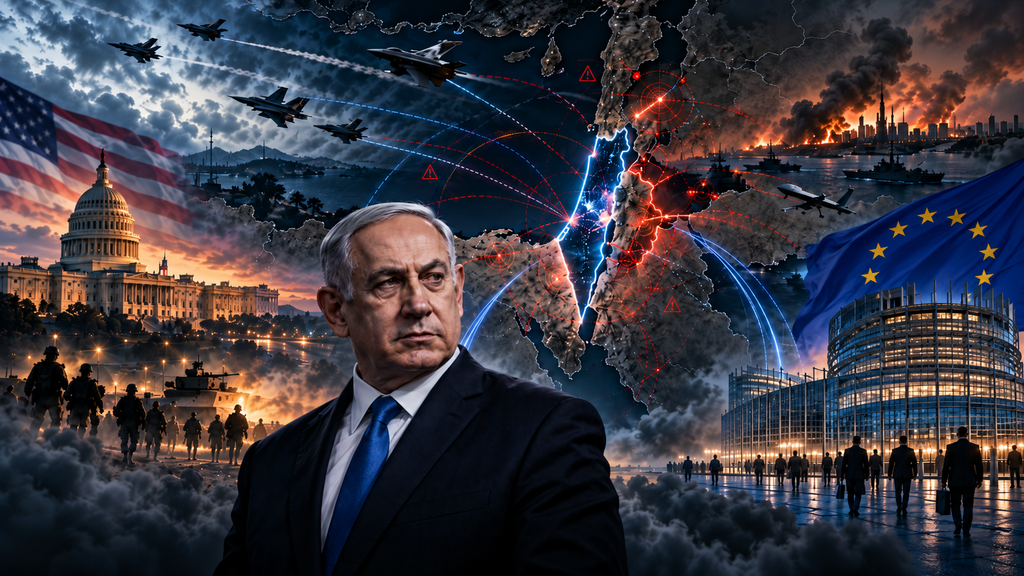
Netanyahu’s new security strategy prioritises offensive operations and military zones beyond Israel’s borders, risking confrontation between Washington, Brussels, and other strategic partners in the Middle East.
By Javier Villamor
Israel has decided to make preventive war one of the central principles of its national security.
Benjamin Netanyahu, still Israel’s prime minister, presented a new doctrine on October 18 that prioritizes offensive action over containment, envisages pre-emptive strikes against developing threats, and opens the door to maintaining military security zones beyond the country’s borders.
Preventive war is a familiar concept from the George W. Bush administration and its “war on terror.” Israel is now reviving it to justify unilateral military operations.
The shift has consequences that extend far beyond Israel and its supposed security. Its implementation could drag the United States and the European Union into conflicts they have not chosen to initiate but whose consequences they would find difficult to avoid, particularly when Israeli operations affect countries with which Washington and Brussels maintain military, energy, and economic partnerships.
The doctrine, developed with support from Israel’s National Security Council, responds to the security failure of October 7, 2023. This failure has become increasingly controversial after revelations that security forces issued numerous warnings up to a year beforehand. That Hamas attack undermined Israel’s confidence in border surveillance, intelligence, and deterrence as sufficient instruments to prevent an assault.
Until then, the traditional model had combined deterrence, early warning, and rapid military victories. The new approach retains those elements but rearranges their priorities: Israel must prevent its enemies from developing capabilities that could threaten it, even if doing so requires acting before an attack takes place.
In other words, Israel is claiming the right to attack any country at any time.
The idea is not entirely new. Israel has conducted preventive operations against its adversaries’ military installations and weapons programmes for decades. The difference is that Netanyahu is now elevating this practice into an explicit principle of national strategy.
The doctrine’s ten principles include preventing Israel’s enemies from acquiring nuclear weapons, strengthening military superiority, improving intelligence capabilities, and reducing dependence on foreign weapons supplies. They also embrace a conception of victory aimed at breaking the enemy’s will to continue fighting.
One of the most sensitive elements is the concept of forward defence. Israel envisages establishing security zones beyond its borders to keep threats away from its civilian population. This approach could translate into a prolonged military invasion of Gaza, Lebanon, or Syria.
The document does not establish a formal policy of annexation, but neither does it specify the geographical limits, duration, or withdrawal conditions for such zones. We may be witnessing the beginnings of what is known as “Greater Israel.”
The problem for the United States
The main difficulty for Washington is that Israel’s military autonomy may conflict with American commitments to other Middle Eastern states. Those commitments, moreover, have already been damaged during the conflict with Iran, as regional partners have come to realise that Israel is the overriding priority.
The clearest precedent came in September 2025, when Israel bombed Hamas targets in Doha, Qatar’s capital, without American approval. The attack drew criticism from Donald Trump and affected a country that hosts one of the largest US military bases in the region and plays an important role in diplomatic mediation.
Washington subsequently strengthened its security guarantees to Qatar through an executive order issued on September 29, 2025. The episode demonstrated that Israeli objectives and American interests do not always coincide.
The new doctrine could aggravate that contradiction. If Israel decides that a threat requires an immediate response, the United States could find itself having to manage retaliation against its forces, protect military installations, or intervene to prevent a regional war.
What is now set out on paper has already been visible in practice following the attack on Iran. Shortly after the strikes against Tehran began, Secretary of State Marco Rubio acknowledged that his administration had been drawn into the conflict by Tel Aviv.
Turkey represents another potential source of friction. Ankara is a NATO member, and its interests in Syria may clash with Israeli operations. A confrontation would not automatically bring the Atlantic Alliance into war, but it would trigger a crisis between two key American partners and further strain NATO’s already damaged internal cohesion.
Netanyahu has also expressed concern about the possibility of a future US administration becoming less supportive of Israel. His pursuit of greater military-industrial self-sufficiency is intended to reduce Washington’s ability to constrain Israeli decisions without giving up the benefits of the alliance.
Europe, between a rock and a hard place
For the European Union, the consequences are different but equally difficult to manage.
Brussels maintains significant economic and technological ties with Israel. According to the European Commission, bilateral trade in goods reached €43.3 billion in 2025, and the EU remains Israel’s largest trading partner. But Europe has also built a network of strategic agreements with countries directly exposed to regional tensions.
Jordan signed a strategic partnership with the EU in January 2025, backed by a €3 billion financial package. Egypt has another agreement covering cooperation on security, migration, and energy. Qatar is also considered a strategic European partner.
The expansion of Israeli preventive operations could clash with the cooperation commitments Brussels maintains with Israel.
The problem was already evident after the attack on Qatar. The European External Action Service condemned the strikes, arguing that they violated international law and the territorial integrity of a strategic EU partner.
There are also the economic consequences of regional escalation. Conflicts involving Iran and its allies could disrupt shipping routes through the Red Sea and the Persian Gulf, increase transport costs, and put upward pressure on energy prices.
Instability in Lebanon, Syria, or Gaza could also worsen population displacement and complicate efforts to stabilise the eastern Mediterranean. As Europe witnessed in 2015 with the war in Syria, following the destruction of Libya and the destabilisation of Iraq and Afghanistan, another massive wave of migration cannot be ruled out.
The EU also faces its own internal divisions. Member states hold different positions on Israel, Palestine, and diplomatic or commercial pressure measures. An Israeli policy increasingly based on autonomous military operations could make a common European response even more difficult.
Criticism also comes from within Israel’s own strategic establishment. In an analysis published on August 18, Ofer Shelah, a researcher at Israel’s Institute for National Security Studies (INSS), warned against a conception of security that normalises permanent war, external military zones, and increasingly costly national mobilization.
Netanyahu’s presentation, nine days before Israel’s October 27 elections, adds an electoral dimension. The opposition has criticized the document’s lack of operational mechanisms and accountability provisions, but has not challenged its underlying premise. Politically, Netanyahu is considered centre-right in Israel.