After more than two centuries of political and cultural de-Christianization, the packed streets of Paris are a reminder that France’s Christian roots remain far more alive than its secular elite is willing to admit.
By Javier Villamor
For more than a century, France has defined itself institutionally as a secular republic. More than half of its citizens aged between 18 and 59 no longer identify with any religion, while the weight of Catholicism has declined for decades. Yet it took just four days of Leo XIV’s visit to present a very different image of the country from the one usually projected abroad.
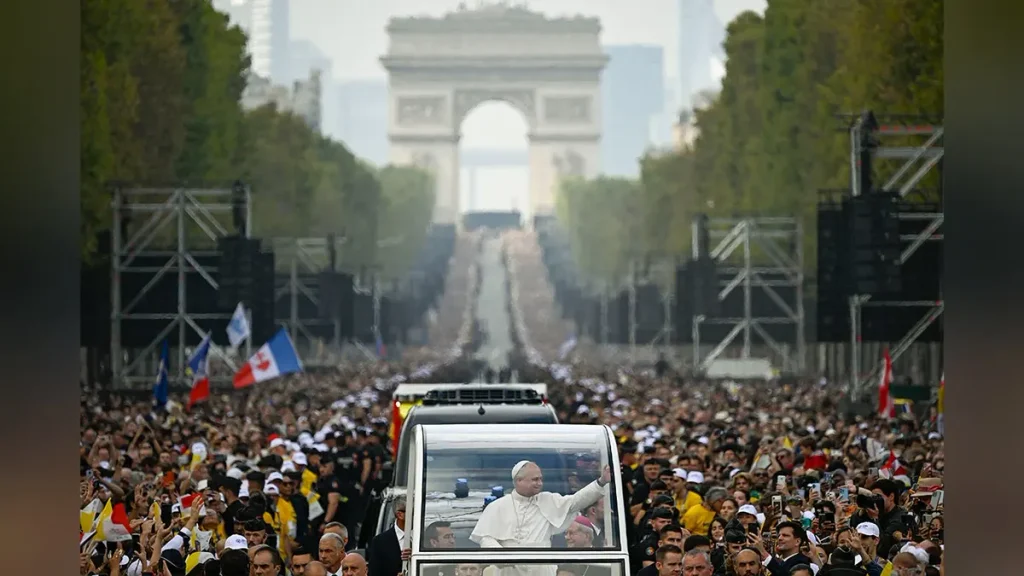
Almost one million people came out to welcome the Pope.
The most striking scene came on Saturday in Paris. More than 800,000 people attended the open-air Mass held along the Champs-Élysées, from Place de la Concorde to the Arc de Triomphe. The figure exceeded initial registrations by around 200,000. The security operation involved 14,500 police officers, gendarmes, military personnel and firefighters.
The previous day, according to Vatican figures, around 300,000 people had lined the streets of the capital as the popemobile passed through. That same evening, 80,000 young people filled the Stade de France for a vigil with Leo XIV. Le Monde described a reception closer to that of a music star than to the image normally associated with a religious ceremony in contemporary Europe.
Across the entire visit, which took the pontiff to Paris, Lourdes and Metz between September 25 and 28, more than 1.3 million people took part in the various events, according to figures published by the French press.
The figure is particularly significant precisely because this is France – a country that has become Masonic, secular and particularly anti-Christian — though not anti-Muslim.
The French Republic made laïcité one of the central principles of its political identity after so much blood had been shed in the name of “liberty, equality and fraternity”. The 1905 law established the separation of Church and State, while the Constitution today defines France as an “indivisible, secular, democratic and social Republic”.
That process has much deeper roots.
During the radical phase of the Masonic French Revolution, an explicit policy of de-Christianisation was pursued. Churches were closed, thousands upon thousands of members of the clergy were forced to abandon their ministry, flee the country or were killed, while new revolutionary cults were promoted as substitutes for Christianity.
Even the Cambridge History of Christianity (not suspected of having close ties to the Vatican) describes that period as a politically sponsored assault on Christianity of an intensity virtually unknown in Europe since Roman antiquity.
What followed were more than two centuries of conflict between Church and Republic, anticlericalism, cultural secularisation and, eventually, a sharp decline in religious practice.
The figures show just how much France has changed. According to the latest major study on religious affiliation published by the National Institute of Statistics and Economic Studies (INSEE), conducted among people aged 18 to 59 in 2019 and 2020, 51% said they had no religion. Some 29% identified as Catholic and approximately 10% as Muslim. Islam has therefore become the country’s second-largest religion, and its growth, linked in part to several decades of immigration, has also transformed France’s religious landscape.
That is why the images from Paris matter far beyond a papal visit.
They do not show a France that has suddenly returned to the Catholic practice of the mid-20th century. Nor do they allow us to conclude that secularisation has been reversed. But they do challenge the idea imposed across the West that modernisation inevitably leads to the disappearance of religion.
There are also signs that invite optimism.
The French Bishops’ Conference recorded 13,234 adult baptisms in 2026, compared with 10,384 in 2025 and just 4,124 a decade earlier. The figure has risen by 28% in the past year alone and has more than tripled since 2016. Among the newly baptised, young people aged 18 to 25 now make up the largest group.
During his visit to the Institut Catholique de Paris, Leo XIV met some of these new converts. One phrase sums up the phenomenon: France may slowly be moving from an “inherited Christianity” to a “chosen Christianity”. A Church smaller than that of previous generations, perhaps, but increasingly made up of people who have consciously decided to enter it.
The Pope himself took that question onto the European stage, echoing the words of Pope Benedict XVI on the future of Christianity.
In Metz, he recalled Europe’s Christian roots and argued that the continent must recover them as it confronts the encounter with new cultures arriving through immigration. Leo XIV defended legal and safe routes for migrants and their integration into European societies, but linked that process to the need for Europe first to understand its own heritage.
The Pope is never going to say it openly — at least not for the moment — but linking integration to the need for Europe to know its roots means that integration ultimately requires the conversion of immigrants.
There is no common ground in a secular, materialistic, nihilistic, individualistic and bland world. There is, however, common ground in faith. The same faith that Europe once carried across the world.
Even Emmanuel Macron, president of a Republic particularly protective of its secularism, spoke during the visit about Europe’s Greco-Roman and Christian foundations and their role in shaping concepts such as individual freedom and human dignity.
And that is probably the most interesting conclusion of the entire visit: two centuries of political de-Christianisation, institutional secularisation and cultural transformation have failed to eliminate the religious impulse within French society.
The France of 2026 is not the Catholic France of 1950, but nor does it appear to be the definitively post-Christian society that for years was assumed to be the status quo.
“…in twenty years there will be nothing left of the Church” Voltaire, 1773
— Catholics for Catholics 🇺🇲 (@CforCatholics) September 27, 2026
More than 250 years later, the Eldest daughter of the Church stills alive.
Christ is King! Vive la France! 🇫🇷 pic.twitter.com/nm0vel0tHo
Save and Share This Catholic Patriotic Minute!