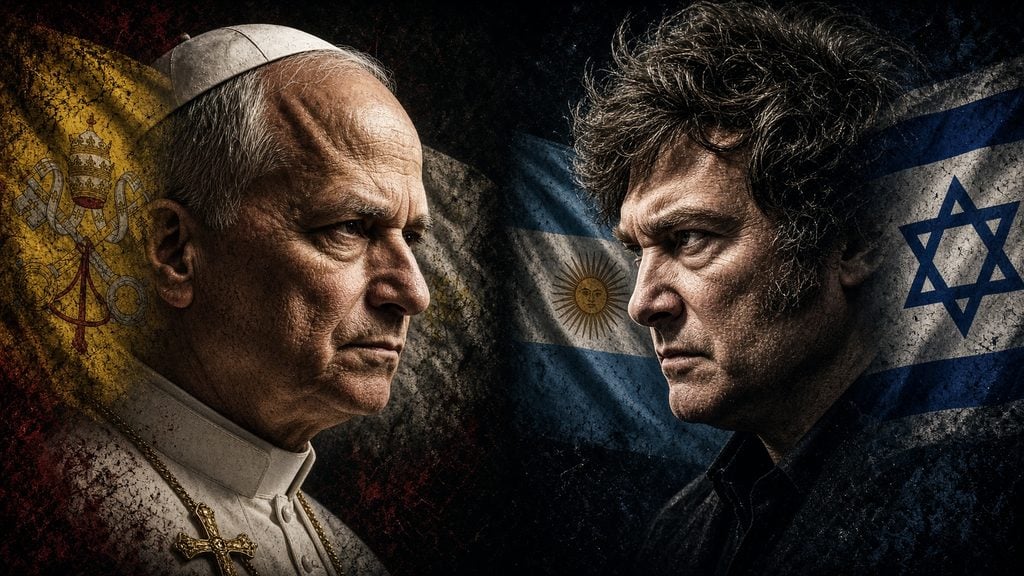
The Pope defends social justice, the common good, and limits on private property against a right that invokes Christian values while embracing radical economic liberalism and alignment with Israel.
By Javier Villamor
The first papal visit to Argentina in almost four decades has made two things clear: Catholicism remains the lifeblood of the country, and its teachings stand in stark contrast to the positions defended by its president, Javier Milei.
Leo XIV has placed the Church’s social doctrine in direct opposition to Milei’s libertarian project, but also against a segment of the new Western right that champions Christian civilisation (or “Judeo-Christian”, depending on who is speaking) while questioning some of its fundamental social principles.
The contrast became clear on November 8, during the Pontiff’s address to Milei and the Argentine authorities at the Palacio Libertad. “The economy must be at the service of the person, not the person at the service of the economy,” Leo XIV declared.
The Pope defended private initiative and entrepreneurship, but also insisted that economic growth must benefit workers struggling to support their families, the unemployed, and pensioners. He also called for prudence in the exercise of power, protection for the vulnerable, and institutional responsibility.
He did not explicitly mention Milei’s economic policies. Nor did he need to in order to expose the underlying doctrinal differences.
Just ten days earlier, on October 30, the Argentine president had defended a radically different understanding of justice at Torcuato Di Tella University.
In his address, Milei once again described social justice as a “moral aberration”, arguing that redistributing resources through taxation amounts to stealing from some citizens to benefit others. He even went so far as to claim that the principle contradicts Holy Scripture.
For Milei, compulsory redistribution constitutes a moral violation of property rights. For the Catholic Church, legitimate ownership carries social obligations that do not depend solely on the will of the owner.
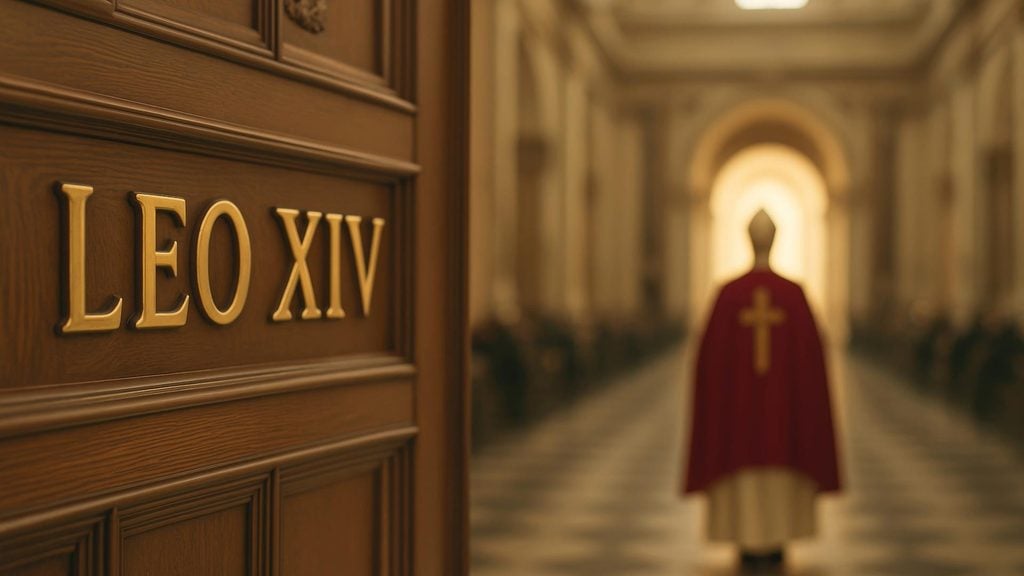
Leo XIV’s position represents neither a progressive innovation nor a personal extension of Francis’s political preferences.
In Rerum Novarum (1891), Leo XIII defended private property and workers’ rights. John Paul II later recalled, in Sollicitudo Rei Socialis, that private property carries a “social mortgage” arising from the universal destination of goods.
Even in Centesimus Annus, published after the collapse of Soviet communism, John Paul II acknowledged the virtues of the market without accepting that market mechanisms alone were sufficient to guarantee justice.
Leo XIV himself developed this continuity in his encyclical Magnifica Humanitas, published in May 2026. In it, the Pontiff explicitly defends social justice, the redistributive function of taxation systems, and the responsibility of public institutions to correct economic imbalances.
This is not a defense of statism, as liberals claim. Catholic doctrine also recognizes subsidiarity, freedom of enterprise, and intermediary institutions as safeguards against the concentration of state power. But it rejects the elevation of individual autonomy into an absolute principle. On this point, the confrontation with libertarianism is fundamental.
During his address in Córdoba on November 10, Leo XIV again stressed that hunger, injustice, illness, and the lack of decent housing demand a Christian response. In Luján, he insisted that religious communion does not allow believers to turn away from their responsibilities towards others.
The confrontation takes on an international dimension because of the particular ideological synthesis represented by Milei. The Argentine president combines anarcho-capitalism with a defense of the West rooted in “Judeo-Christian values” and an explicit strategic alignment with Zionism.
In June 2025, during his address to the Israeli Knesset, he presented Israel as one of Argentina’s principal strategic partners and framed their alliance as part of a moral struggle over the future of Western civilisation.
This orientation does not, in itself, constitute an economic doctrine. It does, however, raise questions about the political use of religious identity. Jewish messianism is one of the keys to Milei’s worldview.
Within this framework, Christianity risks being reduced to a cultural or geopolitical identity, detached from its economic and moral obligations (a rather convenient selection of the Christian inheritance for those seeking to turn it into a political banner).
Leo XIV’s visit has brought these questions back to the forefront. His message does not demand abandoning the market, private property, or economic freedom, but rather recognizing that none of these principles constitutes an end in itself.
Save and Share This Catholic Patriotic Minute!