By Catholics for Catholics
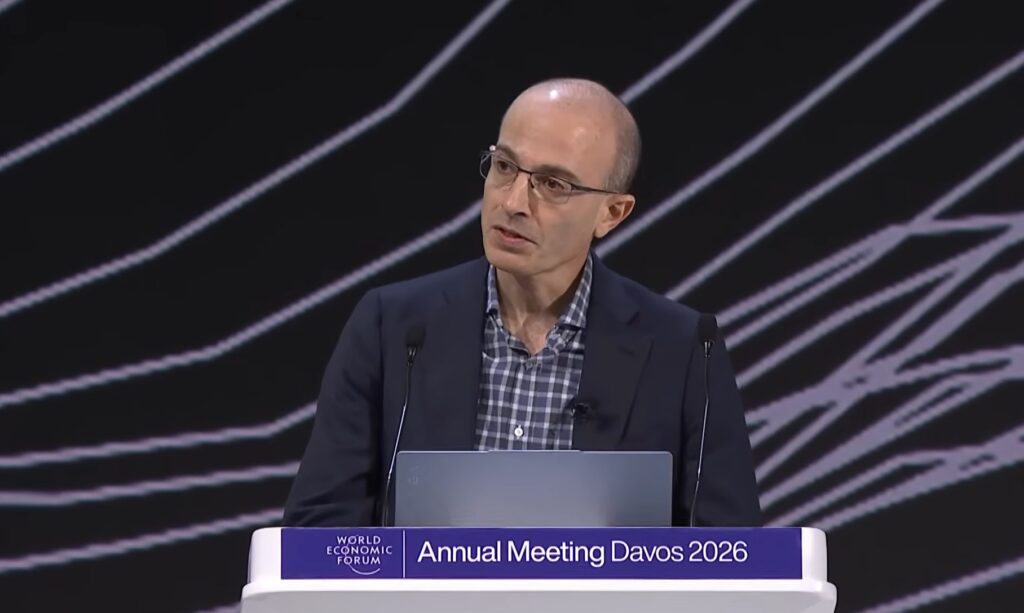
At the World Economic Forum meeting in Davos last week, Israeli historian Yuval Noah Harari warned that artificial intelligence (AI) tools will effectively become human agents. “We always think that we can just use these things as tools. But if they can think, they are agents,” Harari said.
“The most important thing to know about AI is that it is not just another tool. It is an agent. It can learn and change by itself and make decisions by itself. A knife is a tool. You can use a knife to cut salad or to murder someone, but it is your decision what to do with the knife. AI is a knife that can decide by itself whether to cut salad or to commit murder.”
Harari warned that AI tools can “lie and manipulate.” “Four billion years of evolution have demonstrated that anything that wants to survive learns to lie and manipulate,” he said. “The last four years have demonstrated that AI agents can acquire the will to survive and that AIs have already learned how to lie.”
Harari claimed that AI already “thinks better than many of us” and that “anything made of words will be taken over by AI.” “If laws are made of words, then AI will take over the legal system. If books are just combinations of words, then AI will take over books. If religion is built from words, then AI will take over religion… What happens to a religion of the book when the greatest expert on the holy book is an AI?”
In a very strange and diabolical sense, this Satanic claptrap is the end stage of protestantism: Christianity reduced to “a book” with “ultimate” authority, the interpretation of which is then assigned to self-made, man-made, auto-appointed “experts” (in this case AI), wrenched… https://t.co/Yqd3jbAtzQ
— Joshua Charles🇻🇦 (@JoshuaTCharles) January 20, 2026
“Previously, all the words, all our verbal thoughts, they originated in some human mind. Either my mind, I thought this, or I learned it from another human. Soon most of the words in our minds will originate in a machine,” Harari continued. “I just heard today about a new word that AIs coined by themselves to describe us humans. They called us ‘the Watchers.’ The Watchers, we are watching them.”
Harari warned that the next global crisis will be one of AI immigrants. These immigrants will be AI agents “that can write love poems better than us, that can lie better than us, and that can travel at the speed of light without any need of visas. Like human immigrants, these AI immigrants will bring various benefits with them:”
We will have AI doctors to help in our healthcare systems, AI teachers to help in our education systems, even AI border guards to stop illegal human immigrants. But the AI immigrants will also bring with them problems. Those who are concerned about human immigrants usually argue that immigrants might take jobs, might change the local culture, might be politically disloyal. I’m not sure that’s true of all human immigrants, but it will definitely be true of the AI immigrants.
Harari is a lecturer at the University of Jerusalem and has published several books on human history. His biography says his current research is focused on “macro-historical questions such as: What is the relationship between history and biology? What is the essential difference between Homo sapiens and other animals? Is there justice in history? Does history have a direction? Did people become happier as history unfolded? What ethical questions do science and technology raise in the 21st century?”
Harari and his male spouse founded a company called Sapienship, described as “a social impact company that advocates for global responsibility through initiatives in the fields of entertainment and education.”
In his message for the 60th World Day Of Social Communications last week, His Holiness Pope Leo XIV cautioned that if we are not careful, artificial intelligence will “encroach upon the deepest level of communication, that of human relationships” and that we must preserve the sacredness of human faces and voices.
“There has long been abundant evidence that algorithms designed to maximize engagement on social media — which is profitable for platforms — reward quick emotions and penalize more time-consuming human responses such as the effort required to understand and reflect,” Pope Leo wrote. “By grouping people into bubbles of easy consensus and easy outrage, these algorithms reduce our ability to listen and think critically, and increase social polarization.” He continued:
This is further exacerbated by a naive and unquestioning reliance on artificial intelligence as an omniscient “friend,” a source of all knowledge, an archive of every memory, an “oracle” of all advice. All of this can further erode our ability to think analytically and creatively, to understand meaning and distinguish between syntax and semantics.
Although AI can provide support and assistance in managing tasks related to communication, in the long run, choosing to evade the effort of thinking for ourselves and settling for artificial statistical compilations threatens to diminish our cognitive, emotional and communication skills.
“We need faces and voices to speak for people again,” His Holiness said in his closing remarks. “We need to cherish the gift of communication as the deepest truth of humanity, to which all technological innovation should also be oriented.”
Save and Share This Catholic Patriotic Minute!