Carlson remarked that the illusion of NATO has “shattered” and that “now everyone admits it’s not real” so “it’s time to start thinking about the next step.”
By Catholics for Catholics
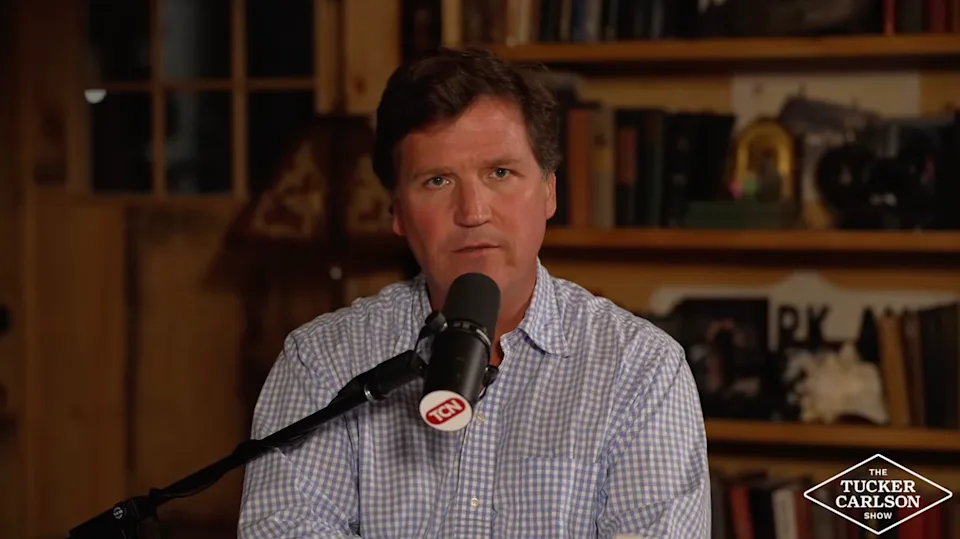
In a monologue entitled “World War Is Coming Soon,” podcaster Tucker Carlson issued a stark warning following the announcement from President Trump that the military’s budget will be jumping from $1 trillion to $1.5 trillion in 2027.
“That’s the kind of budget that a country that anticipates a global or regional war has for its military…That’s not a peacekeeping budget,” Carlson observed. The signs suggest that a big war is coming soon. But with who?
Carlson says to look at a map and ask, “What areas do I want to control? What are the trade routes? Who’s got the resources? Who do I share a language with? Who do I share a common history with? Who do I share a civilization with?” The most obvious conclusion: the United States needs to have a relationship with Russia in order to survive a global conflict because of its scale and resources (gas, gold, minerals).
Further, Trump has repeatedly warned that Russia and China cannot be allowed to become a bloc, but the Biden administration “intentionally drove Russia into an alliance with China.”
“If Donald Trump wants to commit one act as president that will secure a place in history forever as a hero,” Carlson says, “it would be to bring Russia back into alliance with the United States.”
“Russia is not bad or good, it is essential to the United States,” he continues. “We cannot survive a global conflict if Russia and China are aligned against us. Period.”
“And by the way, Russia is a Christian country, a remarkable country, very serious country, that we have a lot in common with whether you like it or not,” Carlson adds.
The proxy war in Ukraine (with an unelected leader at the helm) clearly does not serve the interests of the United States, Carlson says, and “the only reason we are not in alliance with Russia is because the foreign policy establishment in the United States, the weapons manufacturers, and particularly the neocons believe that they somehow own Russia or want to retake Russia or something, and Putin’s in the way. He kicked out the oligarchs. That was gravely offensive to the American finance establishment and to the American foreign policy establishment.”
Whatever the nation’s next steps may be, Carlson urges that it must benefit the United States – America first. “A functioning empire benefits from the empire,” he says. “If you can’t fix Baltimore, you don’t really have a shot at making Caracas functional.”
Carlson applauded President Trump for his efforts in cleaning up Washington, D.C. with the National Guard and encouraged him to keep up these types of operations.
If we’re going to expand the empire – and the taking of Venezuela and talks of Greenland next point to this – our own country must be made not only more prosperous, but also more “stable and cleaner and better for its own citizens.”
“The last thing to remember about being an empire,” Carlson says, “is that it can corrupt you. And this is the fate ultimately of all empires. They are corrupted by the imperial project and they become coarser.”
“So that does happen over time, but fight back against it,” he urges. “You want to retain the fundamental decency of your country even as you expand (as you take Greenland, as you take Venezuela, wherever else we’re going); you need to remember, we are decent people, and we’re going to continue to live as though we are with dignity.”
“Americans have to remember that the point of this exercise is to secure the homeland and everything good about it. And one of the very best things about the United States is the regard that Americans have for human life,” Carlson concludes. “And for dogs.”