The Supreme Court Judge said federal law permits “most (if not all) of the tariffs at issue” in the case.
By Catholics for Catholics
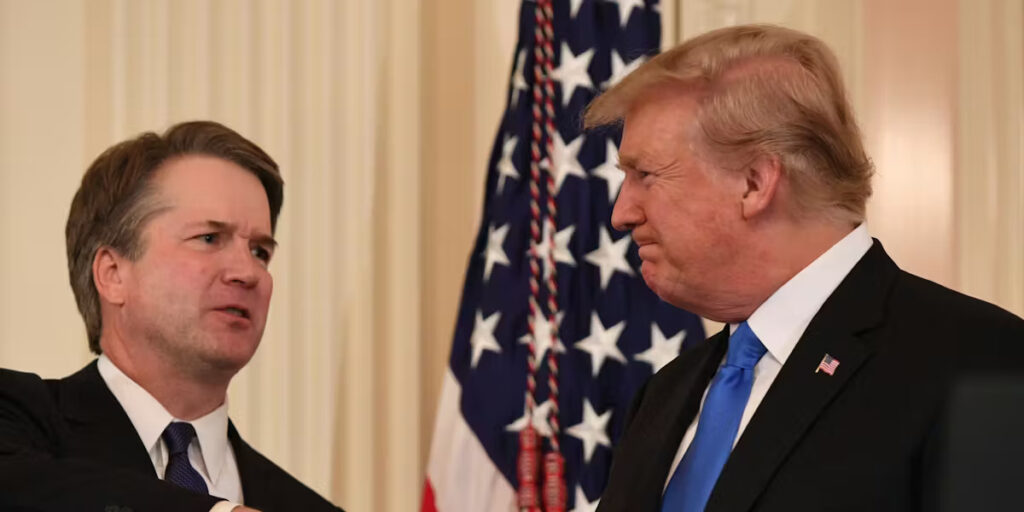
After the Supreme Court struck down President Donald Trump’s far-reaching tariffs, Justice Brett Kavanaugh dissented Thursday and forewarned that the majority’s decision could give a free rein to an economic jam the Court did nothing to prepare for.
Justices Clarence Thomas and Samuel Alito joined Kavanaugh by rejecting the ruling sharply, contending the Court wasn’t just wrong on the law, but had opened the door to instant disorder. He argued that tariffs are a traditional tool presidents have long used to “regulate…importation,” and that the majority’s approach contravenes “text, history, and precedent.”
Still, according to The Daily Wire, Kavanaugh said Friday that President Trump may likely preserve most of his “Liberation Day” tariffs despite the Supreme Court’s decision to do away with them.
Writing in his dissent, Kavanaugh contended that while the Court struck down Trump’s dependence on the International Economic Emergency Powers Act (IEEPA), other federal statutes could authorize most of the tariffs.
“Although I firmly disagree with the Court’s holding today, the decision might not substantially constrain a President’s ability to order tariffs going forward,” he wrote. “That is because numerous other federal statutes authorize the President to impose tariffs and might justify most (if not all) of the tariffs at issue in this case—albeit perhaps with a few additional procedural steps that IEEPA, as an emergency statute, does not require.”
Kavanaugh, according to The Wire, spoke expressly about the Trade Expansion Act of 1962, the Trade Act of 1974, and the Tariff Act of 1930 as alternative statutory bases that could authorize the tariffs Trump sought to impose.
“IEEPA merely allows the President to impose tariffs somewhat more efficiently to deal with foreign threats during national emergencies,” he said. “In essence, the Court today concludes that the President checked the wrong statutory box by relying on IEEPA rather than another statute to impose these tariffs.”
Kavanaugh’s position is similar to one previously expressed by Treasury Secretary Scott Bessent. In December, Bessent said several sections of the Trade Expansion Act of 1962 could be used to “recreate the exact tariff structure” Trump imposed through IEEPA.
Kavanaugh contended in his dissent that law and history were on Trump’s side. He mentioned the global tariffs imposed by former President Richard Nixon in 1971 as a case of a president executing broad trade restrictions during an economic crisis.
“Statutory text, history, and precedent demonstrate that the answer is clearly yes: Like quotas and embargoes, tariffs are a traditional and common tool to regulate importation,” he said.
Save and Share This Catholic Patriotic Minute!