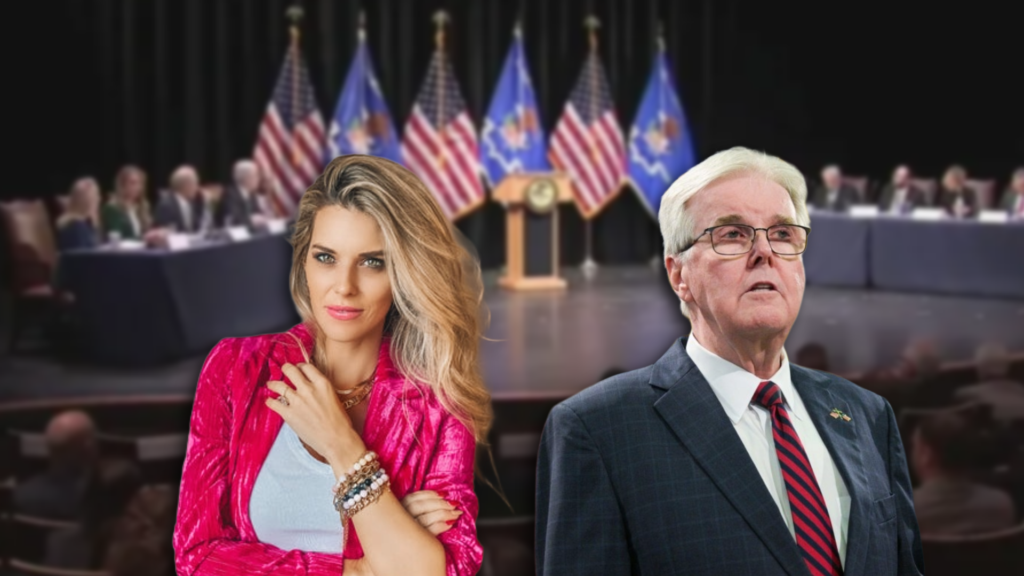
On Wednesday, Texas Lt. Governor Dan Patrick, Chairman of President Trump’s Religious Liberty Commission, announced that Carrie Prejean Boller, a Catholic, has been removed from her post. This comes just two days after the commission held a hearing on antisemitism and Prejean Boller pushed back against the automatic linking of anti-Zionism with anti-semitism.
Patrick wrote on X,
Carrie Prejean Boller has been removed from President Trump’s Religious Liberty Commission. No member of the Commission has the right to hijack a hearing for their own personal and political agenda on any issue. This is clearly, without question, what happened Monday in our…
— Dan Patrick (@DanPatrick) February 11, 2026
Later that day, Boller shared an official statement on X in response to the Governor’s decision:
“The Commission was created by Executive Order of President Donald J. Trump. Members were appointed by the President and serve as his appointees. Nothing in the Executive Order grants you the power to remove presidential appointees. Unless and until I receive written notice from the President of the United States requesting my removal, I will continue to defend religious freedom for all religions on this Commission. I recommend you re-read the Executive Order issued by the President who appointed us.“
Dear Chairman Patrick,
— Carrie Prejean Boller (@CarriePrejean1) February 11, 2026
I write in response to your public statement falsely claiming that you “removed” me from President Trump’s Religious Liberty Commission.
As the name states, this is President Trump’s Religious Liberty Commission, not yours.
You did not appoint me to the… https://t.co/r4VoEXSrPp
Before Prejean Boller was removed, Catholics for Catholics reported on the way in which the Catholic faith was mocked by those who disagreed with her comments and questions during the hearing.
Prejean Boller was not the only commission member who tried to make clear delineations about what anti-semitism is, particularly in the context of American law. Before she even spoke, Dr. Ryan Anderson, author, President of the Ethics and Public Policy Center, and fellow member of the commission, had this to say in response to Yitzchok Frankel’s testimony about the antisemitism he faced as a law student at UCLA:
That was just very compelling testimony that I doubt I’ll ever forget. And as I was listening, you know, two thoughts went through my head: that’s evil, but probably not illegal; and, that’s evil, and probably illegal. You know, in terms of what you were describing as what you experienced on campus.
To this, fellow commission member Paula White could be seen nodding her head in agreement. Dr. Anderson continued:
And then, of course, the stuff that was evil and illegal, you didn’t have anybody, either campus leadership or in the Biden administration, that would actually enforce the law…
…Ultimately, we’re offering advice to the Trump administration. How should we think about where that line is between…evil, but legal, versus evil, but illegal? And the reason I ask the question is, you had helpfully said that, you know, an attack on Mormons is an attack on Jews is an attack on Christians. Religious liberty needs to also extend to people whose theology we disagree with, including their theology about the Jews or their theology about Israel. You know, we may disagree with that theology. The Religious Liberty Commission still has to defend their liberty to hold it.
After several witnesses and commission members spoke, it was Prejean Boller’s turn. Prejean Boller started,
You describe very painful experiences at UCLA, and I take that very seriously. At the same time, many of the students who I’ve spoken to personally who created those encampments say that they were protesting the killing of tens of thousands of Palestinian civilians in Gaza and their university’s financial ties to that war.
So I need to ask you, in a country built on religious liberty in the First Amendment, do you believe someone can stand firmly against antisemitism, including what you experienced, and at the same time condemn the mass killing of Palestinians in Gaza, or reject political Zionism, or not support the political state of Israel? Or do you believe that speaking out about what many Americans view as genocide in Gaza should be treated as anti-Semitic?
Because, in my view, the United States cannot and must not make loyalty to a particular theology about Israel a litmus test for protected speech or moral legitimacy.
Frankel did not answer the question directly but again spoke about being physically blocked from spaces on campus because he was a Jew, and criticized UCLA’s mishandling of the situation.
Prejean Boller emphasized that she was grateful they were having this discussion, and then asked Frankel’s opinion about a quote from Rabbi Shapiro about the conflation between anti-Zionism and anti-semitism. Part of the quote reads:
American Jews are increasingly treated as less fully American—our loyalty questioned, our belonging made conditional—because Zionist ideology falsely claims Israel is the nation-state of Jews everywhere and that every Jew is nationally tied to it. This framing is anti-Semitic at its core: it strips us of our identity as Americans, recasts us as foreigners in our own country, and arms antisemites with accusations of divided loyalties and collective guilt for actions we neither chose nor control.
Frankel responded by quoting Natan Sharansky as saying, There’s three things that you shouldn’t do with Israel. You shouldn’t delegitimize it, you shouldn’t demonize it, and you shouldn’t apply a double standard. If you can abide by those three things, you’re not anti-Semitic.
Prejean Boller responded and asked, “Is anti-Zionism anti-Semitism?” Frankel’s response: “Yes, it is.”
Another panelist, Rabbi Ari Berman, agreed, saying, “Undoubtedly, anti-Zionism is anti-semitism,” to which many in the audience responded with applause. He did clarify that “one does not have to support the specific policies of the government of Israel, but to not support the right of Israel to exist, which is what Anti-zionists do while not taking that same stand to the 28 Muslim countries and 13 Christian countries in this world, is a double standard, is hypocrisy, and is absolutely anti-Semitism.”
FOR PERSPECTIVE: If an American thinks it's bad to have blind support for the Country of the VATICAN …for example send billions of tax pay dollars to them..or other things…We Catholics dont consider you "anti-catholic".
— Catholics for Catholics 🇺🇲 (@CforCatholics) February 10, 2026
We humbly ask you in return not to use your religion to… https://t.co/VMp2t3h31j
Prejean Boller asserted that she is Catholic, and that Catholics do not embrace Zionism. She asked Rabbi Berman if Catholics, then, are anti-semites. Lt. Gov. Dan Patrick then intervened to cut off the discussion.
Zionism has a variety of definitions, but many Zionists justify their political alliance by citing the book of Genesis – “those who bless Israel will be blessed.” It should be noted, however, that there are many Jews who do not declare themselves to be Zionists, and are actually overtly anti-Zionist, including the group Voice of Rabbis who lent their support to Prejean Boller.
A 1985 Vatican document states: “The existence of the State of Israel and its political options should be envisaged not in a perspective which is in itself religious, but in their reference to the common principles of international law.”
Save and Share This Catholic Patriotic Minute!