Opinion piece
Written by Dr. Janet Smith, Catholic Speaker and Author
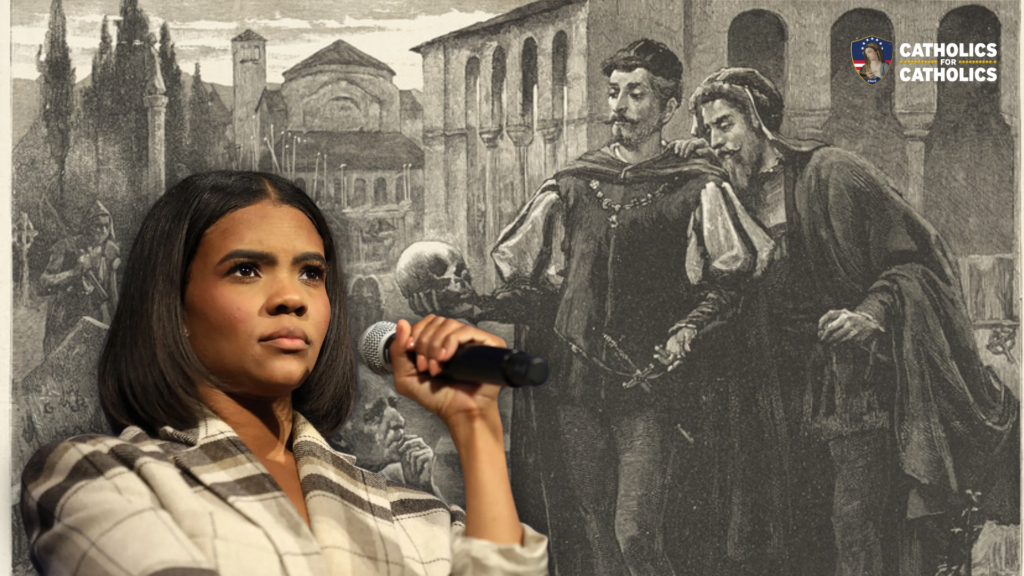
The similarities between the play Hamlet and Candace Owen’s response to Charlie Kirk’s death are uncanny and may help some understand the dynamics of her investigation into Charlie’s death. It may also help people understand the truly Christian approach Candace and others are taking.
When we first meet prince Hamlet, he is distraught because he suspects foul play in respect to the recent death of his father. His suspicions arise because neither the new King–his father’s brother, his uncle Claudius, nor his mother Queen Gertrude — who has married King Claudius only a month after his father’s death, properly mourn the death of his father. Indeed, the first speech Claudius makes refers to “mirth in funeral” and “dirge in marriage” and weighting “delight and dole”. Hamlet notes that “The funeral baked meats/Did coldly furnish forth the marriage tables”. King Claudius thanks the court for going along with this affair. Queen Gertrude, speaking of death as a common thing, chastises Hamlet for his excessive grief. Hamlet responds that his funereal garb, his sighs and tears, are not for show (suggesting that any signs of grief by the King or the Queen are pretense). King Claudius reiterates the Queen’s point: fathers die: get over it.
That beginning matches well Candace’s sense that Charlie’s closest friends at TPUSA have not exhibited sufficient signs of grief at Charlie’s death: the whole outfit seems determined not to miss a step in their enterprise but rather to use Charlie’s death to deepen the coffers of the organization. In the early episodes of Candace’s investigation, she repeatedly expressed distress that those at TPUSA showed no interest in investigating the many suspicious circumstances of Charlie’s death (the list is very long and can easily be found through a Grok search.) The memorial service for Charlie had as much “mirth” as “dirge” , as much “delight as dole”; in fact, with all the fireworks and selling of merch, the celebration of Charlie’s life seemed more to be a celebration of his death — We have been so blessed by Charlie’s death! Money is flowing in! Numbers are growing!
While initially Candace did not suspect Charlie’s wife, Erika, of having anything to do with Charlie’s death, Erika’s behavior in subsequent months and discoveries of her curious and complicated past, have made Erika a chief suspect in the minds of many. Like King Claudius and Queen Gertrude, Erika immediately gained power: she became the leader of TPUSA, a role which she has embraced, it seems, as much for the spotlight it puts upon her as anything else (witness her sexy outfits, sequins and all). Candace recently disclosed that at Charlie’s funeral, TPUSA staff employed the offices of a priest close to Erika to groom a wealthy potential donor.
Candace has been much maligned for doggedly attempting to discover who really killed her dear friend Charlie. While the implausibilities of the official narrative, and the peculiar, not to say, deplorable behavior of TPUSA personnel, have been the chief impetus for her zealous investigation, she also believes that Charlie, in a dream, told her that everyone, EVERYONE, betrayed him. Candace deniers have latched onto what they perceive as a ridiculous fantasy on her part to mock her and dismiss her investigation.
Shakespeare provided Hamlet with a bit more credibility because he has others see the ghost of Hamlet’s father before the ghost appears to Hamlet. Establishing credibility in Shakespeare’s time does not seem all that necessary since the characters in the play and — one supposes –Shakespeare’s audience, accepted the possibility that the dead could appear to the living and give them tasks to perform. Hamlet’s father revealed the circumstances of his death and implored him to avenge his death – it was not a garden snake who deposited the lethal poison into his ears as he napped in a garden, but the snake Claudius who did so.
The ghost that appeared to Hamlet appeared to him twice, once to implore him to avenge his death and to leave Gertrude alone and then again to implore him to stop delaying and to remind him to leave Gertrude alone. Although Hamlet promised his father he would proceed with haste, Hamlet delays. He uses as a reason for his delay that he wants to verify his father’s claim.
Hamlet, after having confirmed Claudius’s guilt (by showing him his crime in a play), has an opportunity to kill King Claudius when he finds him at prayer. In my opinion, the prayer said by Claudius makes for one of the most remarkable scenes in all of literature: Claudius’ conscience bothers him: he knows he has done wrong; he wants to repent, but he realizes repentance is without merit unless he is willing to divest himself of whatever benefits he has obtained from his foul deed. Claudius does not want to give up the kingship or Gertrude. Hamlet, however, infers Claudius is repenting from his sin of murder and decides not to kill him at that moment: he does not want to be responsible for sending Claudius to heaven. Hamlet does not want his uncle to fare better than his father who has made it clear he is headed for purgatory.
The irony is that Claudius does not repent; after Hamlet exits, Claudius arises from prayer without having repented: “My words fly up, my thoughts remain below: words without thoughts never to heaven go.” (“Thoughts”, here, means a determination to reform.)
As a consequence of his failure to repent, Claudius becomes more murderous, more duplicitous, and attempts to arrange for the death of Hamlet. Hamlet, because of the delay caused by his desire that Claudius go to Hell, is ultimately responsible directly or indirectly for the deaths of Polonius, Ophelia, Queen Gertrude, Rosencrantz and Guildenstern, Laertes, King Claudius and himself. The pile of corpses at the end of the play, arranged nicely on a stage, show what happens when one leaves evil unaddressed.
Similarly, the net that Candace has woven will catch many at TPUSA who may have escaped had they not participated in the cover-up.
A constant feature of the play Hamlet are the attempts of the characters to learn what others are thinking and doing, by eavesdropping on them, sometimes with disastrous consequences for the eavesdropper. Polonius’ eavesdropping on Hamlet’s confrontation with his mother results in Hamlet, in the mistaken belief that the shape behind the curtain is King Claudius, killing Polonius.
The equivalent to the eavesdropping scenes in the Kirk case are the text messages that Candace herself received or have been sent from whistleblowers within TPUSA. She uses what could be interpreted as an “entrapment” technique wherein she presents information that implicates people at TPUSA. Time and time again, those implicated deny what Candace attributes to them and she produces the “receipts”: for instance, emails where Charlie explicitly said something that may shed light on his death, such as his decision to break with Israel – by turning down $150 million. Having been shown to be liars, the liars at TLPUSA squirm and obfuscate by making some lame excuse for not having acknowledged what is manifestly the case.
Yet, Candace not only wants to catch the liars out: she also has a genuine concern for the souls of the liars. She seems genuinely to want those at TPUSA to repent and calls for them to examine their consciences (a constant refrain in Hamlet as well): she regularly asks: “How can you sleep at night?!”
Another podcast sleuth who reports on the Kirk case (and there are many) is Baron Colemen, a devout Catholic, a lawyer, a father of eight, who has given up lawyering to devote himself to his podcast. Before Charlie was assassinated, Coleman had about 300 followers; a few months later he had over 100,000. Now he has nearly 200,000.
Coleman is appealing for several reasons – he is smart, knowledgeable, balanced, hilarious, quirky and willing to work collaboratively with other podcasters. They are worth watching if only for his carefully crafted and thought provoking “opening statements.” These recount some historical incident that tie in with his commentary of the day usually by illustrating a truth we just might miss or have trouble believing. As does Candace (who tells us when a priest friend –“the priest” –admonishes her to clean up her language and “chill), Coleman regularly mentions that he is a Catholic, that he goes to daily Mass, and that he overcame fear from crippling anxiety when he decided to trust the Lord radically. He looks directly into the camera and challenges the manifest liars at TPUSA to repent — since he knows that they know better. In a most natural way, he asks his listeners to pray for those at TPUSA who are covering up the truth and prospering because of it and also promises to pray for his listeners who disclose the various challenges they face.
Coleman finds Ericka Kirk’s self-presentation so bizarre and without natural human elements that he theorizes that she may have been abused or programmed through some MKUltra program and is possibly now in the power of the devil. As more is disclosed about Erika’s past, he has come to the conclusion that Ericka might have been very much involved in the death of Charlie.
We really must pray for her – she seems to be in the grip of something very evil.
I don’t think I have missed one of Coleman’s podcasts or any of those by Candace since Charlie died. Most people don’t know that there are perhaps dozens of podcasters who nearly daily have new facts and/or theories on how Charlie died and who did it – and not many of them are more bizarre than the truth is likely to be. Candace’s podcast is now the most popular in the world: many of us find her reporting riveting and entertaining – more so than any series we have watched on TV.
The fact is that Candace and a large contingent of other podcasters have discovered mountains of information that challenges the official narrative, beginning with the nearly unanimous consensus that Charlie could not have been killed with a 30-06 bullet. There is a plausible claim to be made that it was an explosive mic that electrocuted Charlie. The behavior of Charlie’s security guards and TPUSA personnel before, during, and after the execution suggest strongly that they were in on it. There is evidence Mossad was involved, evidence that the ministers associated with TPUSA are in the back pocket of Israel and, even worse, that they are involved in sexual trafficking of children. Believe me, the evidence deserves consideration.
But perhaps the most well-documented piece of evidence that something is rotten in TPUSA is the fact that podcast auditors have found mountains of financial corruption at TPUSA. Right before his death, not only was Charlie determined to sever TPUSA from Israeli funding, but he also wanted a full DOGE audit of TPUSA finances. Upon assuming the leadership of TPUSA, Erika immediately took the money from Israel and cancelled the audit.
I get frustrated with those who dismiss Candace and others although they have watched almost nothing of her show or so little that they truly have no idea of the case she is making. They hear something they think ridiculous and summarily dismiss her claims. People have no obligation to watch any of it, but while they think she speculates beyond known facts that is precisely what they are doing.
If you don’t believe Candace perhaps you don’t know enough about how the guilty behave and to what length dedication to a murdered loved one will drive someone to expose evil done, I recommend you read or reread Hamlet. And suspend your disbelief about Charlie Kirk’s death until all the evidence is in.