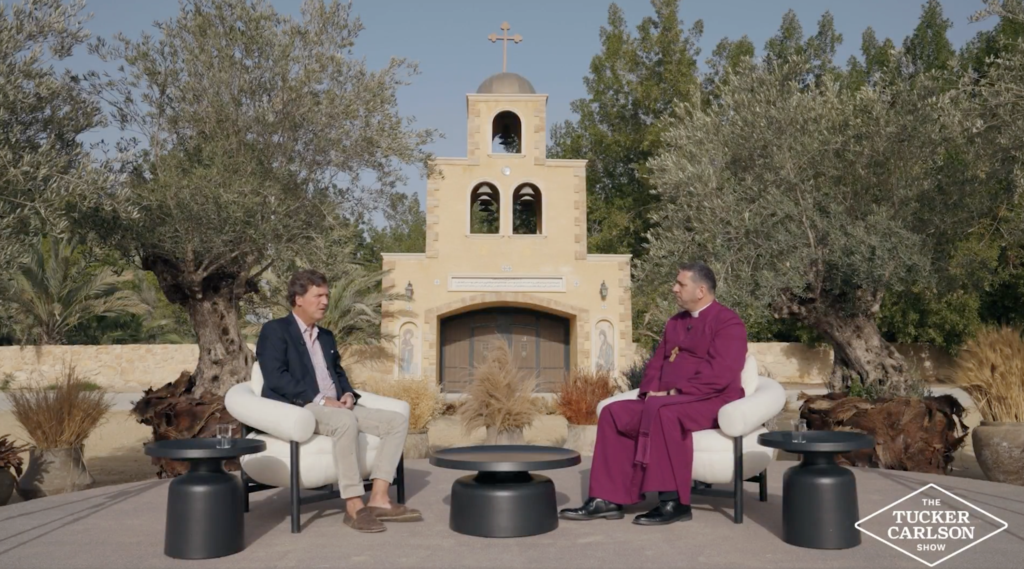
This week, Tucker Carlson published an episode featuring interviews in the country of Jordan with two Christians: the Archbishop of Jerusalem for the Anglican Church and a successful Christian businessman living in Jordan.
Many American viewers might be surprised to hear about the increasing restrictions on Christians in the Holy Land, the discrimination experienced in Jerusalem compared to neighboring Arab nations and even Gaza, and that much financial support to historic holy locations such as the tomb of Jesus and the site of the nativity has generously come from Jordan’s King Abdullah II, a Muslim.
How does the US-funded Israeli government treat Christians in the Holy Land? We asked some. Listen carefully to their accounts. This will shock you.
— Tucker Carlson (@TuckerCarlson) February 5, 2026
(00:00) Monologue
(05:28) How Are Christians Doing in the Holy Land?
(16:57) Do Christians in the Holy Land Receive Support From… pic.twitter.com/3i1LP3BRcs
Archbishop Hoam Naoum
Archbishop Hosam Naoum is a native Israeli. He was born in Nazareth and is the son of a carpenter. He says when he tells people he is a Christian from Nazareth, many ask him when he converted due to the fact that he is Arab. He laughs and says, “2,000 years ago,” for this is where his family is from.
Archbishop Hosam spoke to Tucker about the declining number of Christians in the Holy Land. The Christian population is at best maintaining a presence – certainly not thriving. He cited 1948, the year that the state of Israel was created, and 1967, when the Six-Day War occurred, as two events that presented serious challenges for Christians because so many were expelled from their homeland.
Tucker and the archbishop discussed how Americans have a tendency to automatically associate Palestinians with terrorism; Archbishop Hosam said this is “demonizing” and of course, untrue. “This is like a kind of killing the image of the Palestinian people by claiming that they are terrorists or they are uncivilized or they are savages,” he said, and it amounts to “pushing an agenda where they just want to frame you so that Palestinians lose sympathy in the world.”
Many American Christians supporting the state of Israel are ultimately dismissing their brother Christians, perhaps unknowingly, according to Archbishop Hosam. He says that the money coming from the west sometimes enables Jewish settlers to confiscate land from Christians. When the archbishop told another Christian about this while visiting London with a youth group, he was stunned when this person told him that sometimes we – referring to the Christians whose land is confiscated by Jewish settlers – need to sacrifice for the greater good. The youth group visitors “were in tears” after hearing this.
The archbishop said the Christian people are in this way viewed merely as a “means.” This of course runs contrary to the fundamental Catholic belief that every human must be treated with equal dignity.
Archbishop Hosam said the support that the Christians of the Holy Land receive from Christians around the world is a “drop in the ocean” compared to the support lent to the Jewish population of Israel. “The little town of Bethlehem is bleeding right now,” he said.
As the years have gone on, Christians face increasing difficulty in accessing sites such as the Holy Sepulchre to celebrate occasions such as Easter. This is because the Israeli government controls who can visit these sites. The archbishop told Tucker that safety concerns are often cited, sometimes due to the physical instability of some of these sites. But he did not seem convinced that the restrictions on Christian visitors are purely out of concern for the well-being of pilgrims.
The archbishop also cannot visit his Anglican hospital in Gaza that is managed by the Episcopal Church – again, due to restrictions from the Israeli government. He has been trying to receive permission to visit with no success, even though he is an Israeli citizen by birth. Asked by Tucker if he would feel unsafe going to Gaza, he said “absolutely not.” The Al-Ahli Arab Hospital has been bombed multiple times by the Israelis.
Discussing the 70,000+ Palestinians that have been killed, many women and children, Archbishop Hosam is heartbroken that “nothing will heal” after the amount of “destruction and death” that has befallen the region.
The archbishop says that quite routinely, he is spat at in the streets of the Old City of Jerusalem when he is wearing his cross and cassock. “Shameful things” done by vandals and harassers are caught on camera at Christian churches. Archbishop Hosam emphasizes that this is part of a fringe element that essentially views the Christian cross as a reminder of persecution and expulsion. Every religion has extremists, Christians and Muslims included. The agenda of these Jewish radicals, however, is not a conspiracy or a secret – their main mission is to purify Jerusalem from infidels.
Compared to Jerusalem, Archbishop Hosam says he feels more at home in Jordan and Lebanon than Israel. His message to Christians around the world is that we are all God’s children; we must pray for all of the people of the Holy Land – Muslim, Christian, Jew – and we must preserve the holy sites.
Saad Mouasher
Tucker also sat down with Saad Mouasher, a well-known Christian who was born in Jordan and currently serves as the chairman of Jordan Ahli Bank. Christians only make up about 2-4% of the population of Jordan, but they are disproportionately successful economically in the country. Mouasher says that Christians there have always felt “one and the same” with the Muslims who are an “integral part” of the culture.
Mouasher describes feeling incredulous and even upset when his American friends are surprised to learn he is a Christian from Jordan. “I mean, this is where Christianity started, right?” he says. “We are the ancient Christians,” and Jesus Christ was baptized right in the Jordan River.
Mouasher characterizes the relationship between Muslims and Christians in Jordan as one of respect – never discrimination, even though debates and discussions on theological topics may occur. In his view, Jordan is a collectivist culture, and the nation has a long history of patiently absorbing refugees. The semi-frequent incursions of refugees, however, certainly puts additional stress on the water, energy, and job resources of a country that is not inherently rich.
Indeed, it was Pella, Jordan, that welcomed the very first wave of Christian refugees facing Judean persecution in the first century.
Mouasher says the efforts of King Abudallah II to financially support and restore the Holy Sepulchre is a great example of the “interfaith story” that is inherent to Jordan’s culture.
Tucker believes that when the capital of Israel was moved from Tel Aviv,” a city of recent creation,” to Jerusalem, a city that “long predates the state of Israel, that Jerusalem changed from an international holy site to a kind of government garrison” and that is not good for Christians.
Mouasher recalled conversations with his grandfather about the Jerusalem of the 1920s and 30s in which Muslims, Christians, and Jews formed a very united community.
“That’s the Jerusalem that I think all of us long for…a united Jerusalem. One that’s united for
all faiths.”
Save and Share This Catholic Patriotic Minute!