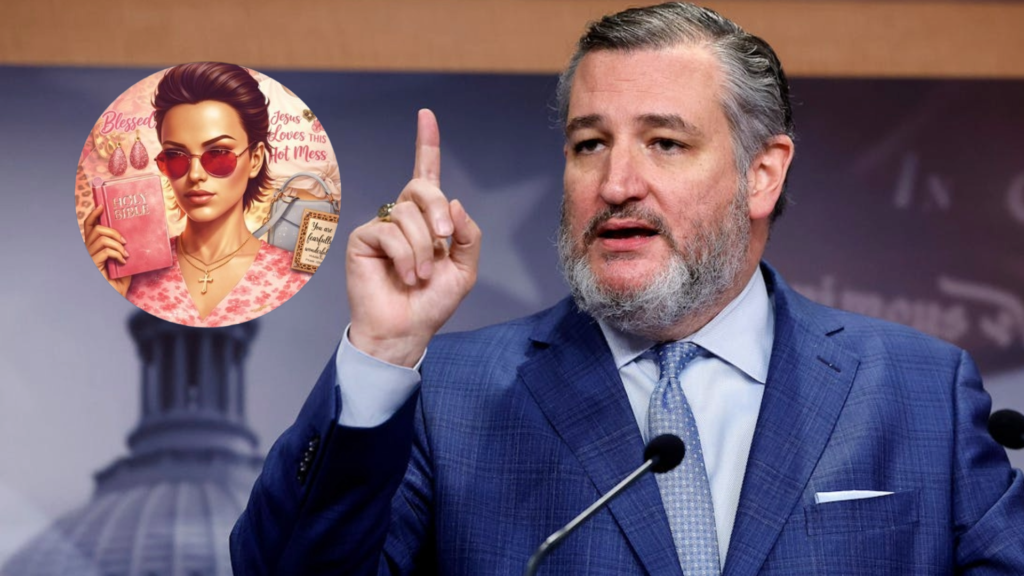
Texas Senator Ted Cruz endorsed an article which attacks traditional Catholics who are politically active as “the best & most comprehensive explanation of what we’re fighting.”
Senator Ted Cruz is a Zionist who uses the phrase “those who bless Israel will be blessed” to justify political support for Israel, even though historical translations of the Bible do not actually mention Israel as a political nation in that verse (Genesis 12:3). Catholics believe that “Israel” refers to the Church as the people of God, not a modern political state. (Read more: The Catholic View on Zionism and the 1948-State of Israel.)
This anti-Catholic manifesto posted by an account on X known as “Insurrection Barbie” conflates several issues, and even implies Pope Francis to be the current pope, leading many to wonder if this article was written in large part by artificial intelligence (AI).
The author asserts that “evangelical Protestant Christians” have controlled the Republican party for 70 years, and that if this changes – referring to increased Catholic influence – “you have a different party. Not a party with different policies. A party with different gods.” This is a stunning statement for Cruz to endorse – that Protestants and Catholics have “different gods.”
The author claims the Zionist view entirely, with no caveats:
“You cannot dismantle evangelical political power without first delegitimizing evangelical theology. The movement’s entire political architecture rests on a theological claim: that God made an eternal, unconditional covenant with the Jewish people, that the modern state of Israel is a fulfillment of biblical prophecy, and that Christians who ‘bless Israel’ are obeying a direct divine command. Remove that conviction and you remove the moral engine that has driven evangelical political engagement for half a century.”
READ every word of this.
— Ted Cruz (@tedcruz) March 15, 2026
It's the best & most comprehensive explanation of what we're fighting. @DefiyantlyFree https://t.co/EYeYBWEM46
A subtitle of the article claims “This Is Not About Catholicism or Regular Catholics but about Political Catholic Integralism,” and yet the term Catholic/Catholicism appears 59 times.
“The 70 million American Catholics who go to Mass on Sunday, vote their conscience, pay their taxes, coach Little League, and have been reliable partners in the pro-life movement for fifty years are not the subject of this investigation,” the author writes. “They are, in a real sense, among its victims.” Historians and even modern, a-religious political commentators acknowledge that it has always been the Catholics that have led the pro-life charge – not mere partners on the bandwagon. The Catholic Church has stuck its neck out on key issues such as abortion, IVF, surrogacy, birth control, and more where other denominations have had mixed approaches or even refused to make firm judgements.
The winding article connects SSPX and traditional Latin Mass goers to antisemitism dating back to the pro-Nazi Vichy government of France and openly dismisses the testimonies of multiple Christians interviewed by Tucker Carlson over the past several months who live in the Holy Land and speak with concern about what’s happening to the Christian population, particularly with regard to recent Israeli government actions.
Without any explanation, the author speaks about American Catholics who act politically in the same breath as Nick Fuentes and “Groypers” – a term that loosely refers to alt-right, white nationalists with insurrectionist inclinations. In putting these groups together, the implication is that Catholics who express concerns about unequivocal political support for the government of Israel – particularly when based in a theological perspective as many Zionists do – are unavoidably adjacent to hateful anti-semites.
The author bemoans that young evangelical men in particular are being drawn to Catholicism, and in the process, no longer feel a moral obligation to the Israeli government’s actions:
“The pattern has been documented: young men raised on the certainty that the Bible provides complete answers encounter arguments they cannot immediately rebut, lose confidence in their evangelical framework, and begin searching for more authoritative tradition. What gets discarded in that exchange, reliably, is the evangelical conviction that God’s covenant with the Jewish people remains active and that Christians are obligated to stand with Israel.”
The article continues at length on topics like sola scriptura, various political commentators like Tucker Carlson, Steve Bannon, and Candace Owens, the “Trad-Catholic Online Pipeline,” and more, but in a perhaps massive oversight, the author does not realize that they have painted the picture of the reality of Christian politics too clearly: young Americans are increasingly turning away from sola scriptura and towards more traditional liturgies and doctrine, which inevitably often leads them to the Catholic Church. The main problem, however, is not the distancing from evangelical theology itself, but from the severed cord to the political state of Israel.
If looking at this situation objectively, the political transition away from Israel should not actually be a threat to American politics, or even the Republican Party, which theoretically should be primarily concerned with issues on the homefront. Why, then, is the distancing from a modern, foreign government being framed as a fundamental threat to the future of conservative politics, and the United States itself?
Critics of this anti-Catholic manifesto, endorsed by Senator Ted Cruz, are quick to point out that this latest attack on conservative dissenters seems to demonstrate further how influential Israeli government and lobbyists are within our own borders.