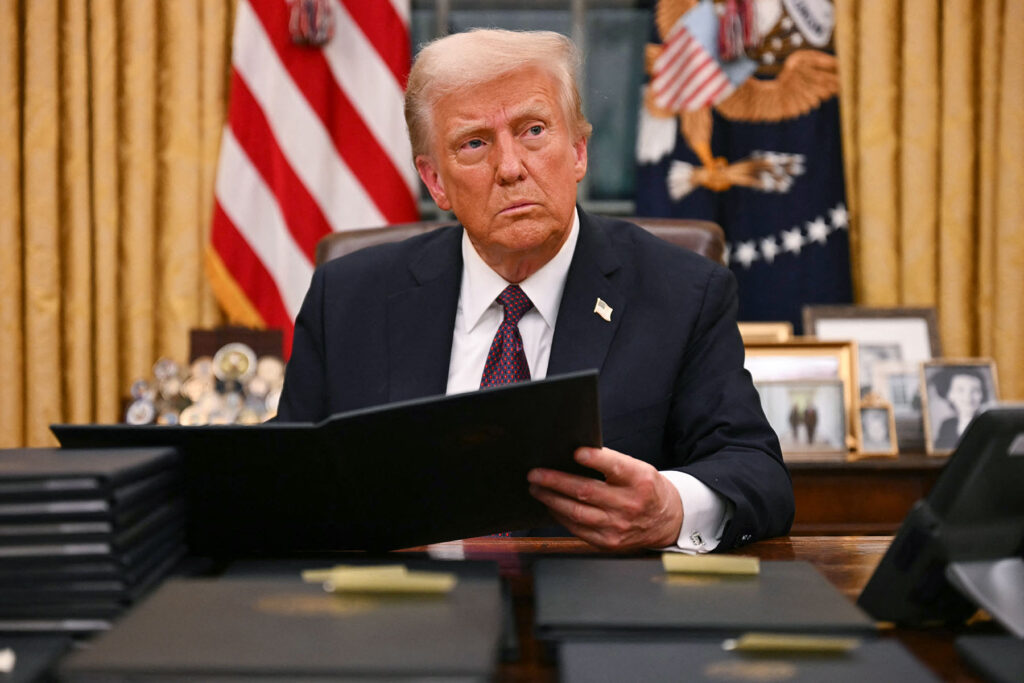
The President was present at the Supreme Court but left partway. The issue is if his instructions can restrict birthright citizenship in the U.S.
By Catholics for Catholics
Though President Donald Trump was present and attentive to their every move, U.S. Supreme Court justices showed skepticism on Wednesday toward the legitimacy of his instructions to restrict birthright citizenship in the U.S., which is part of his hard-hitting immigration tactic.
Trump’s attendance to the top U.S. judicial body was historic, as he donned his trademark red tie and dark suit and sat in the front row of the gallery of the opulent courtroom after arriving by motorcade from the White House, according to a story by The New York Post. But midway through the proceedings he left not long after the Justice Department lawyer arguing for his administration finished his presentation.
On Wednesday, before the Supreme Court a question was raised about whether Trump can do that based on the 14th Amendment and statutory law, namely the Nationality Act of 1940. GOP-appointed Justice Brett Kavanaugh repeatedly questioned why the high court should even get to the constitutional question when there’s a statute involved.
🚨 BREAKING: President Trump said he is GOING to the Supreme Court when they hear the birthright citizenship case tomorrow
— Nick Sortor (@nicksortor) March 31, 2026
Wow!
This could truly be THE most important case in modern US history—and 47’s taking it seriously
No more anchor babies! pic.twitter.com/e5BZZzk0ws
“Our usual practice, as you’re well aware, of course, is to resolve things on statutory grounds and not to do a constitutional ground,” Kavanaugh noted at one point.
Halfway through the oral arguments Trump, who was joined by Attorney General Pam Bondi, left the Supreme Court. Nevertheless, it was not clear if it was due to irritations with how arguments were going or his hectic schedule.
What is clear is that all three of the Democrat-appointed justices looked unconvinced of the Trump administration’s arguments in defense of the executive order. Whereas the six Republican-appointed justices sounded diverse, with Justices Samuel Alito and Clarence Thomas appearing approving to the administration and the others asking tough questions of both sides.
Often seen as one of the more kept back judges who asks few questions, John Roberts, is viewed as a pivotal swing vote. So, his rough questions of US Solicitor General John Sauer were noteworthy, though the chief justice did grill American Civil Liberties Union attorney Cecilia Wang aggressively as well.
Save and Share This Catholic Patriotic Minute!