The Catholic Patriotic Minute #54: St. Kateri Tekakwitha
Catholics For Catholics Special Edition | July 14th, 2026
Saint Kateri Tekakwitha: America’s First Native American Saint
In 1656, Kateri Tekakwitha was born in the Mohawk village of Ossernenon, in present-day Auriesville, New York. Her name at birth was Ioragode, which translates to “Sunshine.” Her mother was a Catholic Algonquin, who was captured and moved to Ossernenon. There, Ioragode’s mother had married a Mohawk chief, with whom she shared two children.
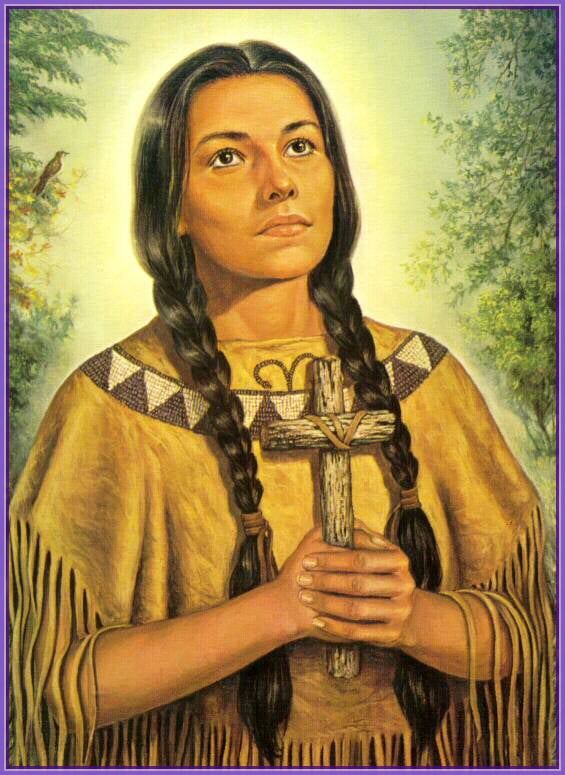
At the age of four, Ioragode faced a smallpox outbreak raging through Ossernenon. While her parents and brother were killed by the epidemic, Ioragode survived it. However, smallpox left her with a scarred face and eyes almost completely blinded. Ioragode’s name changed to Tekakwitha, which means “she who bumps into things,” because her eyesight did make her literally bump into things.
Tekakwitha was adopted by her aunt. In 1666, Ossernenon was pillaged, and so Tekakwitha’s family and the remaining Mohawk resettled in the village of Caughnawaga, which is now located in Fonda, New York. Despite her nearly blinded vision, Tekakwitha practiced basket weaving, beadwork, and making clothes.
Beginning in the year 1666, Jesuit missionaries were permitted into Mohawk settlements due to a peace treaty with the French. While Tekakwitha served food to the Catholic priests throughout her teenage years, she listened to their conversations about God, and she observed them perform their religious practices. She felt drawn to their Catholic faith.
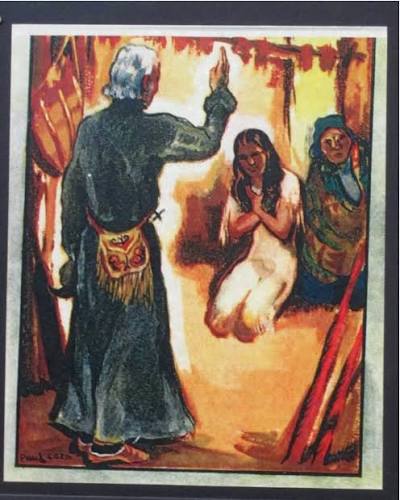
Although Tekakwitha was engaged to a boy when she was thirteen years old, as was according to the Iroquois tradition, she opposed the arranged marriage. Her aunts attempted to push her into marriage in the subsequent years, but Tekakwitha remained adamant in her refusal.
As she came to know God through her encounters with the Jesuit priests, Tekakwitha became more and more sure of the desires God the Father placed on her heart. Later, she explained to a priest, “I can have no spouse but Jesus.” Young Tekakwitha only saw Christ as her Bridegroom and later became a consecrated virgin.
Reluctantly, her anti-Catholic adoptive uncle allowed Tekakwitha to become baptized if she stayed in Caughnawaga. At the age of eighteen, she began her education in the catechism, with Fr. Jacques de Lamberville, a Jesuit priest, as her teacher.
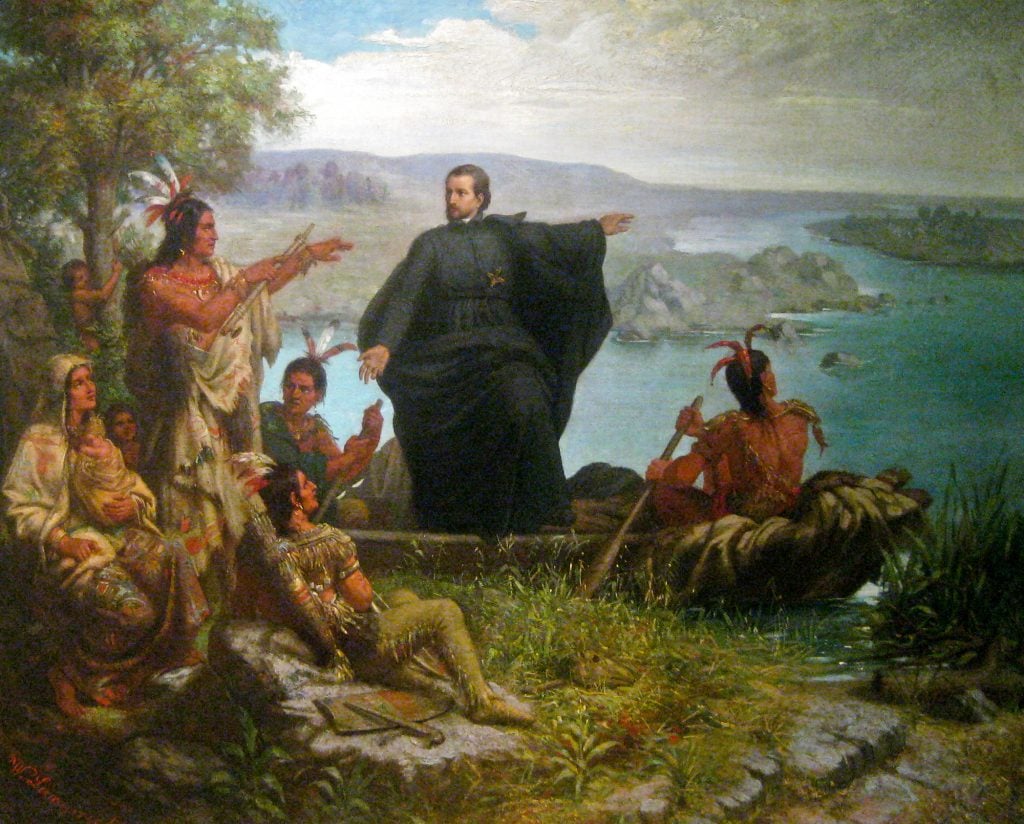
Tekakwitha was baptized Catholic on Easter Sunday 350 years ago in 1676, in Saint Peter’s Chapel. Her baptismal name was Catherine, because of her veneration of Saint Catherine of Siena. She adopted the Mohawk version of her baptismal name, Kateri.
Later, Father de Lamberville wrote of Kateri, describing her as mild-mannered and noting that she endeavored to love God her Father in her everyday life, in spite of the challenges enforced by the Mohawk. Weekly, Kateri observed the Sabbath. However, because she refused to work on Sundays, the Mohawk forbade Kateri from eating food on Sundays as a result. Although most of her time was spent in prayer, Kateri’s conversion and her unceasing insistence on rejecting marriage made her enemies among the Mohawk. Her Mohawk community in Caughnawaga no longer welcomed Kateri, Catholic and unmarried. It became dangerous for Kateri to stay.
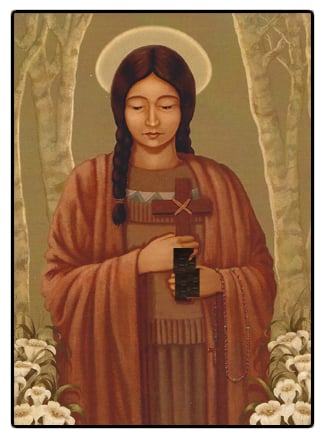
In 1677, encouraged by her priest, Kateri left Caughnawaga and traveled two-hundred miles to a Catholic Native settlement, called the Mission of Saint Francis Xavier, in present-day Montreal, Québec, Canada. Kateri received her first Communion on Christmas Day of the same year. The Jesuits admired her devotion to the Blessed Sacrament. Often at sunrise and sunset, Kateri attended Mass. She walked in the woods to pray alone.
She informed a Jesuit priest, “I have deliberated enough. For a long time, my decision on what I will do has been made. I have consecrated myself to Jesus, Son of Mary. I have chosen Him for husband, and He alone will have me for wife.” Kateri made a vow of perpetual virginity on the feast of the Annunciation in the year 1679. For the short remainder of her life, she instructed children in religion and prayers, and she gave aid to the ill and elderly.
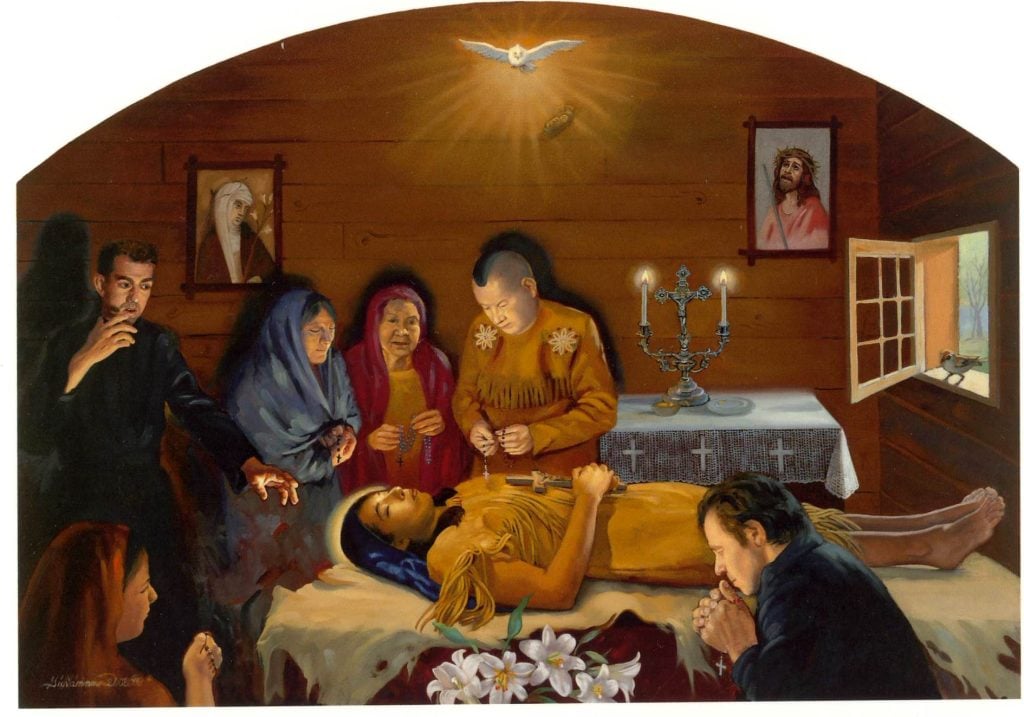
On April 17, 1680, on Holy Wednesday, Kateri died of tuberculosis. Her last words were “Jesos Konoronkwa,” which translates to “Jesus, I love you.” It is reported that her facial scarring disappeared after her death, and she is said to have appeared to two friends, Anastasia Tegonhatsiong and Marie Thérèse, as well as Fr. Claude Chauchetière, in the following weeks.
Two centuries later, in 1884, at the Third Plenary Council at Baltimore, U.S. bishops signed a postulation brief, sending the cause for Kateri Tekakwitha’s canonization to Rome for consideration. On June 22, 1980, Pope Saint John Paul II beatified her.
In his June 1980 address, Pope Saint John Paul II said,
My brothers and sisters, may you be inspired and encouraged by the life of Blessed Kateri. Look to her for an example of fidelity; see in her a model of purity and love; turn to her in prayer for assistance. May God bless you as he blessed her. May God bless all the North American Indians of Canada and the United States.
Pope Benedict XVI canonized Saint Kateri Tekakwitha, on October 21, 2012, making her the first Native American saint in America.
At her canonization, the Holy Father stated that Saint Kateri’s holiness was rooted in the ordinary. He said, “[l]eading a simple life, Kateri remained faithful to her love for Jesus, to prayer and to daily Mass.” During his October 2012 address, he exclaimed, “Saint Kateri, Protectress of Canada and the first native American saint, we entrust to you the renewal of the faith in the first nations and in all of North America! May God bless the first nations!”
U.S. Catholics honor Saint Kateri Tekakwitha on her feast day, July 14, the anniversary of her departure from her Mohawk village to live as a Catholic without persecution.
For more Catholic Patriotic Minutes, visit CATHOLICUSA.COM
Save and Share This Catholic Patriotic Minute!