The Catholic Patriotic Minute #61: Saint Mother Teresa
Catholics For Catholics Special Edition | August 31st, 2026
Saint Mother Teresa: A Model of the Good Samaritan for Americans
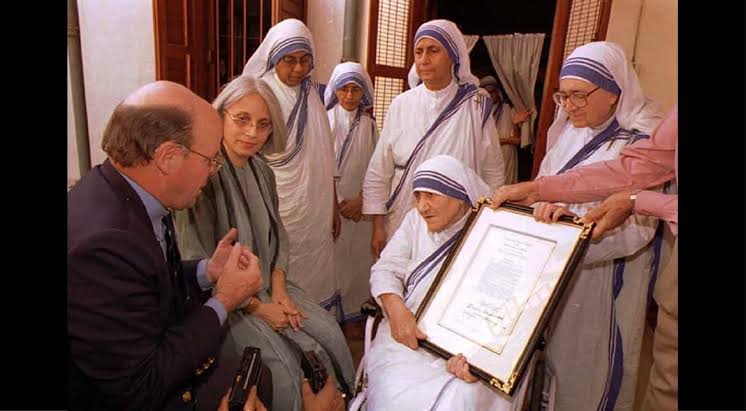
Mother Teresa was the fifth person to be made an honorary United States citizen in our nation’s history. While she received her citizenship papers on November 16, 1996, Mother Teresa told the U.S. ambassador, “[t]his is a gift of God. I am afraid I am not worthy of it.”
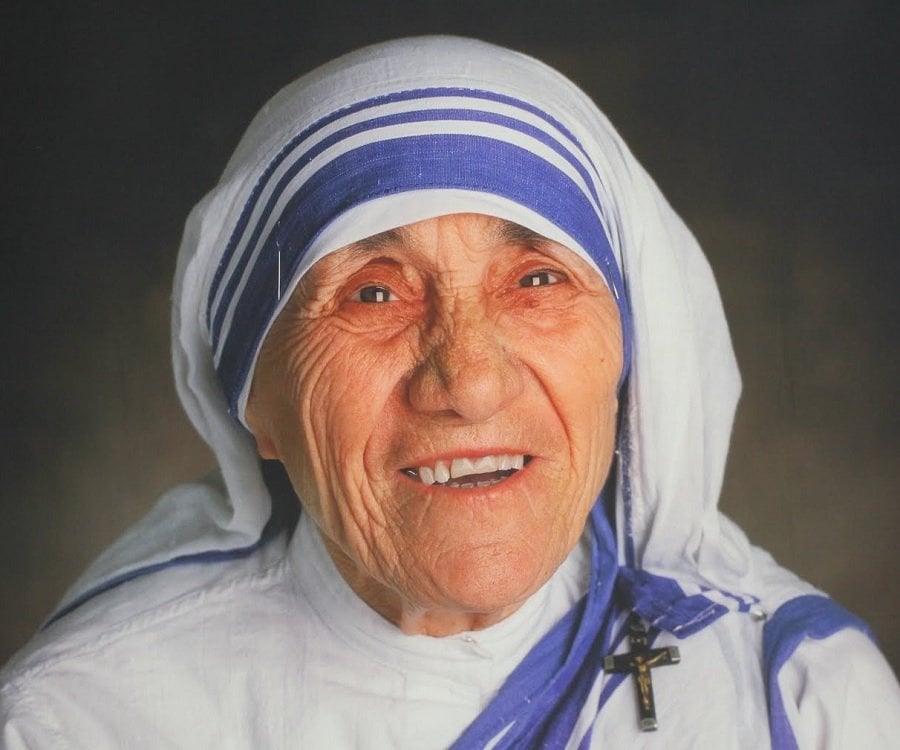
On August 26, 1910, Gonxha Agnes Bojaxhiu was born in Skopje, North Macedonia, into an Albanian family. The youngest of five, Gonxha received her Holy Sacraments and her spiritual formation from the Jesuit parish of the Sacred Heart. By the time she was eighteen, Gonxha decided she was becoming a missionary.
In September of 1928, she entered the Institute of the Blessed Virgin Mary, known now as the Sisters of Loreto, in Ireland. Her name, Sister Mary Teresa, was chosen in honor of St. Thérèse of Lisieux. She left Ireland for India, making Calcutta her new home in January of 1929.
Starting in May of 1931, Sister Mary Teresa taught at St. Mary’s School for girls and became the principal in 1944. In May of 1937, she made her Final Profession of Vows. From here on out, she was called Mother Teresa.
During a train ride from Calcutta to Darjeeling on September 10, 1946, Mother Teresa experienced what she would call a “call within a call”, her “inspiration.” On the train, she reflected on Christ’s dying words, “I thirst.” All of a sudden, she understood God’s call for her to serve the poor. At this moment, Mother Teresa later said, “I abandoned myself totally to God, and He guided me.”
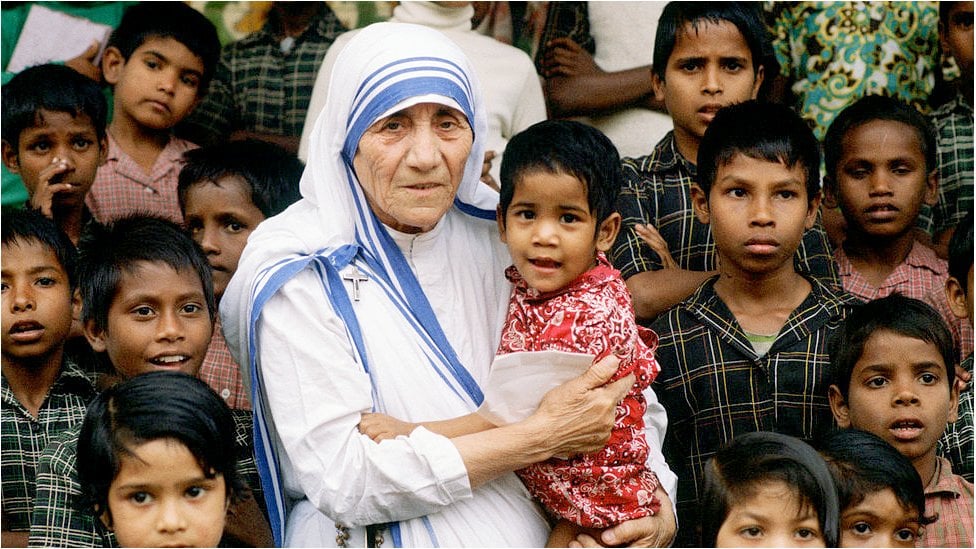
In the following months, Christ unveiled to her in prayer his desire for her to “radiate His love on souls.” He told her, “Come be My light. . . I cannot go alone.” Surrendering to his call, Mother Teresa founded her own religious community, Missionaries of Charity, with a mission to serve the poorest of the poor. On August 17, 1948, she left her convent in Loreto, dressed in her white, blue-bordered sari and armed with her new mission.
Temporarily, she lived with the Little Sisters of the Poor. She nursed the sick and hungry in the slums. Every day, she attended Mass and then sought out people to serve, with her rosary in hand. Eventually, some of her former students joined Mother Teresa.
The Missionaries of Charity became an official congregation in the Archdiocese of Calcutta in October of 1950. The missionaries began opening foundations throughout India and in Venezuela. By the 1990s, they established their centers on every continent, even in communist countries like the former Soviet Union, Albania, and Cuba.
Mother Teresa founded the Missionaries of Charity Brothers, the Contemplative Brothers, and the Missionaries of Charity Fathers for the religious, and for lay men and women, she established the Co-Workers of Mother Teresa and the Sick and Suffering Co-Workers.
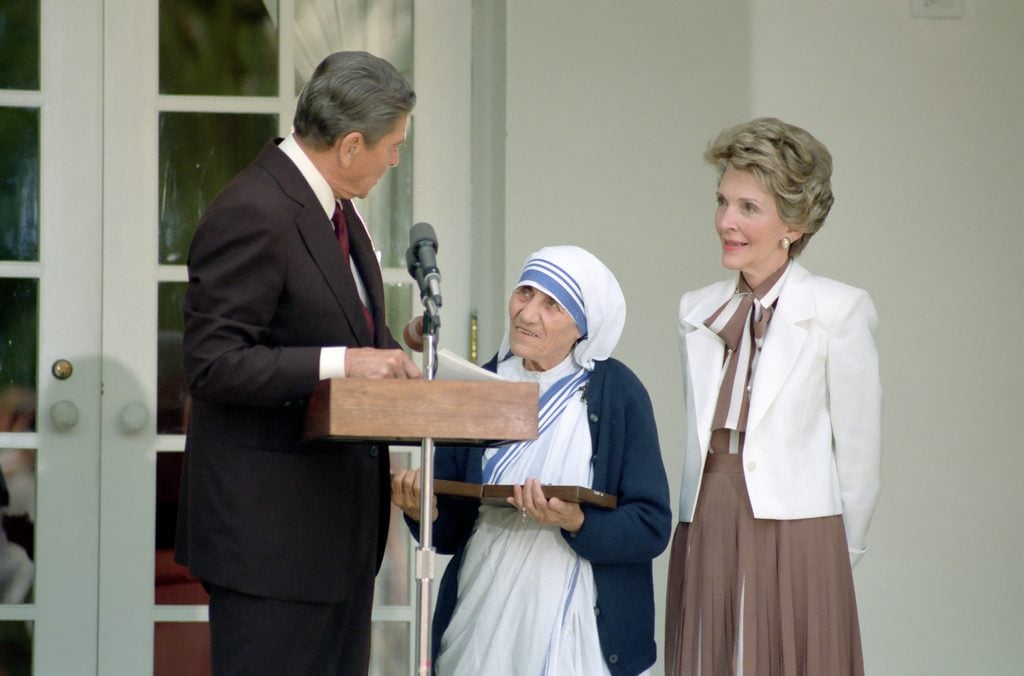
On June 20, 1985, President Ronald Reagan presented Mother Teresa with the Presidential Medal of Freedom for her work serving the poor. The President joked, saying, “[m]ay I say that this is the first time I’ve given the Medal of Freedom with the intuition that the recipient might take it home, melt it down and turn it into something that can be sold to help the poor.
In a more serious manner, he commended her work by stating, “[a]nd I want to thank you for something, Mother Teresa. Your great work and your life have inspired so many Americans to become personally involved, themselves, in helping the poor.”
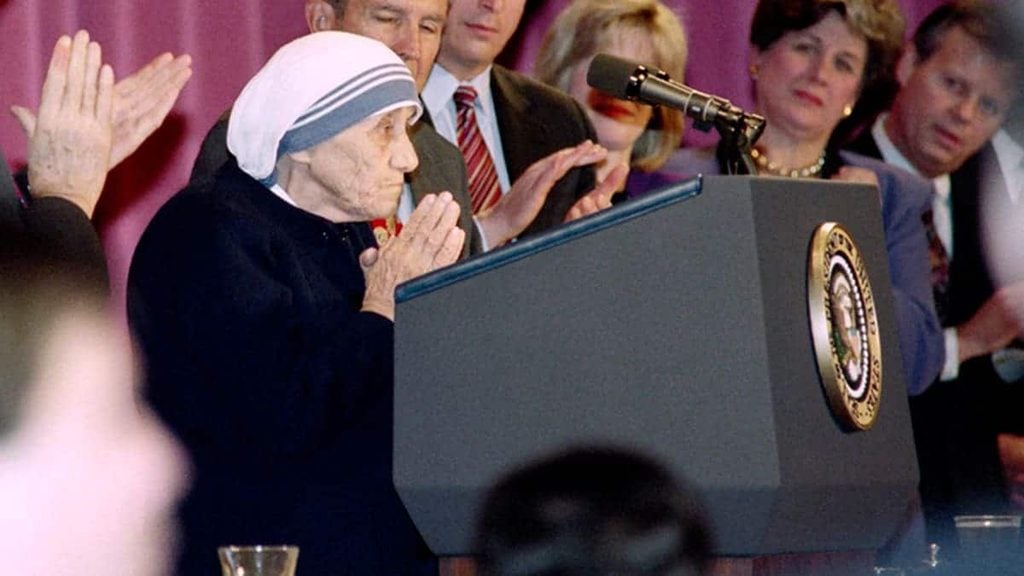
Her care for the poor exhibited to the poor themselves and to observers the inherent dignity of every human life–including the homeless, the sick, and the unborn. On February 3, 1994, Mother Teresa was the keynote speaker at the National Prayer Breakfast, where President Bill Clinton and First Lady Hillary Clinton were present. Famously, Mother Teresa declared, “I feel that the greatest destroyer of peace today is abortion, because Jesus said, ‘If you receive a little child, you receive me.’ So every abortion is the denial of receiving Jesus, the neglect of receiving Jesus.”
Although many applauded her, the President and First Lady did not. Despite the public disagreement, Mother Teresa reached out to the First Lady and became friends. Until her last days, she tried to change Hillary Clinton’s mind on abortion, writing dozens of letters to her on the subject. Clinton wrote, “Mother Teresa never lectured or scolded me; her admonitions were always loving and heartfelt.”
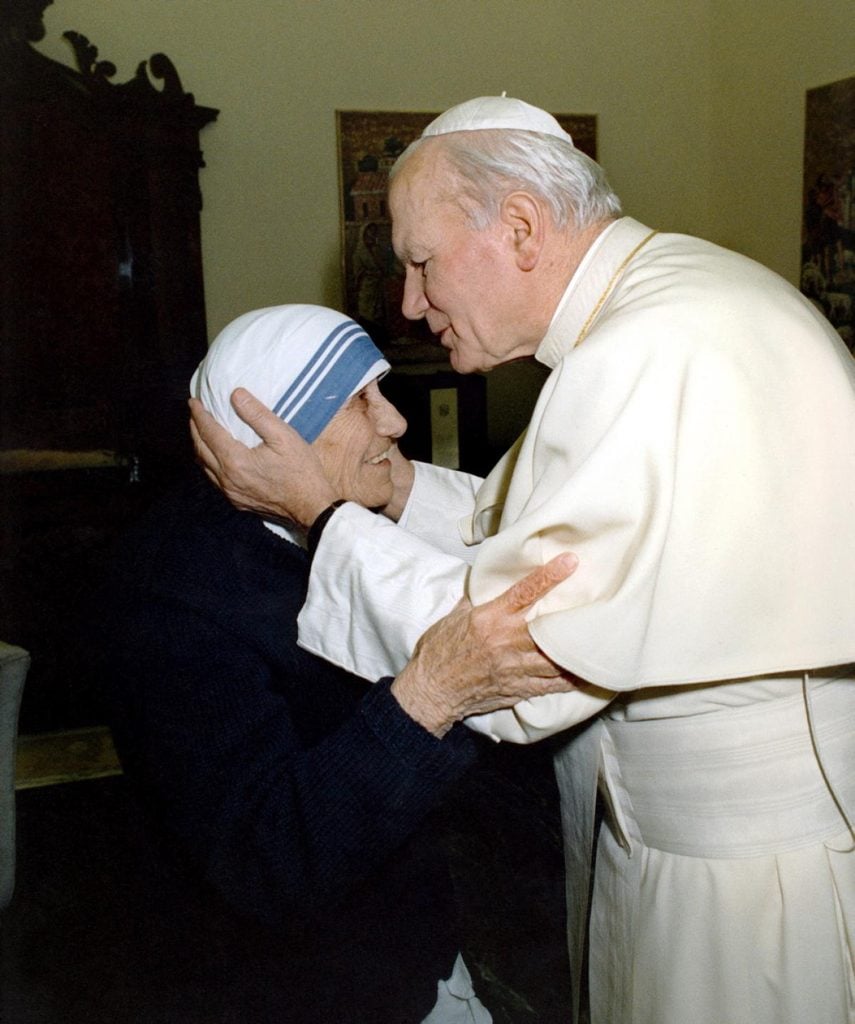
Although she suffered pneumonia and heart failure in the last years of her life, Mother Teresa worked and led a public life until her last meeting with Saint John Paul II in May of 1997, when she received her last blessing from the Holy Father, her close friend. In her last few months, she taught her Sisters in Calcutta and met with visitors. On September 5, 1997, Mother Teresa passed away and was later buried in the Mother House of the Missionaries of Charity, in Kolkata, West Bengal, India.
By the time of her death, the Missionaries of Charity grew to 3,842 Sisters in 594 foundations in 120 countries, under Mother Teresa’s leadership. During the Holy Father’s gospel reflection on the Sunday after her death, Saint John Paul II honored Mother Teresa’s life well-lived. He said,
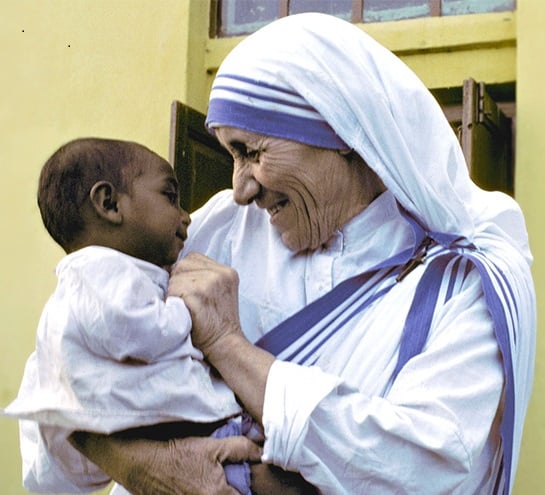
Her mission began every day, before dawn, in the presence of the Eucharist. In the silence of contemplation, Blessed Mother Teresa of Calcutta heard the echo of Jesus’ cry on the Cross: “I thirst.” This cry, received in the depths of her heart, spurred her to seek out Jesus in the poor, the abandoned, and the dying on the streets of Calcutta and to all the ends of the earth.
It was not known until after Mother Teresa’s death that she suffered her own “dark night of the soul” for the last fifty years of her life. Catholics worldwide were surprised, as were her own close friends and companions, after reading her writings of this period of spiritual darkness in her posthumously-published 2007 book, Come Be My Light.
How could Mother Teresa, who led others to Christ through her charity and joy, feel deep sorrow silently for so long? In a Christmas letter, she wrote of this polarity, “Thank God all went well yesterday, sisters, children, the lepers, the sick and our poor families have all been so happy and [content] this year. A real Christmas — Yet within me — nothing but darkness, conflict, loneliness so terrible. I am perfectly happy to be like this to the end of life.”
Rather than abandoning God the Father during this time of spiritual poverty, Mother Teresa embraced it. Of it, she wrote, “I have come to love the darkness — For I believe now that it is a part, a very, very small part of Jesus’ darkness and pain on earth.” She even gave thanks for this spiritual darkness, often telling her friend, “What a wonderful gift from God to be able to offer Him the emptiness I feel. I am so happy to give Him this gift.”
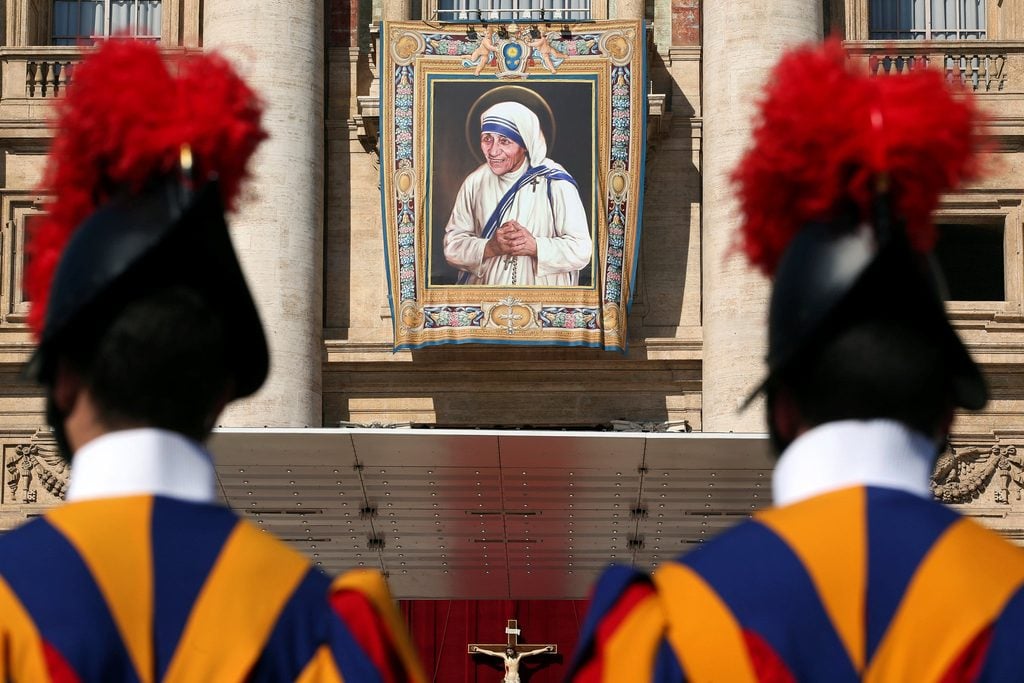
Saint John Paul II allowed the opening of her Cause of Canonization less than two years after her death. On October 19, 2003, he beatified his friend. In his address during the beatification, the Holy Father noted,
In the darkest hours she clung even more tenaciously to prayer before the Blessed Sacrament. This harsh spiritual trial led her to identify herself more and more closely with those whom she served each day, feeling their pain and, at times, even their rejection. She was fond of repeating that the greatest poverty is to be unwanted, to have no one to take care of you.
In spite of her spiritual trial, she sought out the unwanted and loved them as she loved Christ. Saint John Paul II said, “I am personally grateful to this courageous woman whom I have always felt beside me. Mother Teresa, an icon of the Good Samaritan, went everywhere to serve Christ in the poorest of the poor.”
On September 4, 2016, Pope Francis canonized her. Her feast day is September 5, the anniversary of her death. Saint Mother Teresa of Calcutta, pray for us.
For more Catholic Patriotic Minutes, visit CATHOLICUSA.COM
Save and Share This Catholic Patriotic Minute!