The Catholic Patriotic Minute #63: The 21 Martyrs of Santa Fe
Catholics For Catholics Special Edition | September 14th, 2026
The 21 Martyrs of Santa Fe and Our Lady’s Reconquista of New Mexico
Before English Protestants first made their way to the New World starting in 1607, Spanish Catholics had already voyaged to the Americas and founded their first permanent settlement of La Florida in St. Augustine in the year 1565.
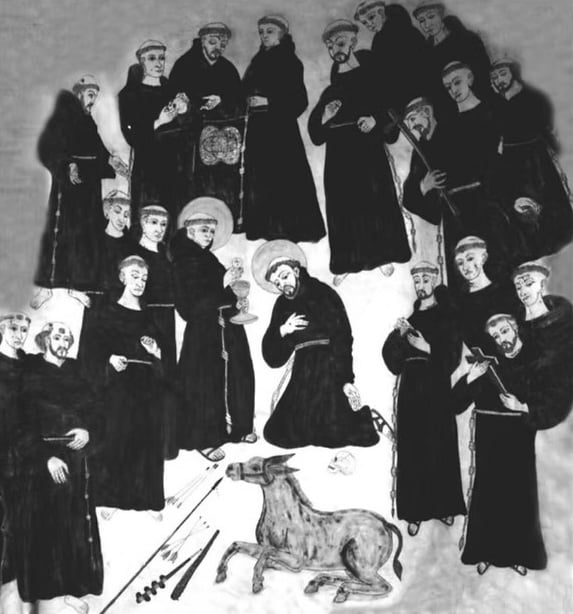
Following the initial settlements in La Florida, Spanish Catholics made explorations along the Gulf Coast and into the American Southwest. In 1598, Juan de Oñate directed an expedition of Spanish soldiers, families, and Franciscan friars from the Viceroyalty of New Spain [Mexico] up north to the New Mexico territory.
Governor Juan de Oñate established San Juan de los Caballeros, the first permanent settlement of the New Mexico Territory, in 1598–nine years before the English founded their first permanent settlement, Jamestowne, in 1607. It served as the capital for New Mexico at first, but shortly thereafter the capital was relocated to San Gabriel del Yunque. Then, Don Pedro de Peralta, the second governor, made Santa Fe the capital in 1610.
Governor Don Pedro de Peralta named the settlement Villa Real de la Santa Fé de San Francisco de Asis, which translates to the “Royal City of the Holy Faith of St. Francis of Assisi.” Throughout the next seventy years, disagreements shared between the Spanish and the Native Americans became points of polarization and antagonism.
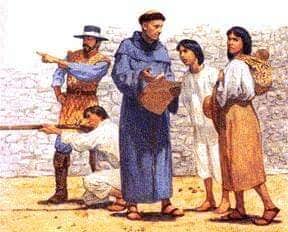
While Catholic churches and chapels were rising throughout New Mexico, so were a drought and famine. Native Americans blamed the religious practices of the Spanish Catholics for the famine, just as the Catholics faulted the pagan practices of Native Americans for the famine. Between 1656 and 1665, the Franciscan missionary leader, Father Alonso de Posada, outlawed the Pueblo people’s ceremonies and Kachina dances and commanded their idols and masks to be burned.
In 1675, the governor of Santa Fe, Juan Francisco Treviño, mandated the arrest of forty-seven medicine men for practicing sorcery. One of these men, Po’pay, upon his release, organized a plan for the Pueblo people to attack the Spanish–a rebellion now known as the Pueblo Revolt of 1680. It was the largest mass murder of Catholic priests in what would become the United States.
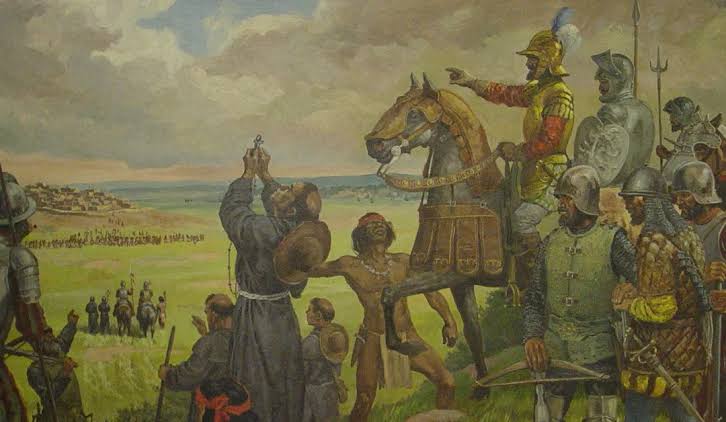
On August 10, 1680, the Pueblo people murdered approximately 400 Spanish people. The remaining 2,000 Spanish were isolated in Santa Fe’s Palace of the Governors, which was surrounded by the Pueblo people, until they escaped and fled to present-day El Paso, Texas, eleven days later.
Of the 400, the Pueblo warriors killed twenty-one Franscican priests, leaving only twelve Spanish priests alive after the revolt. Father Juan Bautista Pío was the first priest martyred, shot by arrows outside Mission San Lorenzo. Before his death, he pleaded with his attackers, saying, “What does all this mean, my children? Are you crazy? Do not disturb yourselves for I will aid you and will die a thousand deaths for you. For the love of God not to kill anybody.”
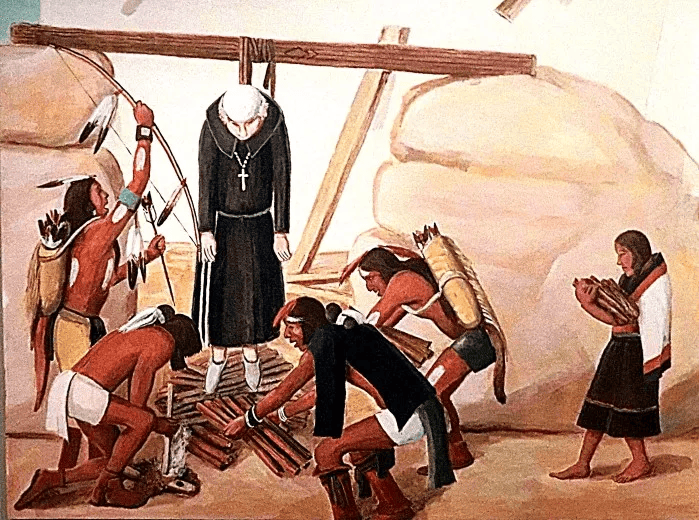
Father Luis Morales and Friar Antonio Sánchez were martyred on the altar during Mass at Mission San Ildefonso. Father José Montes de Oca, Father Juan Talaban, and Father Manuel Tinoco were burned alive in their missions. A rebel hit Father Fernando Velasco with a tomahawk, while he was attempting to alert his superior of the attack. The Pueblo rebels forced Father José Espeleta into slavery, and who later died from their tormenting treatment of him. Father José Figueroa was beaten and hurled in a cave.
Before his murderers, Father Agustin Santamaría knelt down and prayed. After seeing the rebels heading his way, Father Juan JesúsMaría held a crucifix and knelt to pray, before his assailants took him down with arrows and tied him to a boar, which dragged Father JesúsMaría throughout town until he died. Fathers Juan Bernal, Domingo Vera, Francisco Lorenzana, Antonio Mora, Juan de Pedrosa, Matías Rendón, Tomas Torres, José Trujillo, Lucas Maldonado, and Juan Val were discovered and persecuted in their missions and convents by Pueblo rebels as well.
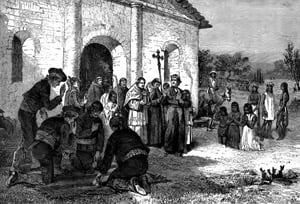
Subsequently, the Pueblo people were in control of the New Mexico territory, desecrating all Catholic churches, crosses, and images. Po’pay acted as the leader of the Pueblo people, until he lost his authority among the people in one year’s time. Tribes governed themselves for the next decade, but disunity among the natives arose, bringing into question whether they could sustain themselves.
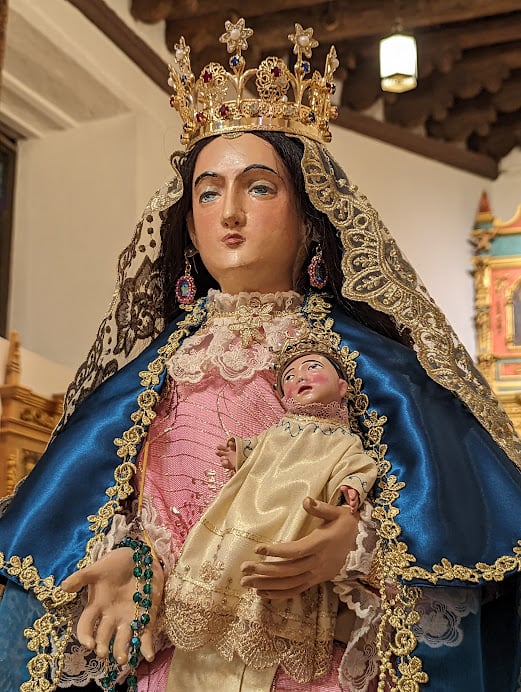
After some tribes encouraged the Spanish through talks of negotiation, Don Diego de Vargas led an expedition of sixty Spanish soldiers, one-hundred native warriors, one Franscican priest, and a statue of Our Lady. Back in 1625, the wooden statue of La Conquistadora (Our Lady of the Conquest), was brought to Santa Fe by the Franciscan friars. During the Pueblo Revolt in 1680, Josefa López Sambrano de Grijalva rescued the Marian statue from a burning church. Twelve years later, La Conquistadora, the oldest Marian statue and the earliest devotions in the United States, was returning to protect her children among the Spanish and Native Americans.
On September 13, 1692, Don Diego de Vargas returned to Santa Fe, offering protection and clemency to all tribes, which gave allegiance to the Spanish King and returned to the Catholic Church. Formally and peaceably, the Spanish reconquered thirteen of the towns in the New Mexico territory the following day. For the next month, Don Diego de Vargas met with other Pueblos, with his statue of Our Lady in hand.
The following year, Don Diego de Vargas left the territory to bring back more Spanish settlers. When he returned, he was met with resistance from some Pueblo warriors in Santa Fe. Outside the town’s limits, he placed the statue of La Conquistadora on a makeshift altar and interceded to her that they may enter the capital and she may protect Santa Fe. By the end of December 1693, Our Blessed Mother answered his prayer.
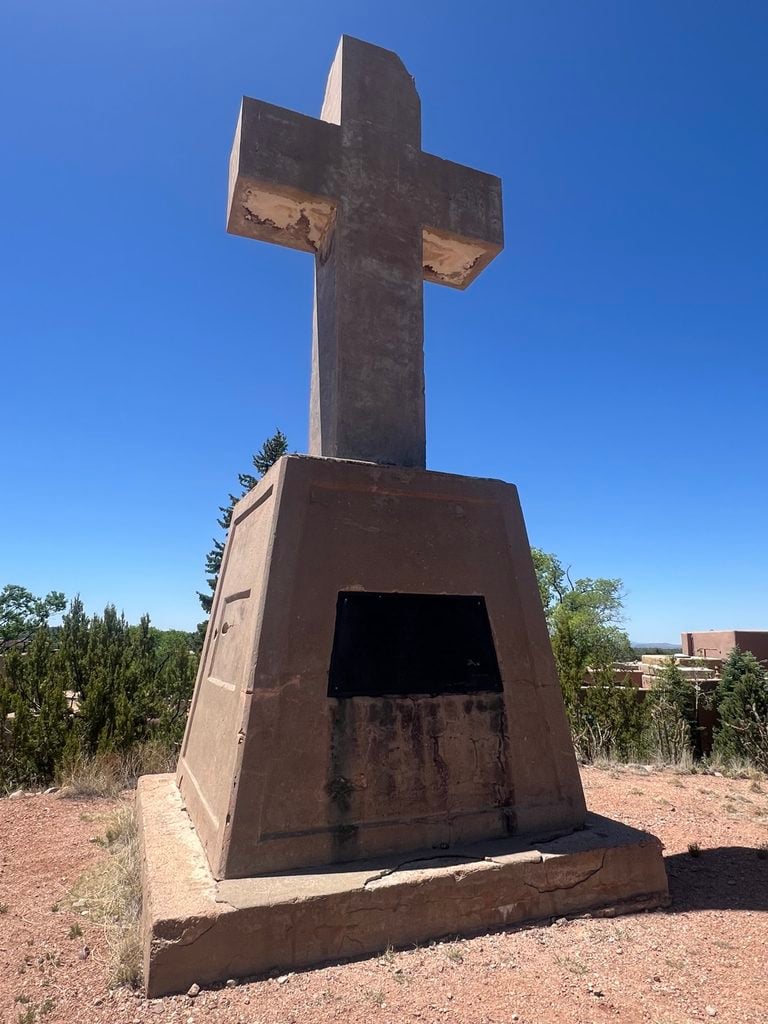
Every year, on September 13, a Marian procession walks the streets of Santa Fe to honor La Conquistadora and remember Our Lady’s Reconquista of New Mexico. The procession starts at the Palace of the Governors–where the Spanish sought refuge during the Pueblo Revolt–and ends at the Cathedral Basilica of Saint Francis of Assisi. After a Mass of Thanksgiving at the cathedral, a candlelight procession heads to the original Cross of the Martyrs Memorial, often vandalized by pro-indegenous and anti-Catholic activists, which honors the twenty-one martyrs and the hundreds of Spanish settlers murdered amidst the Pueblo Revolt of 1680.
Today, La Conquistadora is honored in the side chapel of the Cathedral Basilica of Saint Francis of Assisi. It remains the oldest Marian statue in the United States.
For more Catholic Patriotic Minutes, visit CATHOLICUSA.COM
Save and Share This Catholic Patriotic Minute!