The Catholic Patriotic Minute #66: Clare Boothe Luce
Catholics For Catholics Special Edition | October 5th, 2026
Clare Boothe Luce: Playwright, Congresswoman, Ambassador, and Catholic Convert
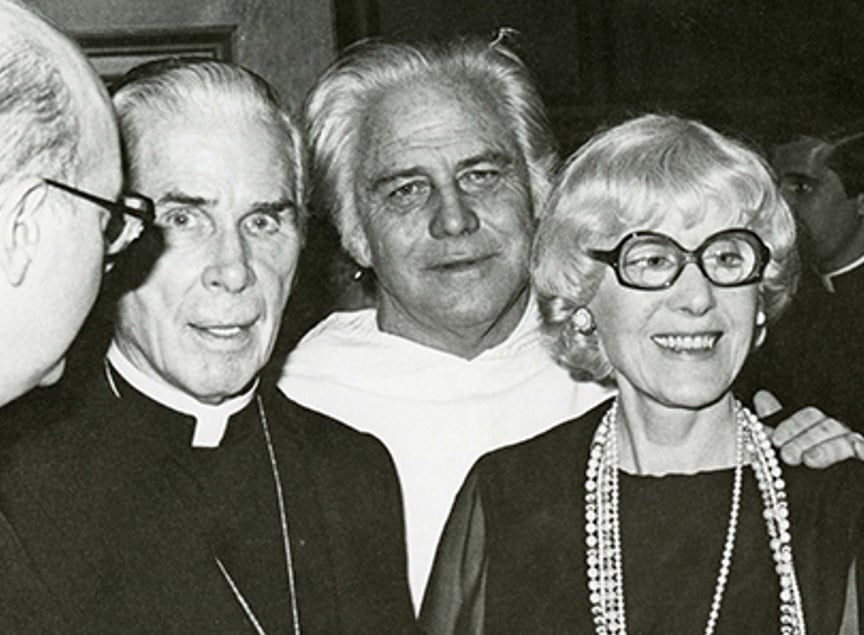
About eighty years ago, by the grace of God, U.S. Congresswoman Clare Boothe Luce and Blessed Fulton Sheen met in our nation’s capitol. For the following six months, Sheen led Clare through her conversion to Catholicism.
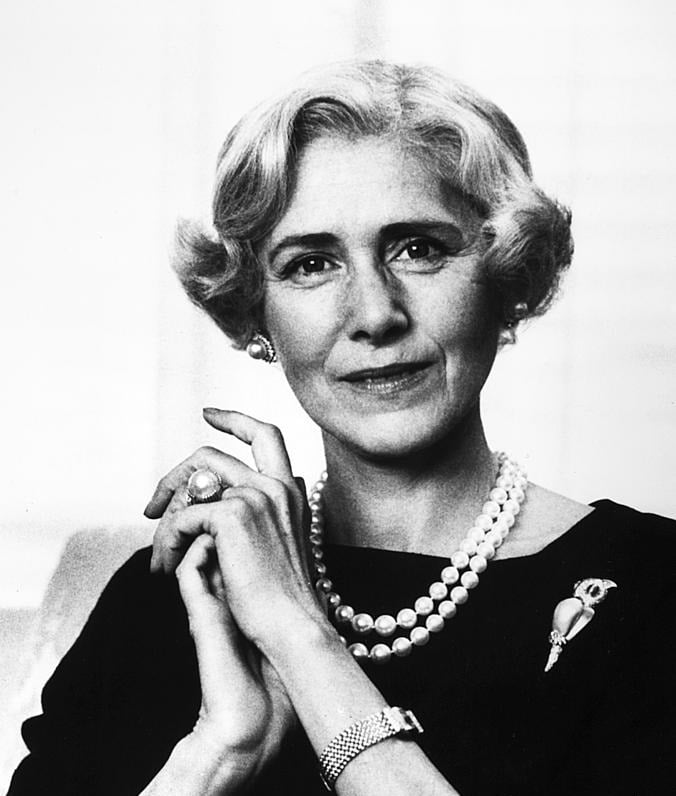
In his autobiography, Treasure in Clay, Blessed Fulton Sheen wrote of Clare, “Never in my life have I been privileged to instruct anyone who was as brilliant and who was so scintillating in conversation as Mrs. Luce. She had a mind like a rapier.”
On April 10, 1903, Clare Boothe was born the daughter of a pit orchestra violinist and chorus girl in New York City. By the time she was eight years old, her parents were separated. Clare and her brother David were raised by her mother, who made ends meet so her two children could attend private schools. Clare began acting as an understudy in a Broadway production at the age of seven and then took up writing plays when she was ten.
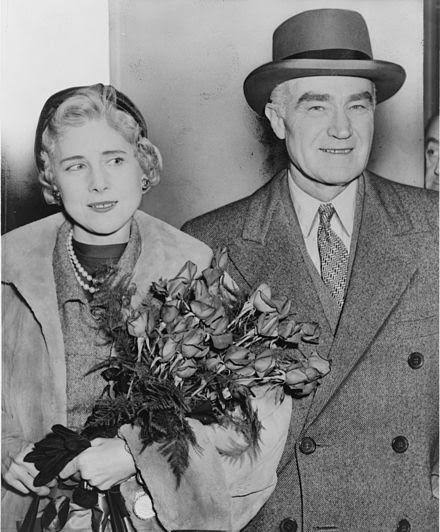
Her mother’s marriage to Dr. Albert Austin introduced Clare to more and more socialite circles. One day, she attended a Sunday service with one of these elite families, where she sat next to George Brokaw, a 43-year-old millionaire bachelor. Brokaw sought out 20-year-old Clare immediately, with her parents’ approval. Within a year, the two were married. Clare gave birth to her daughter Ann on August 24, 1924. Her marriage did not last long because George was an alcoholic and physically abusive. In 1929, the two were divorced.
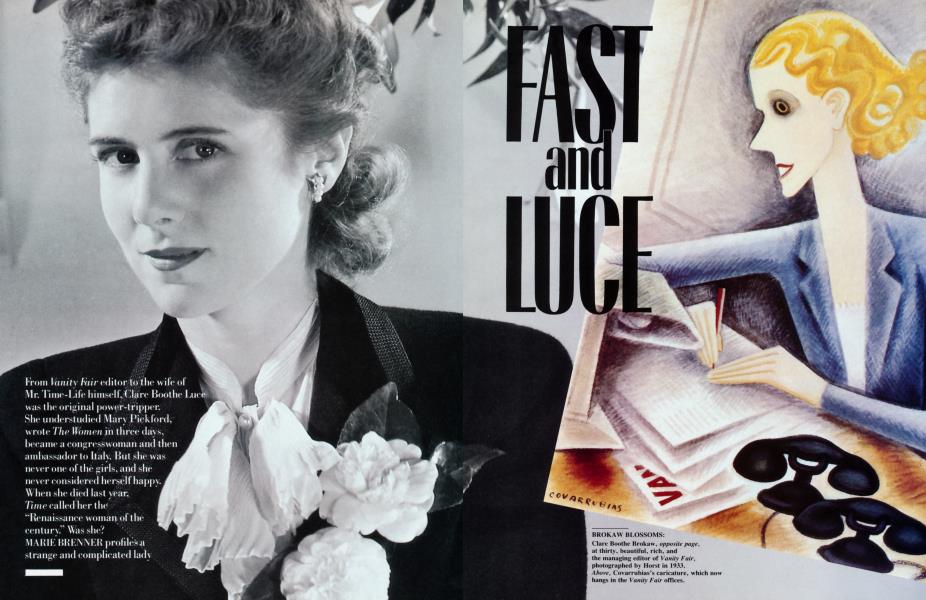
In the same year, Clare asked Conde Nast, the publisher of Vogue, for a job. Although her inquiry was met with a “no,” she sat at a desk at Vogue and stated she would write the picture captions. Clare was certainly ambitious, eventually becoming the managing editor of Vanity Fair.
Clare’s marriage to Henry R. Luce, the publisher of Time and Fortune, in 1935 overlapped with her departure from Vanity Fair and her beginnings as a Broadway playwright. Even though her first produced play, “Abide with Me,” in 1935 was considered a disaster, her second play, “The Women,” produced on Broadway in 1936, was a triumph.
When the Second World War broke out, Clare left for Europe to serve as a war correspondent for Life, resulting in her book, Europe in the Spring. Driven by her disapproval of how the Roosevelt Administration handled the war, Clare ran for and won the House of Representatives seat, representing Fairfield County, Connecticut, as a Republican candidate in 1942. In her first speech on the house floor, she denounced Vice President Henry A. Wallace’s proposal to grant postwar freedom of U.S. airspace to the Soviet Union, notoriously calling it “’globaloney.”
During her campaign for reelection in 1944, Clare’s daughter Ann Clare Brokaw died in a car accident. Clare was completely devastated.
According to Clare’s own account of her conversion, she experienced a turning point in her faith during “a black hour on a certain late night in the autumn of 1945, in a New York hotel room.” In the aftermath of the overwhelming grief over her daughter’s death, Clare was confronted with, in her own words, a “dread confession that is made to the self alone, without faith, hope or charity.”
After crying and praying, she found an unopened letter from Father Edward Wiatrak on her desk. For the previous five years, Father Wiatrak wrote letters to Clare every few weeks simply to remind her that he was praying for her and that God was waiting to play a part in her life. Using the hotel’s telephone book, Clare called Father Wiatrak’s Jesuit Mission house.
She said, “Father, I am not in trouble. But my mind is in trouble.” Father Wiatrak consoled her, by sharing, “We know. This is the call we have been praying for.” Subsequently, he set up a meeting between Clare and a priest, Father Fulton Sheen, in Washington D.C.
Over dinner with Clare Boothe Luce, Blessed Fulton Sheen suggested, “Give me five minutes to talk to you about God, and then I will give you an hour to state your own views.” As Sheen later recounted, “when I mentioned the goodness of God, she immediately bounded out of the chair, stuck her finger under my nose and said: ‘If God is good, why did he take my daughter?’”
He responded: “In order that through that sorrow, you might be here now starting instructions to know Christ and His Church.” Blessed Fulton Sheen guided Clare towards her entrance into Catholicism for about six months. Clare asserted the real reason she became Catholic was Jesus Christ Himself. By way of her reading and Sheen’s instruction of the New Testament and its Four Gospels, Clare encountered a God she did not want to live without for another day.
Reflecting on her conversion, Clare wrote,
It finally took two world wars, the overthrow of several dozen thrones and governments, the Russian revolution, the swift collapse, in our own time, of hundreds of thought-systems, a small number of which collapsed on me, the death of millions, as well as the death of my daughter, before I was willing to take a look at this extraordinary institution, the Catholic Church. So much and more—God’s Grace—was needed to hasten my mind on the fact that this One Church has survived towering o’er the wrecks.
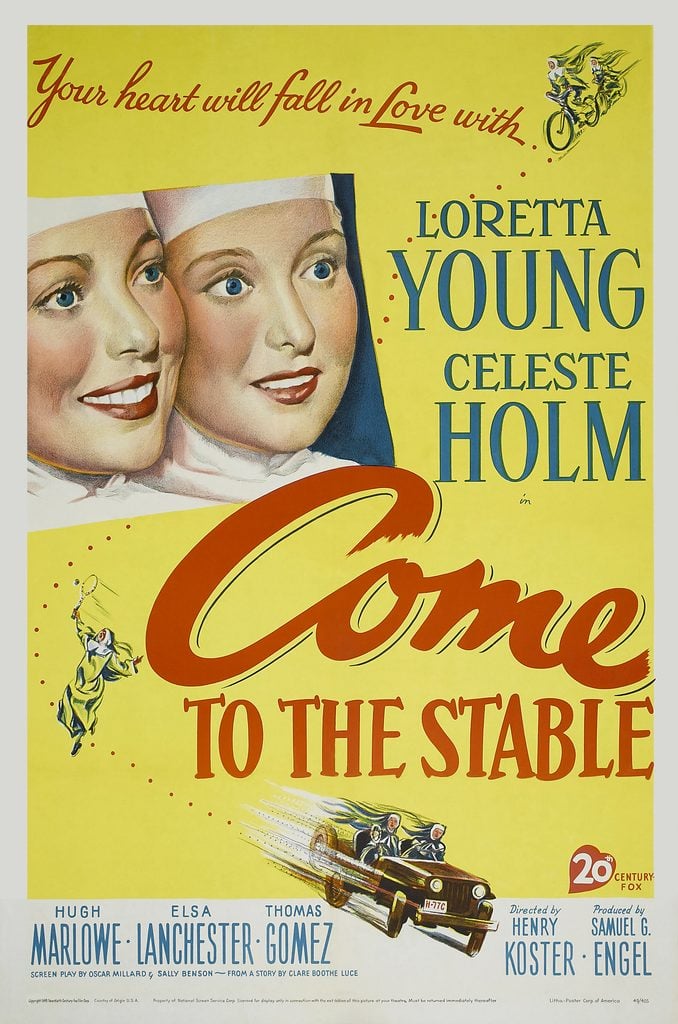
Clare did not seek out reelection in 1946. Rather, she wrote a short story, which inspired the 1949 film, Come to the Stable. This script was a drastic shift from her previous scripts, especially “The Women.” The women of her former scripts were gossipy socialites. After her conversion, Clare wrote a story of two nuns, whose petitions to God to save a hospital of over a hundred children amidst the Second World War were heard. Throughout the film, the nuns’ primary motivation is to build a children’s hospital in Bethlehem, Connecticut, out of gratitude for God hearing their petitions. Clare’s conversion clearly influenced her new perception of womanhood, where caring for others is a core element of femininity. For this story, Clare Boothe Luce earned an Academy Awards nomination for Best Writing, Motion Picture Story, in 1950. In 1952, Clare published a book, Saints For Now, a compilation of essays about the saints written by renowned figures such as Evelyn Waugh and Whittaker Chambers.
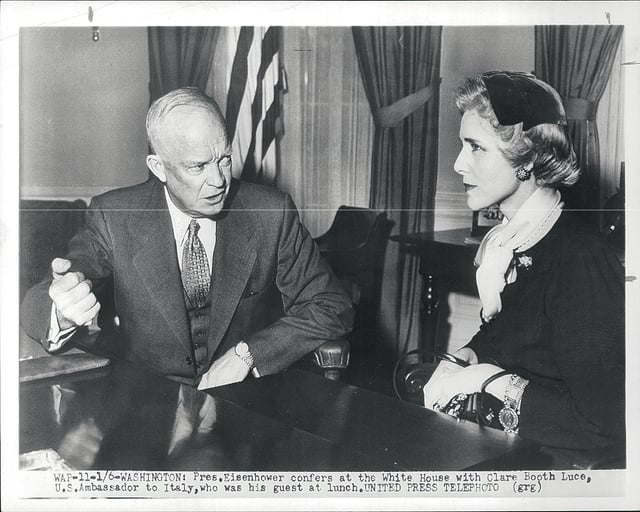
Eventually, Clare made a return to politics, campaigning for the Republican Presidential candidate, General Dwight D. Eisenhower, in 1952. After Eleanor Roosevelt, Queen Elizabeth II, and Mamie Eisenhower, Clare Boothe Luce was reportedly the “the most admired woman” in the world, according to Time and a Gallup poll in early January of 1953. President Eisenhower asked her to serve as the U.S. Ambassador to Italy. Clare’s husband Harry messaged her from Jakarta, “you must keep your personal rendezvous with history.” In 1953, Clare Boothe Luce became the first woman to serve as U.S. Ambassador to a major power.
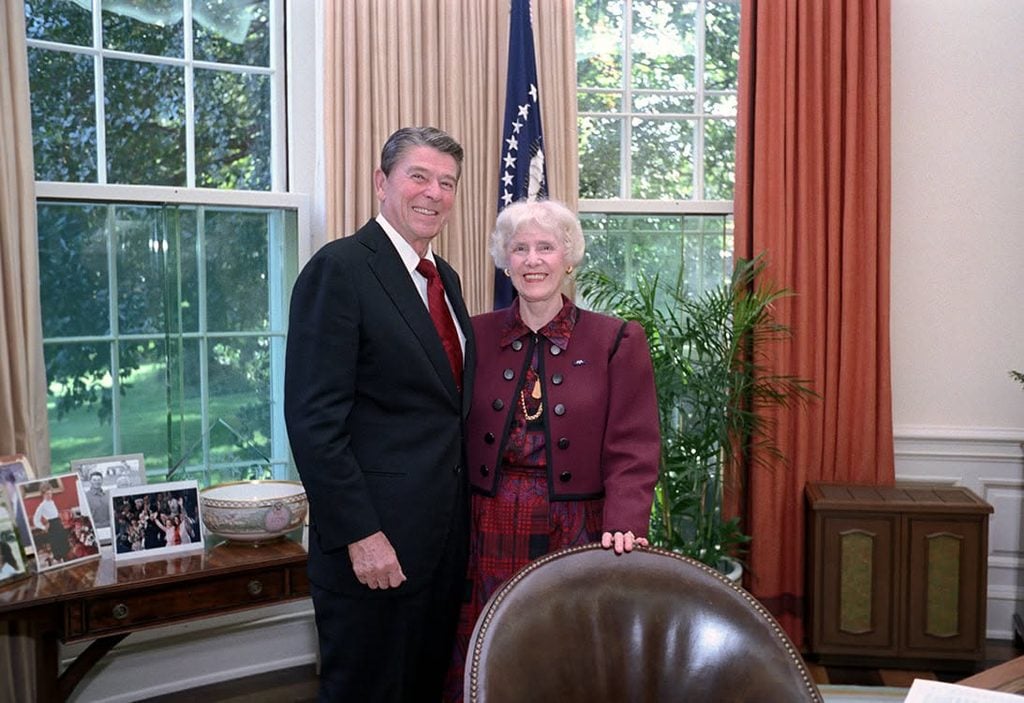
In the 1960s, Harry and Clare Luce lived in Phoenix, Arizona, in semi-retirement. While she supported Senator Barry Goldwater’s presidential campaign, Clare took up needlepoint, painting, mosaics, and writing. After the death of her husband in 1967, Clare moved to Honolulu, Hawaii, and lived there until 1983. Clare returned to Washington D.C., joining the President’s Foreign Intelligence Advisory Board. On October 9, 1987, Clare Boothe Luce passed away from cancer.
Near the end of her life, Clare received the highest civilian honor, the Presidential Medal of Freedom, in 1983 in the nation she served. Of Clare, President Ronald Reagan said,
A novelist, playwright, politician, diplomat, and advisor to Presidents, Clare Booth[e] Luce has served and enriched her country in many fields. Her brilliance of mind, gracious warmth and great fortitude have propelled her to exceptional heights of accomplishment. As a Congresswoman, Ambassador, and Member of the President’s Foreign Intelligence Advisory Board, Clare Booth[e] Luce has been a persistent and effective advocate of freedom, both at home and abroad.
For more Catholic Patriotic Minutes, visit CATHOLICUSA.COM
Save and Share This Catholic Patriotic Minute!