The Catholic Patriotic Minute #24: The Miracles of Saint Nicholas in West Virginia and Pennsylvania
Catholics For Catholics Special Edition | December 15th, 2025
The Miracles of Saint Nicholas in West Virginia and Pennsylvania
December 1907 became known as the most fatal month for coal mining in the United States, with the number of casualties being over seven hundred. December 6th and 19th of 1907 were marked by two infamous mining disasters that killed hundreds of men. However, Saint Nicholas of Myra seemed to have played a role in saving a few hundred lives on both dates, which happen to be his two feast days according to the Gregorian and Julian Calendars.
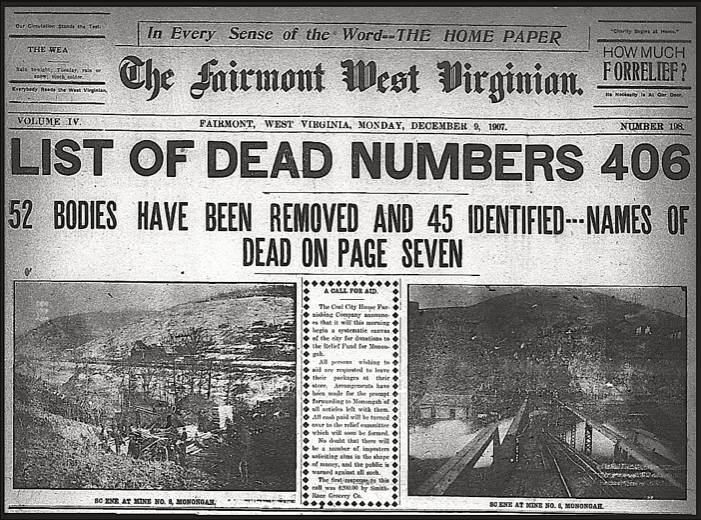
On December 6, 1907, in West Virginia, the Monongah mining disaster claimed the lives of 362 men. Today, it is still the deadliest mining disaster in United States history. At half past ten in the morning, two explosions resulted in the mine’s entrance toppling down and the destruction of its ventilation system. Hundreds died, some immediately from the blasts and others eventually from suffocation by the trapped poisonous gas. At the Monongah mine, the number of deaths might have even been higher than 362 because men often brought their sons, who were younger than twelve, the minimum age for legal employment at the mines. Boys younger than twelve were not accounted for in this estimation.
However, there were about sixty to one-hundred men who unknowingly avoided death because they honored a religious feast. The New York Times published on December 8, 1907, “[a] thorough investigation was made by the company today, and it was discovered that many miners believed to be entombed had escaped because they had not gone to work on Friday after Thursday’s holiday.”
On December 5th, the night before the feast of Saint Nicholas, it is tradition for Roman Catholics to leave gifts for their children to open the following morning, inspired by the story of Saint Nicholas. On December 6th, sixty to one-hundred Catholics woke up and decided to observe this saint’s feast by attending Mass.
These Catholics had to accept the consequence of surrendering their day’s wage. On average, West Virginia coal miners were paid two dollars for a twelve-hour day of work. Sacrificing their one day’s wage may seem small, but it was at risk of future unemployment. Yet, honoring the feast of Saint Nicholas led to their lives being saved from this industrial disaster.
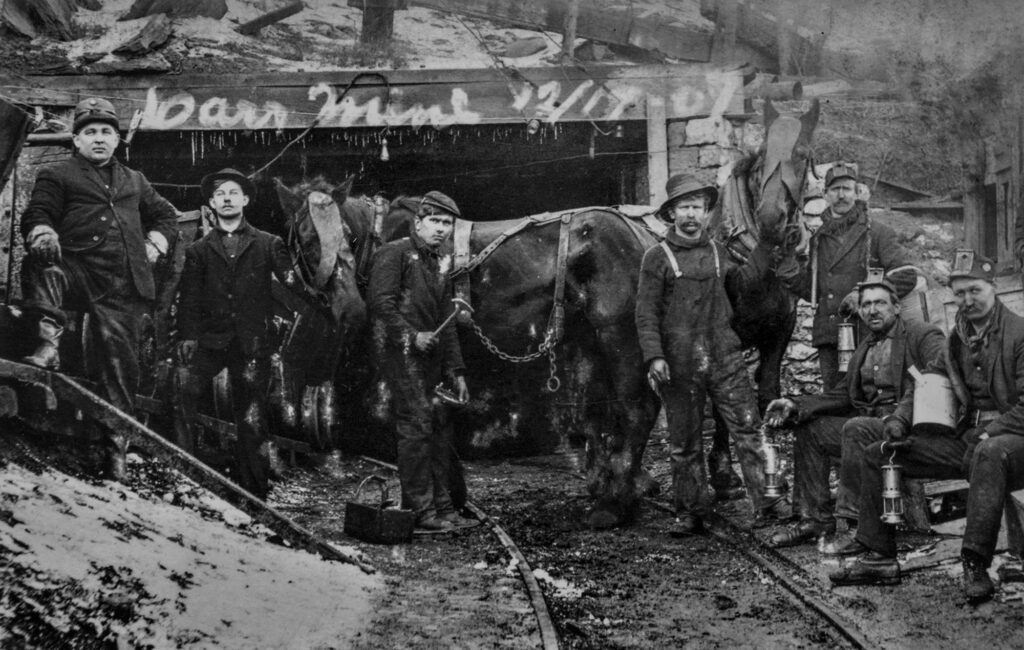
Even more Catholics, as well Orthodox Christians, would be saved from death by a coal-mining disaster thirteen days later. On December 19, 1907, at half past eleven in the morning, another explosion occurred at the Darr mine in Jacob’s Creek, Pennsylvania, with 239 casualties.
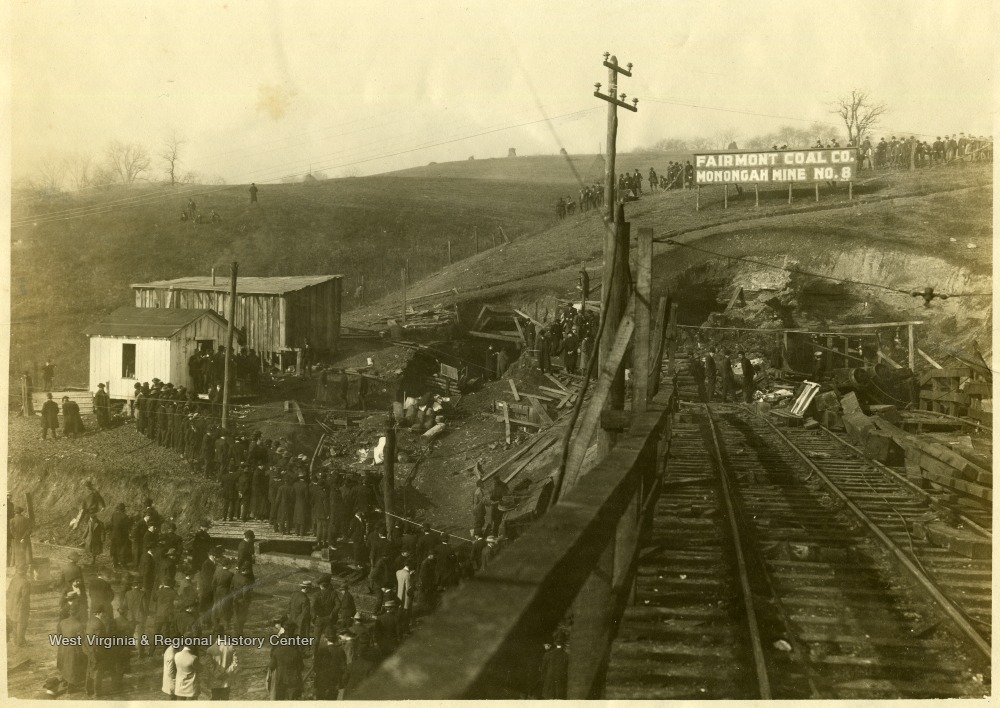
But, about two-hundred men were not present at Darr Mine with these 239 miners. On December 20, 1907, The New York Times wrote of these men, “[t]hat to-day’s disaster does not equal or even surpass In loss of life the West Virginia tragedy is due to the devotion to church duties of a considerable number of the miners. In observance of St. Nicholas Day many of the 400 or more Russians employed at the mine did not go to work this morning.”
These men–Greek, Italians, and mostly Carpatho-Rusyns–sacrificed their day’s wages to attend Mass for the feast of Saint Nicholas. They belonged to both Byzantine Catholic and Orthodox churches. In 1907, Byzantine Catholic churches followed the Julian Calendar, which assigned the feast of Saint Nicholas to December 19th, rather than December 6th.
Following the disaster, a Pittsburgh Newspaper wrote of their affinity for Saint Nicholas, “[r]eligious fervor is due to sweep through the Youghiogheny Valley as never before as a consequence of the Darr disaster. Today was a holiday of the Greek Catholic Church, and as such it was observed by many of the men who usually work in the Darr mines. Usually about 400 men toil within the mine. On account of the religious holiday—it was the Feast of St. Nicholas—this number was nearly cut in half, and these, almost two hundred men, who were saved by religious devotion, will certainly be more devout than ever, after the extent of the mine’s horror is fully realized.”

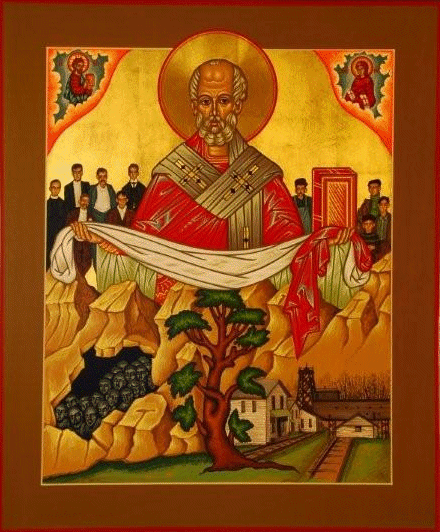
And a religious fervour did sweep through this area in Pennsylvania. Subsequently, Catholics founded St. Nicholas Byzantine Catholic Church in Perryopolis, Fayette County, near Jacobs Creek, where the Orthodox established St. Nicholas Orthodox Church. This history of Saint Nicholas’s protection was handed down through subsequent generations in the Eastern Catholic circles, leading to Pennsylvania’s Holy Trinity Ukrainian Catholic Church commissioning and blessing the Saint Nicholas Feast Day 1907 Pass Over icon on the 111th anniversary of the Monongah and Darr mine disasters.
Why should these two incidents, amidst the suffering of hundreds of deaths in December of 1907, be called miracles? If the sixty to one-hundred Roman Catholics had not attended Mass for the Feast of Saint Nicholas on December 6th, they would have gone to work as per usual. They would have died. If about two hundred Eastern Catholics and Orthodox Christians had not attended Mass for the Feast of Saint Nicholas on December 19th, they would have gone to work as per usual. And, they would have died. This correlation of the feast days is not a coincidence.
Devotion to Saint Nicholas saved nearly three hundred Catholics and Orthodox. Born in the third century A.D., in the East, in southern Turkey, Nicholas offered his inheritance to the poor, ill, and weak after his parents passed away. While he was the Bishop of Myra, Turkey, Saint Nicholas became a prisoner under the dictatorship of Emperor Diocletian and later went to the Council of Nicea where he argued against Arianism. Eastern Catholics and Orthodox have harbored a special devotion well before December of 1907, honoring him as the Wonderworker as numerous miracles have arisen from Saint Nicholas’s intercession. Roman Catholics pray for his intercession because Saint Nicholas is the patron of children, young people, sailors, and laborers.
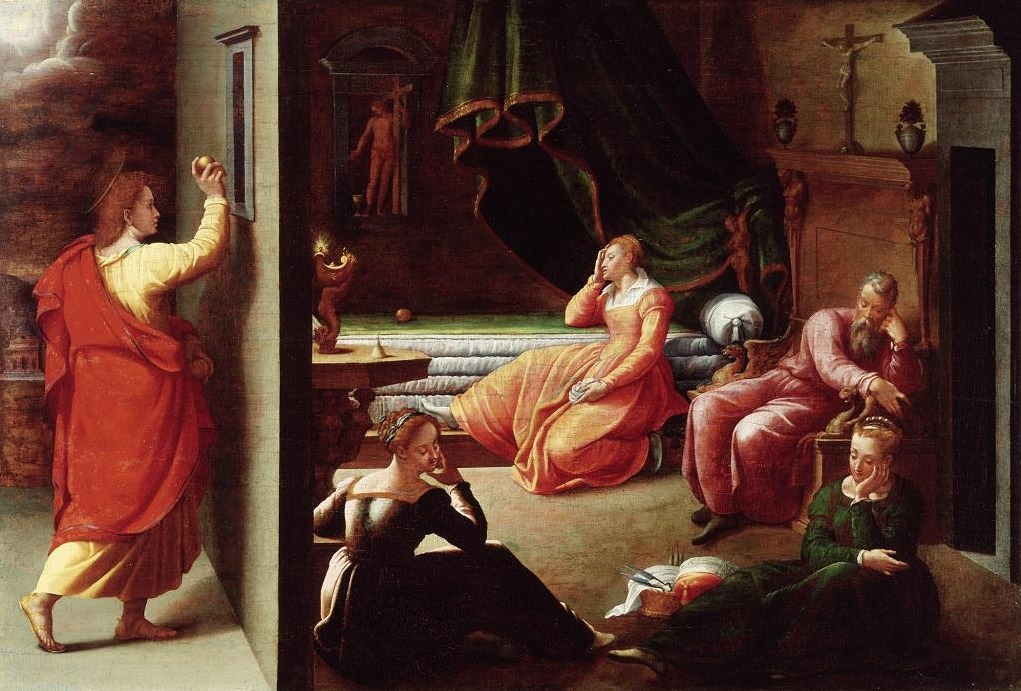
There is one story about Saint Nicholas that inspired the figure of Santa Clause. He discovered a family, whose father was about to have his three daughters sold into prostitution because the father could not afford dowries for them. During the nighttime, Saint Nicholas launched a bag of coins through a window of this family’s home. Saint Nicholas’s money allowed for the oldest daughter to have a dowry. He threw two other bags of coins into this family’s home windows, paying for the dowries of the two remaining women. Performing quiet acts of kindness, not loud ones, was his aim.
May Americans remember that the spirit of Christmas is partially derived from Saint Nick, a man who so selflessly and quietly gave to others. May Americans remember that the story of Saint Nick teaches that even miracles can emerge from utter tragedy. May we have the same faith and devotion as those three-hundred Catholic miners that risked their livelihoods simply to go to Mass.
For more Catholic Patriotic Minutes, visit CATHOLICUSA.COM
Save and Share This Catholic Patriotic Minute!