The Catholic Patriotic Minute #30: The Martyrs of La Florida
Catholics For Catholics Special Edition | January 26th, 2026
The Martyrs of La Florida: Servants of God Antonio Inija and Companions
Between the years 1549 and 1715, at least fifty-eight people were killed for their Catholic faith in the Spanish territory of La Florida. These Spanish and Native American martyrs are known as Servants of God Antonio Inija and Companions in their beatification cause that was sent to Rome in 2023.
The first of the martyrs of La Florida were Fr. Luis de Cáncer and his two Dominican companions. Born in Barbastro, Aragon, Spain, Fr. Cáncer attended to those in the Caribbean and Central America before sailing for La Florida upon hearing of the struggles the Spanish faced at establishing missions there. According to his diary, he hoped to “plant the Gospel in the land of Florida.” Alongside Dominican friars–Gregorio de Beteta, Juan Garcia, and Diego de Tolosa–Brother Fuentes, and their Christian, Indian translator Magdalena, Fr. Cáncer attempted to make their way to the east coast of La Florida. Even though their interactions with the natives were friendly at first, Fr. Tolosa and Fuentes were killed by natives upon temporarily splitting up from their party. Later, on June 26, 1549, Fr. Cáncer was praying along the shore near present-day Tampa Bay, Florida, when a group of Tocobaga natives killed him.
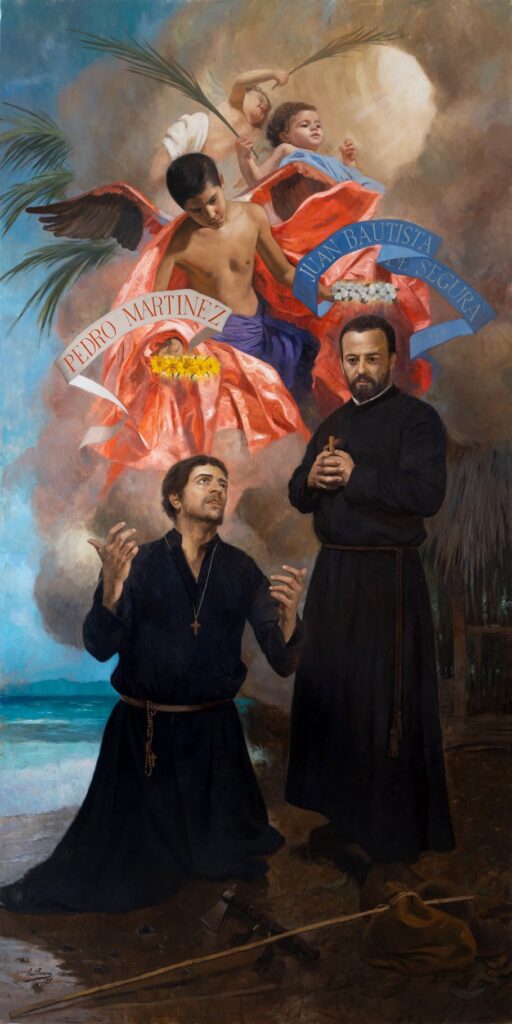
Raised in Teruel, Aragon, Fr. Pedro Martínez led two fellow Jesuits, Fr. Juan Rogel and Br. Francisco Villareal, in leaving Spain for La Florida in June of 1566. The Spanish onboard recounted later that Fr. Martínez was joyful in his ministry of praying with the sailors and administering Confession. On September 14, 1566, they landed, most likely, in Georgia. Shortly after, Fr. Martínez was aboard a boat with some companions near Jacksonville, Florida, while the rest were on shore seeking out fish. Tacatacuru Indians, who were hostile toward the Catholic Spaniards as they preferred the Protestant French settlers, encircled the boat, grabbed Fr. Martínez, and killed him.
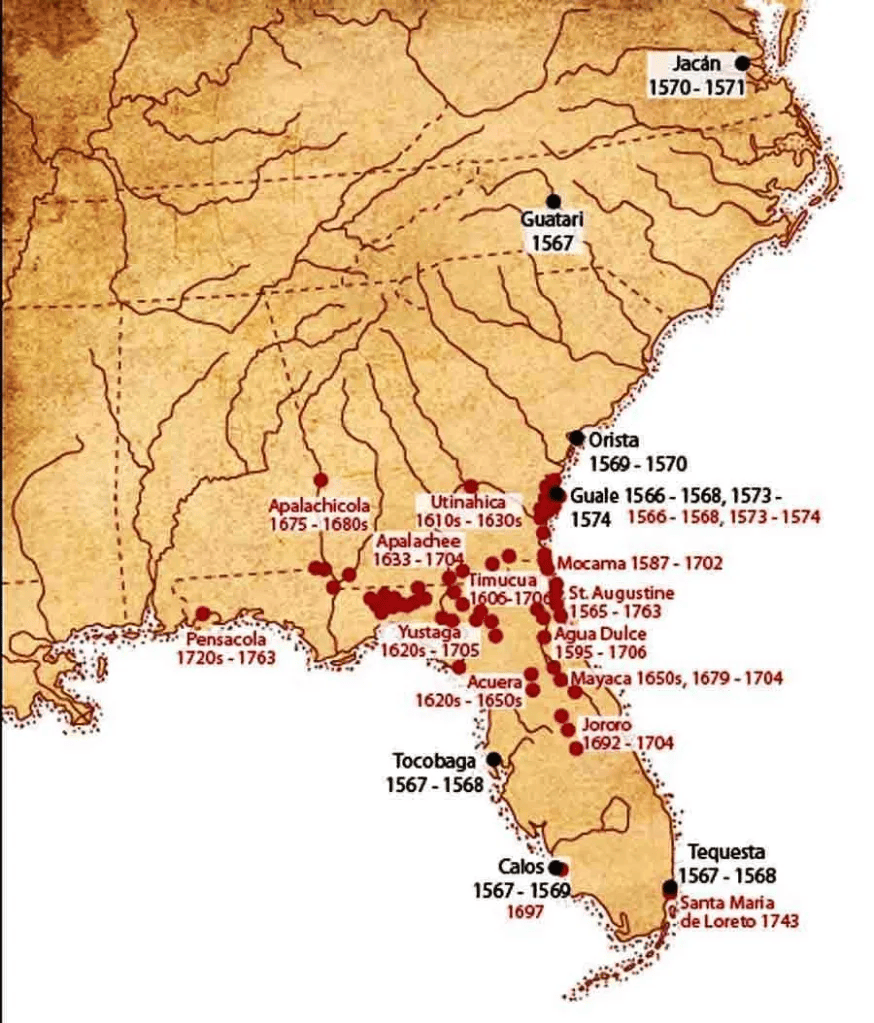
In 1570, Fr. Juan Bautista Segura and his seven Jesuit companions–Fr. Luis Francisco de Quirós, Br. Gabriel de Solís, Br. Juan Bautista Méndez, Br. Pedro de Linares, Br. Sancho Cevallos, Br. Gabriel Gómez, and Br. Cristóbal Redondo– voyaged for the region Ajacán in present-day Virginia, with the sole purpose of conversion. Fr. Segura picked Ajacán because Paquiquineo, one of the natives there who already converted to Catholicism, proposed helping the Jesuits meet and evangelize his tribe at Ajacán. However, a few days after meeting the Jesuits, Paquiquineo left them. In February of the following year, Paquiquineo returned with his tribe and martyred all eight Jesuits.
At the mission of San Antonio de Bacuqua near what is now Tallahassee, Florida, in the evening of February 14, 1647, the Spanish and natives honored the next day’s feast, the Feast of the Translation of St. Anthony’s Relics. However, there was an attack during this celebration. Although six other churches in the region of northern Florida were burned at the time, only eight martyrs at this mission are listed in historical accounts.
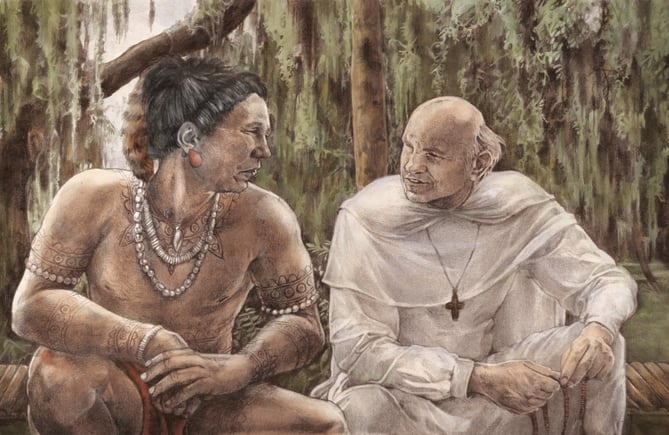
Three Franscican friars were murdered, as were five people of the Florencia family, Lt. Gov. Claudio Luis de Florencia, his wife Juana de Leiva y Arteaga, and their three children including their teenage daughter Antonia. Antonia’s martyrdom, in particular, is remembered because she courageously praised the “Law of God” and was punished by being constrained to the pillar of the church’s bell tower and brutally tortured before her death.
Fr. Luis Sánchez and four converted Native Americans were martyred in Central Florida near the end of the year 1696. Fr. Sanchez’s strong Catholic faith impressed a Quaker named Jonathan Dickinson, who wrote of the priest in his journal.
The most well known of the martyrs is Antonio Inija, the second in command of the mission of San Luis de Talimali, which was the largest Apalachee mission in La Florida. One of the reasons he was picked as the lead martyr of the beatification cause is the majority of the martyrs were Catholic natives, even though many were not named in the beautification cause as their histories are not recorded in written accounts.
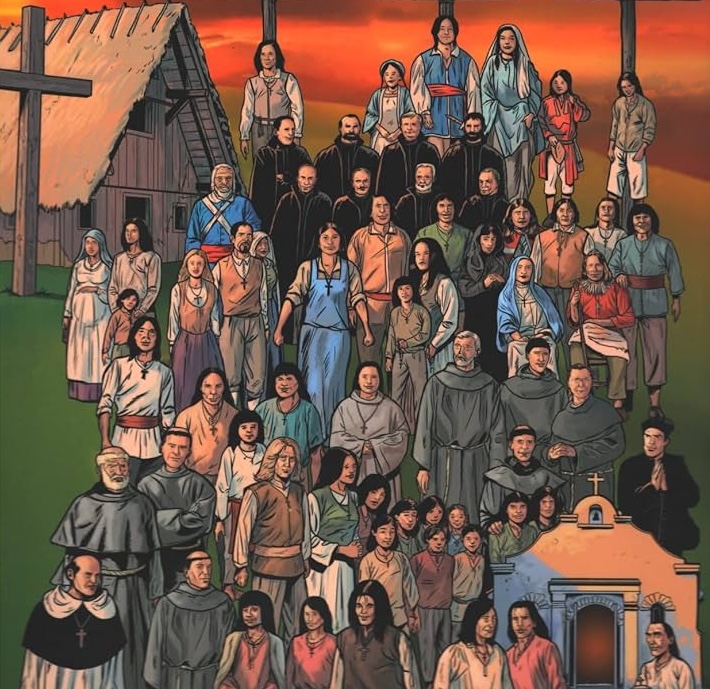
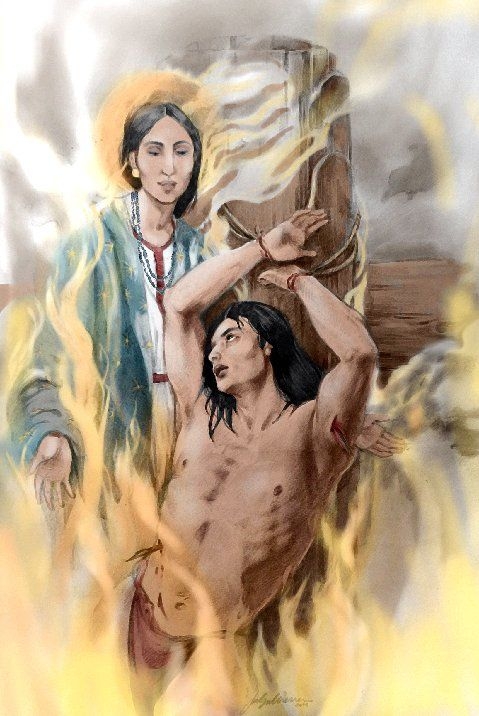
On January 26, 1704, English colonists and the Creek Indians captured Antonio, along with Spanish priest Father Juan de Parga Araujo and Apalachees Cui Domingo and Cuipa Feliciano, near Mission Of San Pedro y San Pablo de Patale, after the English and Indians had launched an attack on the Ayubale mission. Even though the English and Indians tied the men to stakes and set fires below them, the four Catholics tried to convert their captors. The Blessed Mother revealed herself to Antonio and consoled him in his last moments. News of the bravery of these four men reached Emperor Charles V, who communicated the same news to the Pope.
After the attack on the Ayubale mission in January of 1704, the English settlers continued their attacks on missions in La Florida in June of the same year. The English shot and burned Fr. Manuel de Mendoza, after twenty-six years of serving the Spanish and natives in La Florida. They also burned his convent at Mission Of San Pedro y San Pablo de Patale near what is now Tallahassee. The English also murdered an Apalachee sacristan and two other Native Americans.
A month later on July 4, these English settlers and Creek Indians martyred two Spanish soldiers, Baltasar Francisco and Don Pedro Marmolejo, as well as fifteen Apalachee Indians, by mirroring the Crucifixion of Jesus Christ. These seventeen martyrs were crucified, tortured, and burned. Despite this brutality, Francisco evangelized from his cross and prayed for the intercession of the Blessed Mother.
Later, the English would also kill the leaders of the Timucuan Caciques for their faith and decimate their missions. Fr. Domingo Criado remained with the Catholic, Apalachee natives until other Indians took Fr. Domingo as a slave. In 1705, he died a prisoner in Macon, Georgia. The remaining Apalachee Catholics, guided by Don Patricio Hinachuba, relocated close to St. Augustine, Florida. However, the Creek Indians sought them out and killed Don Patricio Hinachuba in 1706.
It is possible that the first martyr, who was native to America, is Fr. Agustín Ponce de León. On September 3, 1705, during a battle near St. Augustine, Florida, Fr. Agustín attempted to save some of the Spanish and Native American women and children from his flock that were taken captive by other Native Americans. He gave the Holy Sacrament of Reconciliation to the wounded and freed most of the captives, and after a while he died doing so.
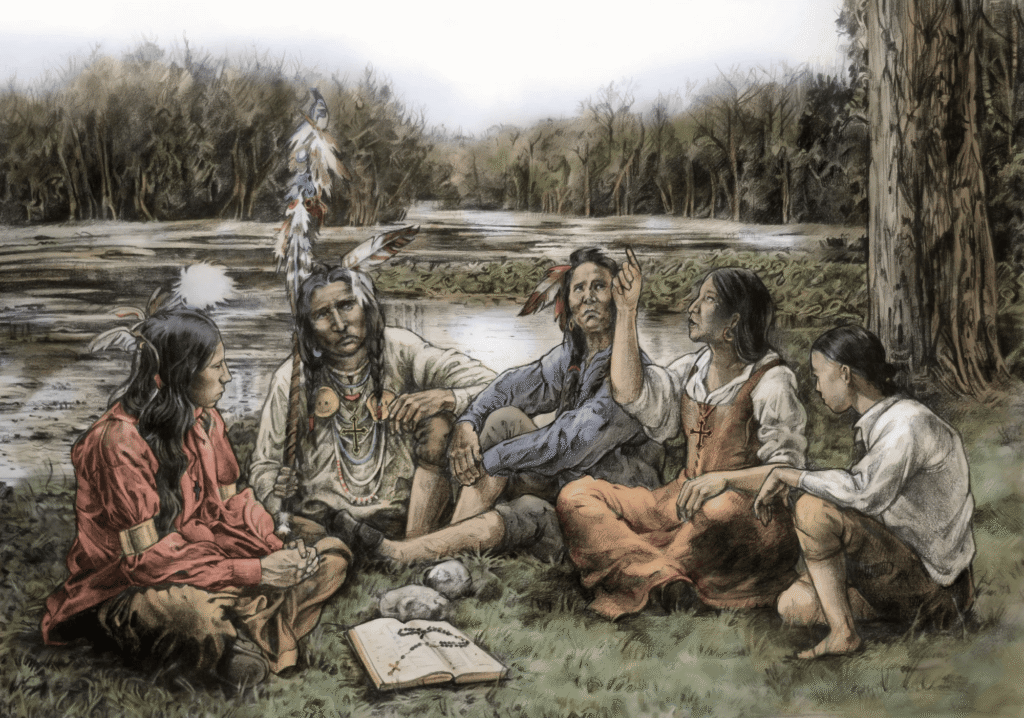
Those remaining of the Catholic Apalachee either lived in St. Augustine or in Pensacola at the fort, Santa Maria de Galve. Influenced by the Protestant English, the Creek Indians ambushed Santa Maria on September 1, 1712. They killed Fr. Phelipe de Orbalaes, who was a priest and a surgeon, and took Fr. Tiburcio de Osorio as a prisoner. In July of 1715, Father Tiburcio died the last martyr of La Florida, according to historic accounts.
May the souls of the faithful Spanish and Native Americans martyred in La Florida, through the mercy of God, rest in peace.
For more Catholic Patriotic Minutes, visit CATHOLICUSA.COM
Save and Share This Catholic Patriotic Minute!