The Catholic Patriotic Minute #34: Venerable Emil Kapaun
Catholics For Catholics Special Edition | February 23rd, 2026
Venerable Emil Kapaun: Catholic Hero of World War II and the Korean War
On February 24, 2025, the Supreme Pontiff gave Father Emil Kapuan the title of “Venerable” as the chaplain offered his life for the soldiers among his flock in the months leading up to his death. After serving as a U.S. chaplain in the Second World War and the Korean War, Kapuan’s life while he was caring for his fellow prisoners-of-war in North Korea.
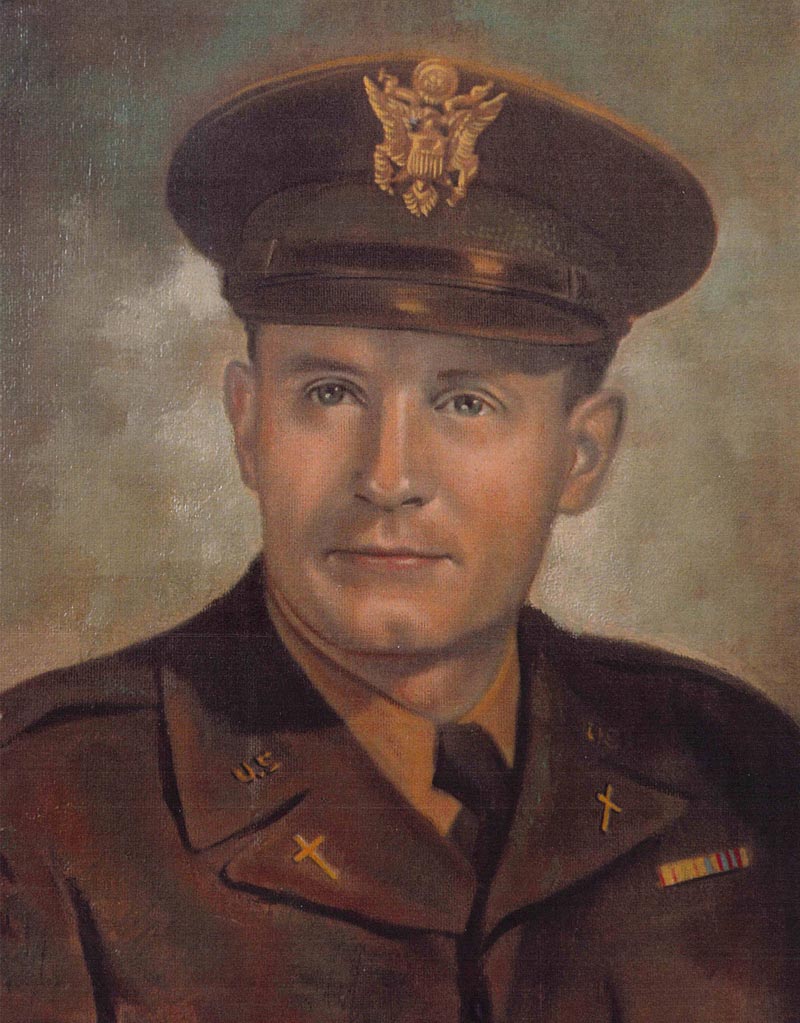
Emil Joseph Kapaun was born in the kitchen of a farmhouse in Pilsen, Kansas. His birthday was April 20, 1916–Holy Thursday. On May 9, just a few weeks later, he was baptized in St. John Nepomucene Church near the Kapauns’ farm. Close to his brother, Eugene, and his parents, Emil grew up quiet and driven by his purpose and responsibilities. On their 160-acre farm, his time was spent gardening, hunting, swimming, fishing, and simply walking the land. He was quite the handyman–an ability that would serve him later in life. When Emil was confirmed on April 11, 1929, he picked St. Joseph as his saint. Emil’s life of labor and service was lived well because he was inspired by St. Joseph’s own life as the leader of the Holy Family.
He would later tell seminarians, “Jesus wished to show that the simple, humble life is very pleasing to God. The will of God was that the Holy Family live a life of poverty and of humble labor. The life of the Holy Family was a simple life; it was marked not by the honors and glamour which the world can give, but it was marked by the peace and holiness from God. The life of the Holy Family was a life of true happiness. In order to have happiness in our Christian families we must practice the virtue of self-sacrifice.”
Called to the vocation of the priesthood, fourteen-year-old Emil joined Conception Seminary in Missouri in 1930. He continued his studies at Kenrick Seminary in St. Louis, Missouri in 1936. Father Kapaun was ordained a priest on June 9, 1940, before saying his first Mass back at his home parish, St. John Nepomucene, in Pilsen with 1,200 in attendance. He was the first from Pilsen to be ordained.
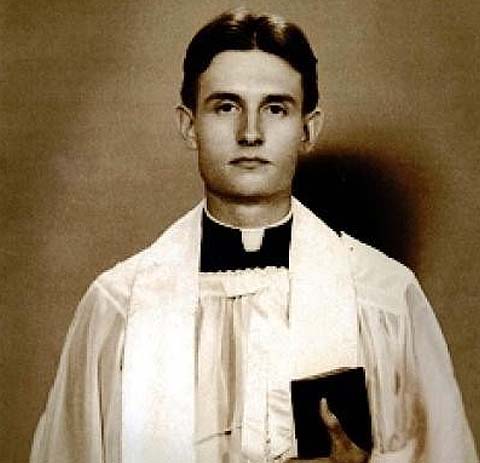
Father Kapaun remained at his home parish, as he was assigned there first. His bishop gave him another task of being the auxiliary chaplain at an Army airbase nearby until 1944. Father Kapaun sent a letter to his bishop, asking if he could join the U.S. Army Chaplain Corps. He wrote, “[w]hen I was ordained, I was determined to ‘spend myself’ for God. I was determined to do that cheerfully, no matter in what circumstances I would be placed or how hard a life I would be asked to lead.” His bishop granted Father’s request.
From March 1945 till the end of the Second World War in September 1945, Chaplain Kapaun served soldiers overseas in Burma and India. On January 3, 1946, the Army made Kapaun Captain due to his excellent service.
Father Kapaun earned a Master’s Degree in Education in 1948, with a dissertation titled “A Study of the Accrediting of Religion in the High Schools of the United States.” Although he asked his bishop to allow him to return to active military duty as a chaplain, his bishop assigned Father Kapaun to a parish in Timken, Kansas. Six months later, Father wrote to the bishop that he believed God was directing him back to spiritually caring for the troops in the U.S. Army.
His bishop assented, and Father Kapaun was assigned to the Anti-Aircraft Artillery Corps at Fort Bliss in Texas. The last time Father Kapaun would visit his family and community in Pilsen would be in December 1949, before being sent overseas in January 1950 to Yokohama, Japan, where the peacekeeping forces of the 1st Cavalry Division were located after the Second World War. However, North Korea invaded South Korea months later, on June 25, 1950.
On July 11, 1950, Chaplain Kapaun’s unit set out to help South Korea. He wrote to his bishop, “[t]omorrow we are going into combat. I have everything in order, all Mass stipends, my will, etc. The way the Catholic soldiers are rallying around the priest is edifying.”
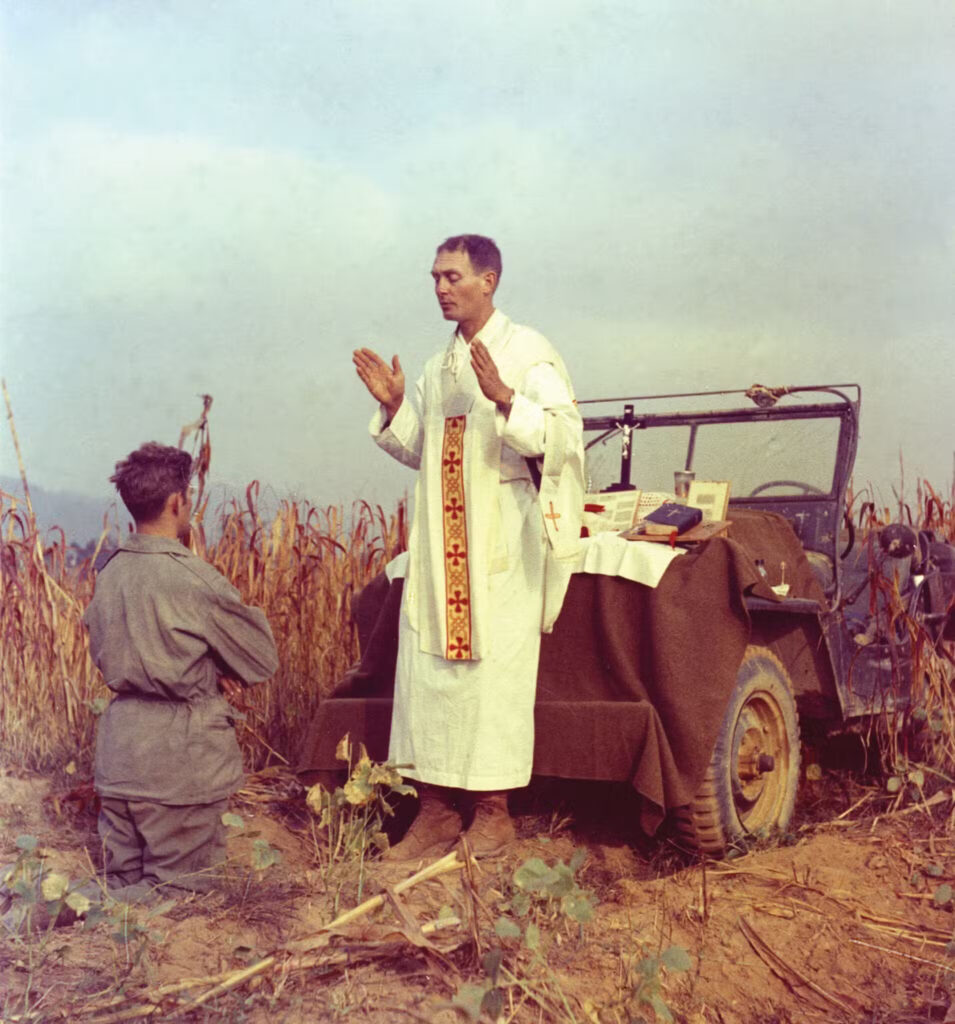
Attending troops off and on battlefields, Father Kapaun was considered extremely brave by soldiers who were guided in prayer by the chaplain, especially in moments of immediate danger. He celebrated Mass on the battlefield, with the hood of his Jeep as his altar. Not only did he administer the Holy Sacraments to troops, but he also wrote letters to the family of those soldiers who were killed in action. After saving a wounded soldier in the face of enemy machinegun fire, Kapaun received the Bronze Star Medal in August 1950.
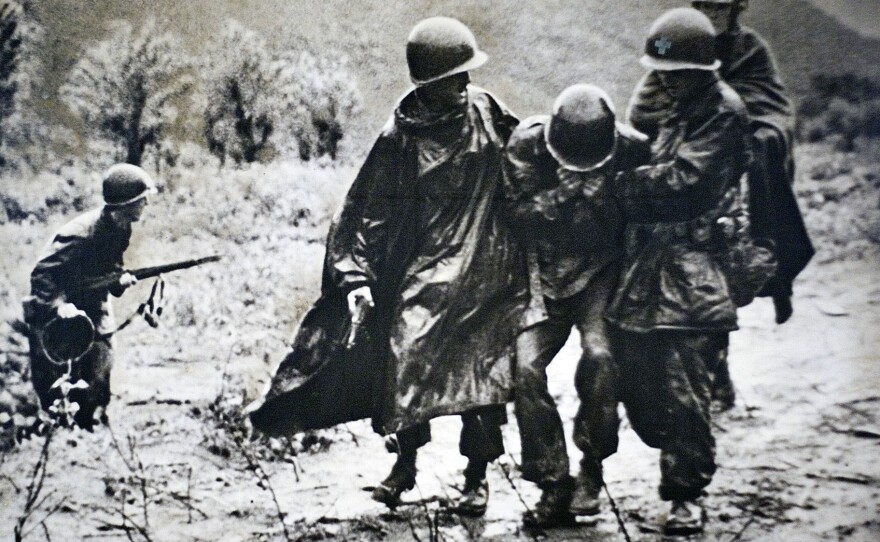
Communist China joined the Korean War in the fall of 1950 to support North Korea. On the eve of November 1, 1950, Father Kapaun’s unit was ambushed. Even though he was offered an opportunity to escape, Kapaun stayed with the wounded. Those remaining were taken captive the following day. During their abduction, Kapaun stopped a North Korean soldier from shooting one of his wounded, and interestingly enough the North Korean allowed the two men to live.
The prisoners-of-war walked about eighty miles to the prison camp at Pyoktong. Prisoners, who could not keep up from injuries or frostbite, were shot down. But, Kapaun walked up and down the line of prisoners, directing able-bodied soldiers to assist the wounded, just as he was.
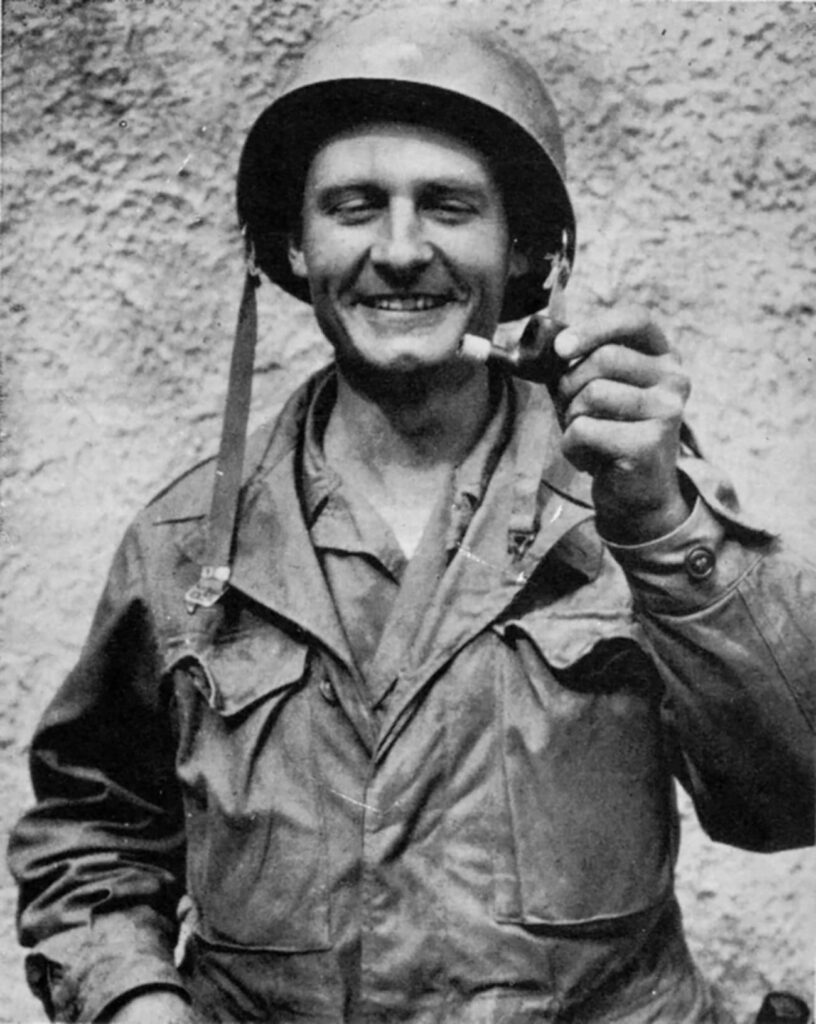
For the next seven months, Father Kapaun brought hope to Prison Camp No. 5. Daily, he would wake at 5:30 a.m. to start a fire and melt snow for his fellow prisoners. He cared for their wounds. Asking for the intercession of St. Dismas, the Good Thief, he would flee camp momentarily to find food for others. He washed their clothes. When prisoners passed away, he offered to bury them so that he could pray over them. All prisoners suffered indoctrination sessions twice a day. Witnesses attested to Father Kapaun peacefully rejecting indoctrination. When the prisoners were told that God did not exist, Father responded, “God is as real as the air you breathe but cannot see; as the sounds you hear but cannot see; as the thoughts and ideas you have but cannot see or feel.”
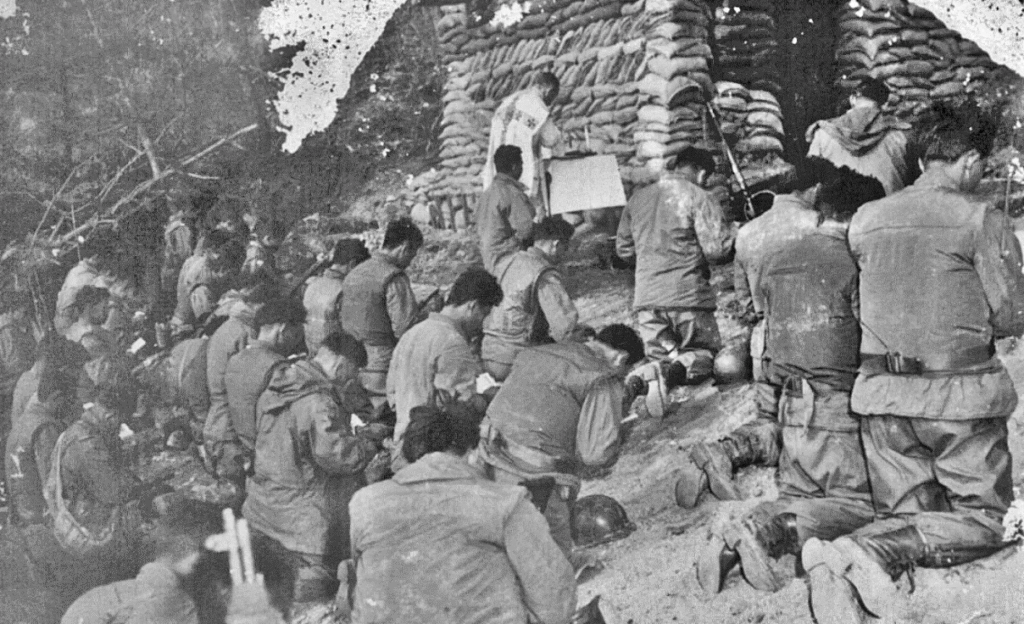
Father Kapaun prayed in private during the day, and at night, he prayed in hiding with his prisoners. He would say Mass, the Stations of the Cross, and the Rosary. He would even pray for the Communists that ruled over the prison camp. The captors knew the influence Kapaun had over the prisoners, but they knew that a rebellion was likely to occur if they killed the chaplain.
A few weeks after Easter in 1951, Father Kapaun became sick with malnutrition and pneumonia. The captors decided to isolate him in the hospital, known as the Death House, so that he might die without other prisoners interfering. Although prisoners fought against the directive immediately, the chaplain told them, “[d]on’t worry about me. . . I’m going where I always wanted to go, and when I get there, I’ll say a prayer for all of you.” He requested one of the soldiers to “[t]ell my bishop I died a happy death.” He died on May 23, 1951.
In addition to being two steps away from canonization, Emil Kapaun was posthumously awarded the Medal of Honor in April 2013. For Kapaun, the physical toil, sacrifice, and suffering that made up his chaplaincy was his way of living the life of Saint Joseph.
For more Catholic Patriotic Minutes, visit CATHOLICUSA.COM
Save and Share This Catholic Patriotic Minute!