The Catholic Patriotic Minute #43: Senator Joseph McCarthy
Catholics For Catholics Special Edition | April 27th, 2026
Catholic Senator Joseph McCarthy: Despised, Yet Vindicated
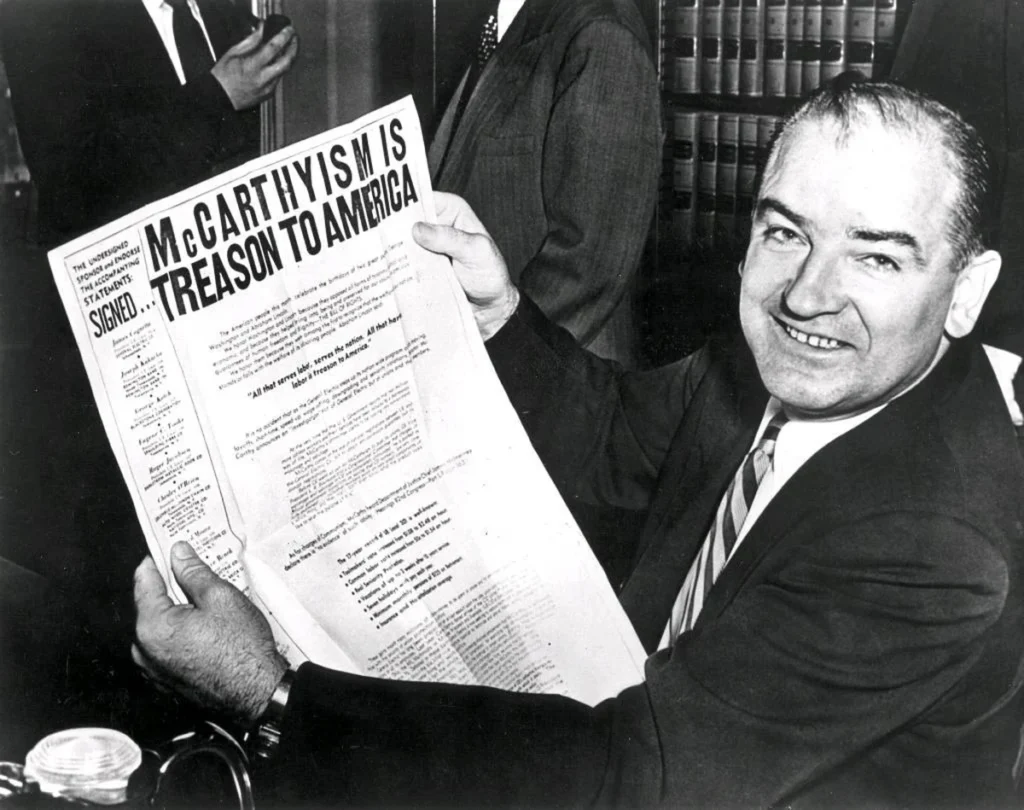
The whole world was, and is still, told to hate Joseph McCarthy. He is known as America’s most despised senator. Textbooks profess his evildoing in, what critics call, his Communist witchhunt. And yet, by the beginning of the twenty-first century, history vindicated McCarthy.
In Appleton, Wisconsin, Joseph McCarthy was born on November, 14, 1908. Joe grew up and worked on his family’s farm. Every evening, his family would pray the Rosary. Every Sunday, the McCarthys attended Mass. He had multiple jobs, one of which was running a chicken farm.
At the age of twenty-one, Joe entered high school alongside teenagers and completed four years of education in nine months, becoming the first McCarthy to graduate high school. To fund his law degree at Marquette University, Joe worked full-time at a gas station. Although he lost his 1936 election for district attorney of Shawano County, he won his 1939 election to become the judge in Wisconsin’s Tenth Judicial Circuit.
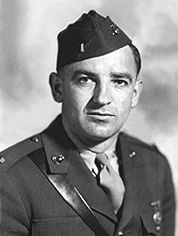
After the United States entered the Second World War, McCarthy joined the Marines as a second lieutenant intelligence officer, despite being exempt from the draft. He returned home a war hero and soon won the 1946 election for the Senate seat against the widely-popular incumbent, Robert La Follette, Junior.
When McCarthy began to work in the nation’s capitol, Congress and the FBI were already investigating possible Soviet infiltration in the government. On the national stage, former Soviet Spy, Whittaker Chambers, accused Alger Hiss–a leading figure within the State Department during President Roosevelt’s Administration–of espionage.
It became national news. Americans questioned further their nation’s relationship with Soviet Russia, as Hiss was present at the Yalta Conference, where Roosevelt famously informed his adviser, “I have just a hunch that Stalin doesn’t want anything but security for his country, and I think that if I give him everything I possibly can and ask nothing from him in return, noblesse oblige, he won’t try to annex anything and will work for world democracy and peace.”
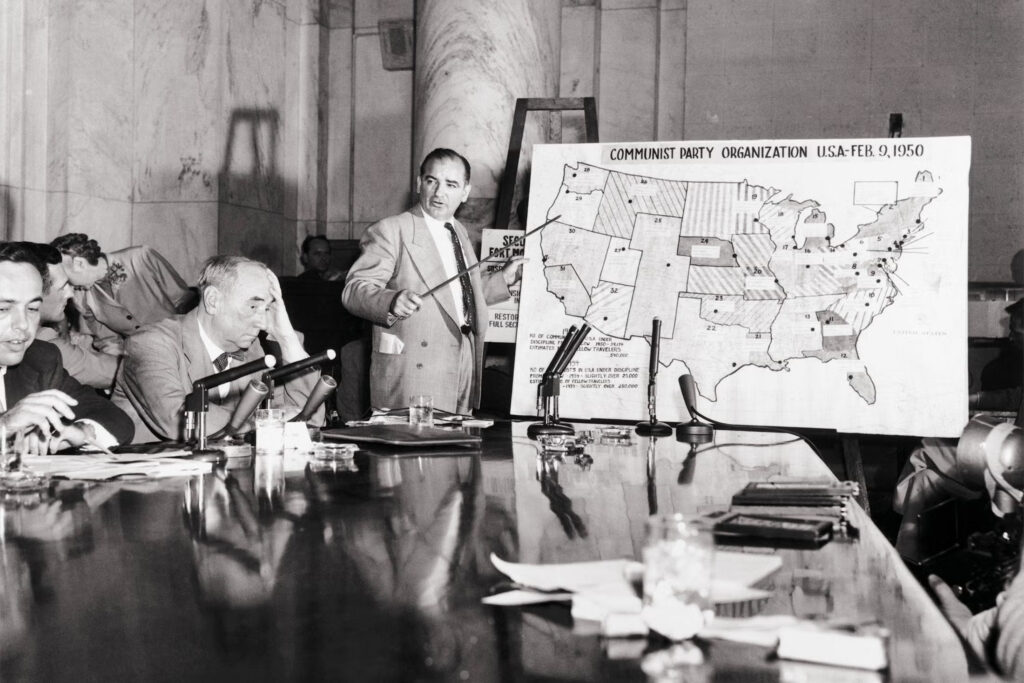
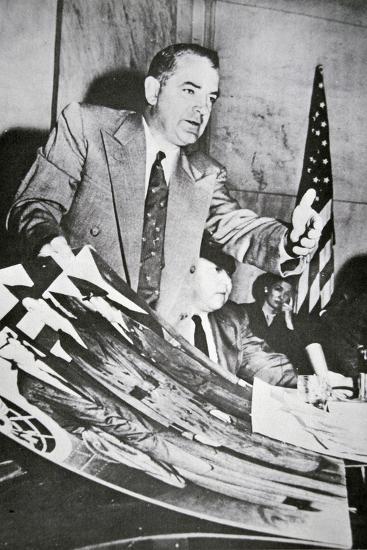
Reflecting on the Roosevelt Administration’s subservient position toward Russia, alongside the possibility of Hiss being a Soviet spy, Americans–including Joe McCarthy–wondered if there were more spies in their government. And so, McCarthy did his own investigation. In a 1950 speech, he announced, “I have here in my hand…a list of names that were made known to the Secretary of State as being members of the Communist Party and who nevertheless are still working for and shaping policy in the State Department.”
Rather than the Truman Administration pursuing their own inquiry into McCarthy’s allegations, they decided to investigate McCarthy himself. The Administration formed a subcommittee with Senator Millard Tydings as its head.
But, the Truman Administration faced backlash from the American public because the public, largely convinced by McCarthy, believed the Democratic Administration escalated the Cold War. The 1952 election of President Dwight D. Eisenhower also brought a Republican majority to the Senate. McCarthy became the chairman of the Senate’s Committee on Government Operations and its Permanent Subcommittee on Investigations (PSI). With subpoena power, McCarthy could finally question government officials he suspected worked for Soviet Russia.
Although history paints the picture of McCarthy as the head of a witch hunt, textbooks do not admit that, out of the two-thousand federal government officials fired for their affiliation with the Communist Party, Senator McCarthy was only responsible for about forty. He was never involved in the “red scare” in Hollywood or the education system. His manner of questioning was heightened by his temper and his genuine anti-Communism sentiments. Later, Robert F. Kennedy would defend McCarthy, saying “OK, Joe’s methods may be a little rough, but after all, his goal was to expose Communists in government—a worthy goal.”
Perhaps the incoming attacks on McCarthy’s character would have been less if he had only accused Democrat officials of allegiance to Communism. However, he accused Republican officials of the same, resulting in losing favor with President Eisenhower. Once the Korean War ended and Stalin died, as McCarthy’s questioning was not leading to imprisoned Soviet spies and more government officials disliked McCarthy for pointing his finger at both political parties, McCarthy’s time ran short. In 1954, the Senate voted to censure McCarthy, effectively tarnishing his career attempting to rout out Soviet espionage in the United States government.
But, history vindicated Senator Joe McCarthy about his suspicions. The U.S. Army’s Signal Intelligence Service, which later became the National Security Agency, instituted a secret program called Venona, with the goal of “examin[ing] and exploit[ing] Soviet diplomatic communications,” including “espionage efforts.” By 1950, the Venona Project had discovered between two-hundred and four-hundred Soviet spies in the United States. However, it was not public knowledge. In fact, the Venona Project was not declassified until the late 1990’s.
Alexander Vassiliev, a former KGB operative, transcribed notes from KGB files regarding Soviet espionage in the United States and gave his notebooks to the U.S. Library of Congress in 2009. Alongside the testimony of Whittaker Chambers and Elizabeth Bentley, the Vassiliev Notebooks and Venona Project reveal part of the harsh reality, that during the 1930’s and 1940’s, the State Department was the most occupied by Soviet Agents, in addition to the Departments of Justice, Treasury, War. Commerce, and Agriculture. America’s first foreign intelligence agency– the Office of Strategic Services, that is, the World War II intelligence agency–contained at least twelve spies, according to the Vassiliev Papers. McCarthy’s suspicions of a Soviet infiltration into the U.S. government were proven correct. Only, they were done so decades after his death.
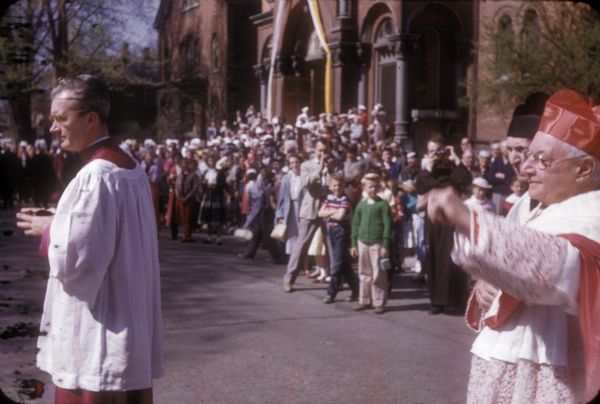
On May 2, 1957, Senator Joe McCarthy died of hepatitis. At his funeral, Monsignor John J. Cartwright said McCarthy “will be more and more honored as history unfolds its record.” Hopefully, history begins to tell McCarthy’s story of a man who, yes, with a passionate temper, demanded that his colleagues in the United States Government drive out corruption and espionage and as a result was himself pushed away and later slandered, rather than the hundreds of foreign agents roaming the nation’s capitol at the time.
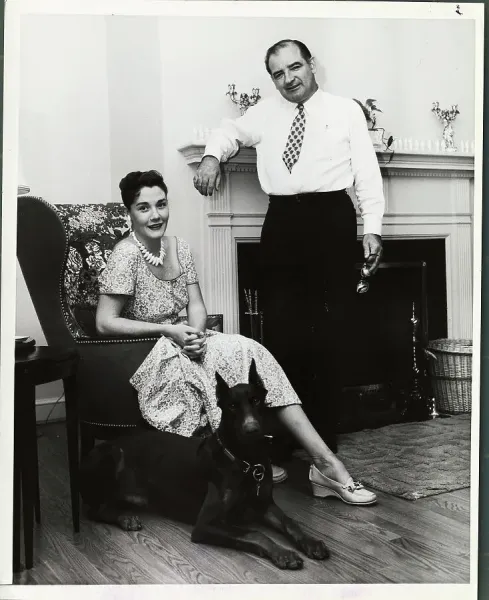
Throughout his political persecution, McCarthy held on close to his Catholic faith. His wife Jean Kerr wrote of him, “Gradually, as I came to understand the Catholic faith and began to see how much his faith meant to him, in a quiet, basic way—like breathing or eating—I saw a new side to Joe. . . Behind the warm, happy, bubbling personality, behind the kidding and the humor was a serious man, a purposeful man whom God had endowed with an extremely keen, absorbent and discriminating mind and the drive to make right what was wrong.”
For more Catholic Patriotic Minutes, visit CATHOLICUSA.COM
Save and Share This Catholic Patriotic Minute!